1,120 middle school chemistry tutors, rated 4.9/5
Middle School Chemistry Tutoring for the Chemistry Chapters of Grades 7, 8 and 9
Indonesian middle schoolers meet chemistry as part of integrated science (IPA) under Kurikulum Merdeka, spread over three chapters across three school years. EduPoint's middle school chemistry tutors help students work through those chapters at their own study place or online, starting from Rp61.000 per hour.
1,120+
tutors
6,960+
students
4.9
rating · 2,088 reviews
60+
cities
What is Middle School Chemistry Tutoring?
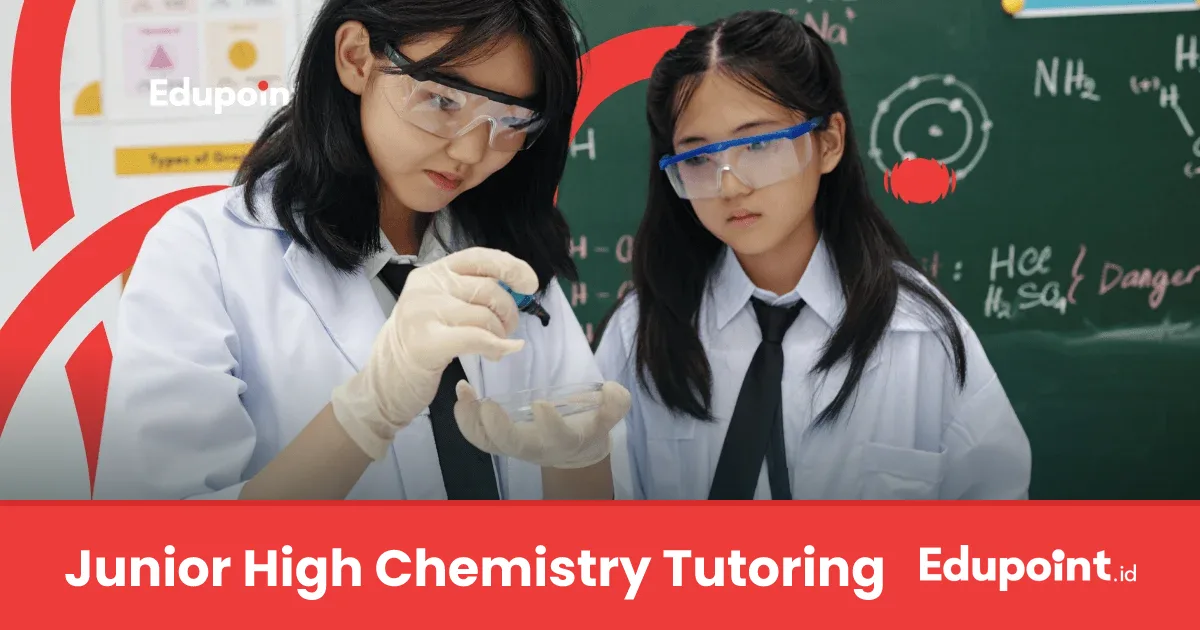
Middle school chemistry tutoring is private help with the chemistry inside grade 7 to 9 science (IPA). Kurikulum Merdeka teaches Phase D science as one combined subject, so chemistry sits in chapters on matter and its changes, separating mixtures, and food additives and addictive substances. Home and online lessons start from Rp61,000 per hour.
- Grade 7: the particle model behind solids, liquids and gases, physical versus chemical change, density
- Grade 8: homogeneous and heterogeneous mixtures and how to separate them
- Grade 9: food additives and the addictive substances worth avoiding
- Sessions of 60, 90 or 120 minutes, in person or online, priced the same for the same length
Services
Ways to Take Private Chemistry Lessons in Middle School
Students pick the format that suits how they learn best, and can switch formats later on.
Tutor Comes to the Student
A good fit for students who want to try simple experiments with the tutor at their own desk.
Rp 97.000/ 90-minute session
Price on the 28-session monthly plan, 90-minute sessions. Fewer meetings, higher price per session.
- Tutor visits the student's home or study place
- Tutor travel is already included in the rate
- Kitchen materials can double as lab equipment for mixture work
Online Middle School Chemistry Lessons
Online chemistry runs over Zoom or Google Meet; particle models and separation diagrams are drawn on a shared digital whiteboard.
Rp 78.000/ 60-minute session
Price on the 28-session monthly plan, 60-minute sessions. Fewer meetings, higher price per session.
- Digital whiteboard and screen sharing
- Shared document for the student's glossary
- Session recordings to replay before a test
Small Group Chemistry
Two classmates study together with one tutor, handy when a mixture separation project is due.
Rp 73.000/ 90-minute session
Price on the 28-session monthly plan, 90-minute sessions. Fewer meetings, higher price per session.
- Content follows the same class
- Discussion practice like a school project
- Schedule agreed by both students
Online and in-person cost the same — the gap between these cards is session length, nothing else.
Chemistry Topics by Grade in Kurikulum Merdeka Science
Report cards show a single science grade, and the chemistry inside it sits in a handful of chapters. The outline below follows the revised science teacher's guides published by the Ministry.
The teacher's guides present their learning sequence as a sample, so chapter order varies between schools. Students using the 2022 edition will find a chapter on Elements, Compounds and Mixtures in grade 8 and one on chemical reactions and acids and bases in grade 9. The tutor works from whichever book the student actually uses.
Grade 7: Matter and Its Changes
The first chemistry chapter in middle school, with roughly 20 lesson hours suggested. Students lean on these ideas again in grade 8 when they start separating mixtures.
- States of matter and the particle model
- Melting, freezing, evaporating, condensing, subliming, crystallising
- Reading melting point and boiling point data
- Physical versus chemical change, such as paper burning to ash
- +1 more
Grade 8: Separating Mixtures Around Us
The official book calls this chapter an introduction to chemistry and suggests about 18 lesson hours. Students are asked to pick a separation method for an everyday problem.
- Homogeneous mixtures (solutions) and heterogeneous ones (suspensions, colloids)
- Decanting, filtering, centrifuging, magnetic separation
- Evaporation, crystallisation, distillation, chromatography
- Real cases: clearing muddy water, making salt, distilling essential oils
- +1 more
Grade 9: Additives and Addictive Substances
In the 2025 revised book, grade 9 chemistry is concentrated in this chapter, with chemical pollution covered again in the environmental issues chapter.
- What preservatives and emulsifiers do in food
- Reading an ingredient list, for example benzoic acid
- Addictive substances and their effect on the body
- Deciding to steer clear of substances that cause harm
- +1 more
Science Process Skills
The second strand of the Phase D science learning outcomes. Middle school chemistry is often assessed through experiments and write-ups, so the tutor trains these skills alongside the content.
- Observing, questioning and predicting
- Naming independent, dependent and controlled variables
- Writing a hypothesis and an experiment plan
- Turning data into tables or graphs
- +1 more
Cambridge and Science Olympiad
Some students study chemistry on another track. Cambridge Lower Secondary Science has a Chemistry strand assessed in the Stage 9 Checkpoint, and the 2022 OSN middle school science syllabus reaches well past the school textbook.
- Materials and their structure, properties of materials
- Atoms, elements, molecules and compounds
- Solutions and mixtures
- Acid, base and salt reactions
- +1 more
Who It Is For
Who Middle School Chemistry Tutoring Suits
Each grade brings different needs, so the tutor plans sessions around the chapter the student is on.
Grade 7 Students
Meeting matter and particles for the first time and needing a firm base, since grade 8 builds directly on it.
Recommended:
Particle modelPhysical and chemical changeDensity
Grade 8 Students
Working through the separating mixtures chapter along with its project and lab report.
Recommended:
Types of mixtureSeparation methodsLab reports
Grade 9 Students
Covering additives and addictive substances while getting ready for senior high, where chemistry may become a subject of its own.
Recommended:
Additives and addictive substancesEnvironmental issuesElements and compounds enrichment
Cambridge or National Plus Students
Studying science in English or bilingually, with chemistry content assessed in Cambridge Checkpoint.
Recommended:
Chemistry strandBilingual explanationCheckpoint practice
Science Olympiad Entrants
Preparing the chemistry part of OSN middle school science, which covers atoms, solutions and acid-base-salt reactions.
Recommended:
Atoms and compoundsAcid-base reactionsOlympiad-level problems
Where Middle School Chemistry Gets Tricky
Chemistry Ideas Middle Schoolers Mix Up Most
The official science teacher's guides list these six as common misconceptions among SMP students. A private session gives the tutor time to untangle each one.
Assuming every mixture is a liquid
Why it happens
Class examples tend to be tea or sugar water, so students rarely think of a solid mixture, let alone a gaseous one.
How we fix it
The tutor points to things nearby: a cooking pot as a mixture of metals, the air as a mixture of gases. The student then finds three fresh examples on their own.
Confusing suspensions with colloids
Why it happens
Both look cloudy, and the difference only shows once the mixture is left to stand or poured through a filter.
How we fix it
Student and tutor build a comparison table around two questions: do the particles settle, and does ordinary filter paper catch them?
Calling a change of state a chemical change
Why it happens
Melting ice or evaporating water looks like a complete transformation, while the substance stays the same.
How we fix it
The tutor drills one deciding question: has a new substance with different properties formed? Paper turning to ash and rice turning into cooked rice serve as reference cases.
Picturing all particles as identical
Why it happens
The round dots in textbook diagrams lead students to think every substance has particles of the same size and shape.
How we fix it
The tutor shows where a model stops being accurate, then has the student sketch the particle arrangement of several different solids, liquids and gases.
Too many change-of-state terms
Why it happens
Six terms for changes of state plus melting and boiling points pile up quickly, and the similar-sounding ones swap places in tests.
How we fix it
The student writes a personal glossary with the tutor, each term paired with an everyday example, which is what the teacher's guide itself recommends.
Struggling to name experiment variables
Why it happens
Chemistry lab reports ask for independent, dependent and controlled variables plus a hypothesis, yet class time for practising this is short.
How we fix it
The tutor runs small desk-top experiments, such as timing how fast sugar dissolves in warm versus cold water, to practise naming each variable.
In the first sessions the tutor looks through the student's notes and assignments to see which ideas need revisiting.
Middle School Chemistry Tutors with a Chemistry Degree Background
Six EduPoint tutors who studied chemistry at university, listed by nickname and initial. Each card's university and study programme is taken from the academic history the tutor entered.
Tutor Qualifications
- Studied Chemistry, Chemistry Education, or Chemical Engineering
- Teach the chemistry chapters of grade 7, 8, and 9 science
- Follow the science textbook used at the learner's school
- Can come to the learning location or teach online
Octa O.
Chemistry Education, Universitas Pendidikan Indonesia
Particle models for the states of matter chapter“States of matter in grade 7 become easier to follow once a learner can sketch how the particles are arranged. Octa studied Chemistry Education at UPI and uses those simple drawings as an anchor before introducing the terms for changes of state.”

Ariq A.
Chemistry, Universitas Tanjungpura
Reading melting and boiling point tables“Melting and boiling point tables often leave learners unsure which state a substance is in at a given temperature. Ariq, a Chemistry graduate of Universitas Tanjungpura, walks through the table row by row and asks the learner to state the conclusion in their own words.”
Laiely L.
Chemistry Education, Universitas Negeri Yogyakarta
Graded practice ahead of chapter tests“In Chemistry Education at UNY, Laiely studied how to write questions and assess understanding. She puts that to work in graded practice sets, starting with key terms and building up to the word problems that tend to appear in science chapter tests.”

Akmal A.
Chemical Engineering, Universitas Brawijaya
Separating mixtures through everyday cases“Filtration, distillation, and crystallization are routine work in chemical engineering. Akmal brings that perspective from Universitas Brawijaya so grade 8 learners get used to choosing the separation method that fits each case.”
Imamah I.
Chemistry Education, UIN Sunan Kalijaga
Acids, bases, and indicators from the kitchen“Turmeric, red cabbage, and soapy water can all serve as observation material for the acids and bases chapter. Imamah, from Chemistry Education at UIN Sunan Kalijaga, uses ingredients like these so grade 9 learners record colour changes and then explain why they happen.”

Rafa R.
Chemistry, Institut Teknologi Bandung
Linking middle school topics to high school chemistry“Grade 9 learners preparing for high school chemistry or the OSN olympiad need a firm base in elements, compounds, and reactions. Rafa studied Chemistry at ITB and connects each middle school topic to the chapter the learner will meet at the next level.”
Middle School Chemistry Tutoring Fees
Chemistry lessons use the middle school rate, and the rate is identical in person and online for a given session length.
Starting from
Rp 61.000 / hour
Final price is set at registration.
This is the lowest hourly rate, derived from the 28-session monthly plan at 120 minutes per session. Per-session prices (60, 90, or 120 minutes) appear in the format options above.
Register & Get a QuoteFlexible payment — QRIS, Virtual Account, Alfamart, Indomaret, transfer & e-wallets.
The registration fee appears in the sign-up form. Tutor travel is built into the rate, and one month can include from 4 up to 28 sessions.
FAQ
Questions About Middle School Chemistry Tutoring
Quick answers to what students and those enrolling them ask most before signing up.
In SMP, chemistry belongs to the science subject (IPA). Under Kurikulum Merdeka, Phase D science is one combined subject, which is why chemistry, physics and biology share a single textbook. Middle school chemistry tutoring concentrates on the chapters of that book that carry chemistry content.
In the revised textbooks, grade 7 covers matter and its changes, grade 8 covers separating mixtures, and grade 9 covers additives and addictive substances. Classes still following the 2022 edition meet elements and compounds in grade 8, then chemical reactions in grade 9.
The middle school TKA tests only Mathematics and Indonesian, so science sits outside it. Chemistry is still graded through each chapter's formative and summative assessments at school, and the same ideas return when students take chemistry in senior high.
Rates for middle school chemistry tutoring start from Rp61.000 per hour. The rate is the same for in-person and online sessions of equal length, and tutor travel is already included. The registration fee is shown in the sign-up form.
Each chemistry meeting is 60, 90 or 120 minutes long, placed anywhere in the 06.00-23.00 window, after-school afternoons included. Monthly totals range from 4 to 28 lessons, depending on how busy the test calendar is.
Complete Guide
Complete Guide to Middle School Chemistry Tutoring: Particle Models, Separating Mixtures, and Food Additives
On an Indonesian middle school report card, chemistry sits inside the science (IPA) grade. The revised Phase D science teacher's books spread it over three chapters that lean on each other, so a student who wobbles in one chapter usually feels it a year later.
In grade 7, the chapter on matter and its changes sets up the most basic idea in chemistry: every substance is made of particles, and the way those particles are arranged decides the state and properties of the substance. From there students read melting and boiling point data, sort physical changes from chemical ones, and use density to explain why an object floats, hovers, or sinks.
Grade 8 puts that groundwork to use in the chapter on separating mixtures, which the official book itself calls an introduction to chemistry. A student who understands why sugar dissolves in water while sand settles finds it much easier to choose between filtering, evaporation, distillation, and chromatography. Elements, molecules, and compounds appear here as enrichment.
Grade 9 turns chemistry toward everyday decisions through the chapter on additives and addictive substances, such as spotting benzoic acid as a preservative on a food label. Schools still using the 2022 edition place elements, compounds, and mixtures in grade 8, and chemical reactions with acids and bases in grade 9. That is why a middle school chemistry tutor checks which edition the student uses in the first session, so the sequence matches the class.
Middle school chemistry runs on observation, and a kitchen holds most of what a student needs. Small experiments at home help a learner connect the words in the textbook with something they have watched happen.
For the grade 7 chapter, a student can watch ice melt, water boil, and droplets condense on a pan lid, then write down the name of each change of state. An egg placed in fresh water and then in strong salt water gives a very concrete picture of density. Cooking rice is a good prompt for discussing chemical change, since the result is a new substance with different properties.
For the grade 8 chapter, a jar of muddy water can be left to settle and poured off slowly as decanting practice, then filtered through thin cloth. Salt water left to evaporate on a flat plate leaves crystals behind, the same principle used to make salt along the coast. Simple chromatography works with marker ink on a strip of tissue paper dipped in water.
Another habit that pays off is a glossary notebook. The teacher's book recommends it, because terms like sublimation, crystallisation, melting point, suspension, and colloid are easy to mix up. One page per term, with a meaning, an example, and a quick particle sketch, is plenty. Any experiment involving a flame or a stove should be done with an adult present.
A middle schooler's chemistry mark is built at school, chapter by chapter, from the formative and summative science assessments. The opening formative check shows the teacher what a student already knows before the chapter starts, while the summative test closes the chapter and feeds the science report grade. Several chapters also ask for a project or lab report, such as the mixture separation project in grade 8.
The national learning outcomes for science weigh two elements: conceptual understanding and process skills. Process skills cover observing, questioning and predicting, planning an investigation, analysing data, evaluating, and communicating results. Students who know the definitions by heart yet have never practised naming independent, dependent, and controlled variables often drop marks on lab reports. Writing a short hypothesis for every home experiment is a cheap way to close that gap.
So what about the TKA? The 2026 middle school TKA ran from 6 to 16 April and tested only Mathematics and Indonesian, which means chemistry is outside its scope. For grade 9 students this makes planning simpler: the weeks before April can lean heavily on those two subjects, while chemistry stays in shape through the school tests on additives, addictive substances, and environmental issues. Chemistry lessons can be spaced out during that stretch and brought back to a fuller schedule afterwards.
With one student and one tutor, a single misunderstanding about particles or mixtures can be traced all the way to its root, which a teacher facing a full classroom seldom has time for. The tutor usually spends the first session looking through the student's notes, homework, and recent tests, then marking the ideas that need another pass.
The sticking points in middle school chemistry are fairly predictable. Some students picture the particles of every substance as the same size and shape. Some think a change of state counts as a chemical change. Others treat suspensions and colloids as the same thing because both look cloudy. For each of these, the tutor works with particle drawings, objects around the student, and questions that climb from recognising an idea to analysing a real case.
A 60-minute meeting is usually enough to revisit one sub-chapter, say changes of state or density, and 90 or 120 minutes leaves room for an experiment or a lab report written together. Any start time inside the 06.00-23.00 window works, and a month can hold 4 to 28 lessons. Chemistry lessons are priced from Rp61,000 per hour. A 60-minute lesson comes to Rp78,000 when the month is booked as a 28-session plan, whether the tutor visits the student's home or teaches online.
Enrolment starts with a consultation. Whoever registers the student shares the grade, the textbook edition, the difficult chapters, and the free time slots. With those details in hand, EduPoint looks for a chemistry tutor who fits, and lessons start from there. A student who does not click with the assigned tutor can ask for a replacement without paying more.
From grade 10, high schools may teach chemistry as a separate subject. A grade 9 student who wants to arrive well prepared can use the rest of middle school to firm up three things: the particle model, the difference between elements, compounds, and mixtures, and the habit of recording experimental observations. Together they form the footing for atoms and reactions at the next level, and middle school chemistry tutoring can shift toward this enrichment once the school chapters are done.
Students drawn to the National Science Olympiad (OSN) at middle school level should know that the science field includes chemistry. The OSN middle school syllabus from Puspresnas covers matter and its states; atoms, elements, molecules, and compounds; solutions and mixtures; acid, base, and salt reactions; and additives and addictive substances. That scope reaches well beyond the school textbook, so practice needs its own plan, with graded problems and deeper discussion of each concept.
For students at international schools, Cambridge Lower Secondary Science has a Chemistry strand on the structure and properties of materials, alongside Thinking and Working Scientifically, and Stage 9 ends with Cambridge Checkpoint. Tutors can teach in Indonesian, bilingually, or fully in English, following the language of instruction at the student's school.
Guides & Tips
Supporting articles to help you decide and maximize learning outcomes.
How to Balance Chemical Equations Quickly
Balancing reactions becomes fast when you handle atoms in a fixed order, starting with elements that appear in few places and finishing with hydrogen and oxygen.
How to Learn Chemistry: Master the Mole and Stoichiometry from Scratch
Chemistry becomes logical once the mole is understood as a way of counting particles, and every calculation flows from there.
How to Memorize the Periodic Table and Electron Configuration
The periodic table becomes easy to recall when elements are clustered by groups that share properties, then locked in through mnemonics and electron configuration practice.
Related Programs
Other programs that might be suitable for you
Start Middle School Chemistry Lessons From the Chapter at Hand
Share the student's grade, textbook and schedule. A middle school chemistry tutor is matched by the EduPoint team, and the first lesson can follow soon after, at home or online.