#1 Robotics Tutoring
Private Robotics Tutoring, Where Kids Build Real Robots
One child, one tutor, learning to build and program real robots from micro:bit to Arduino and competition machines. Lessons happen in your living room or over video, moving at the speed of your child's curiosity. Sixty-minute sessions begin at Rp126,000.




180+
tutors
1,400+
students
4.9
rating · 1,336 reviews
60+
cities
What is Robotics Tutoring?
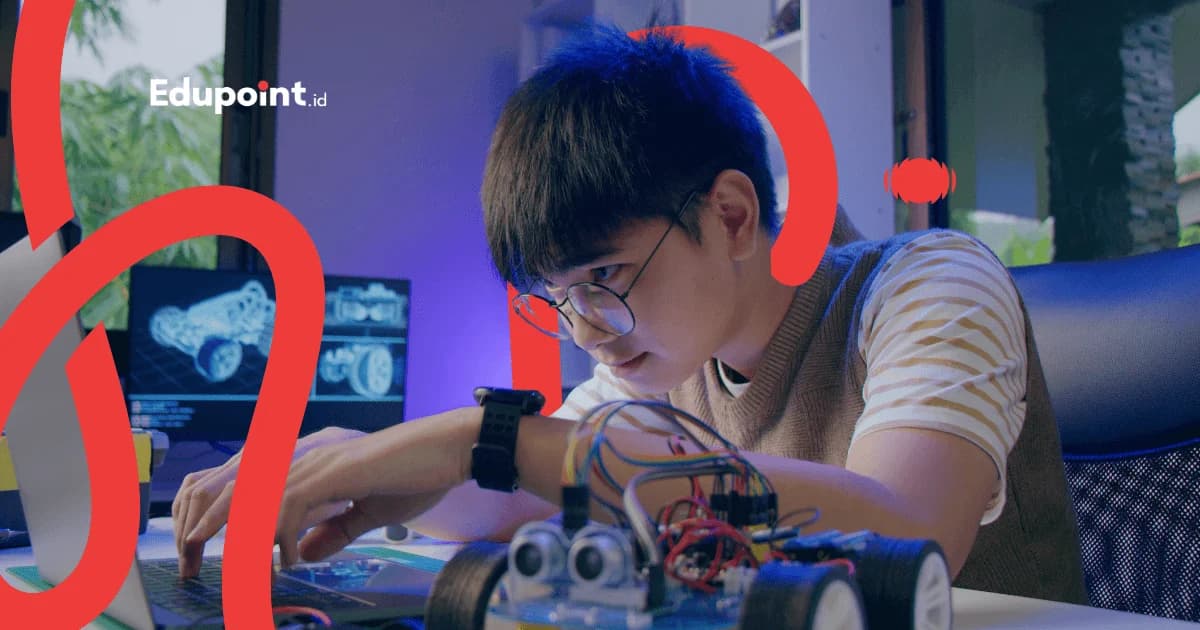
Robotics tutoring is private one-on-one guidance that teaches children to design, build, and program robots. Kids learn to combine three skills at once: electronics, mechanics, and programming. The material progresses with age: block robots and micro:bit for ages 7-10, Arduino and electronics for ages 10-14, then Raspberry Pi and competition robots for teens. Teaching can take place at your house or online, and an hour-long session starts from Rp126,000.
- One child, one tutor, with robots built and programmed by the child's own hands
- Combines electronics, mechanics, and programming in one real project
- A step-by-step path from micro:bit to Arduino and autonomous robots
- Preparation for WRO, FIRST LEGO League, and regional robotics competitions
- Regular progress reports complete with photos of the child's project
Services
In-Person, Online, or Small Group: Shape Your Robotics Lessons
The tutor brings equipment to your home, guides through the screen with a simulator, or builds together with siblings. Match it to your family's rhythm.
In-Person Robotics Tutoring
The tutor comes to your home with a robot kit, and the child handles components and builds right away.
Rp 204.000/session
120 minutes
- Tutor comes home with a robot kit
- The child directly handles sensors, motors, and circuit boards
- Full guidance while assembling and basic soldering
- Flexible schedule to fit the family
Online Robotics Tutoring
Learn via Zoom with the Tinkercad simulator and guidance for assembling a kit at home.
Rp 159.000/session
90 minutes
- Circuits tested first in the Tinkercad simulator
- The tutor guides assembly of the child's own kit over camera
- Recorded sessions to replay during independent practice
- Available for students across Indonesia and abroad
Small Group Robotics Tutoring
Build together with siblings or 2-3 friends, like a mini robotics team.
Rp 153.000/session
120 minutes
- 2-3 children per group
- Learn teamwork like a competition squad
- The registration form works out each child's share and deduction
- Collaborative robot projects
Robotics Learning Path by Platform
Each child starts with the device that fits their age, then moves up to more advanced hardware when ready.
Block Robots & micro:bit (Ages 7-10)
Grades 1-4Children meet robots through motorized LEGO and the micro:bit board. Programming uses colored blocks, so children who are not yet strong readers can still make a robot move and blink.
Subjects:
micro:bit MakeCodeMotorized LEGOLight & button sensorsSimple motors
Focus Areas:
- Understanding input, process, and output
- Making a robot move with blocks
- Grasping cause and effect in the real world
- Fine motor skills while assembling
Arduino & Electronics (Ages 10-14)
Upper elementary to junior highChildren step into real electronics: wiring on a breadboard and writing C++ code for Arduino. Here they understand how electricity, components, and code work together.
Subjects:
Arduino UnoBreadboard & circuitsBasic C++Ultrasonic & infrared sensors
Focus Areas:
- Wiring components on a breadboard
- Writing their first C++ code
- Reading sensors and driving motors
- Their first obstacle-avoiding robot
Raspberry Pi & Smart Robots (Ages 13-16)
Late junior high to senior highChildren move up to Raspberry Pi with Python, adding a camera and internet connection to their robot. The robot begins to recognize simple objects and can be controlled remotely.
Subjects:
Raspberry PiPython for roboticsCamera & basic computer visionIoT-based robots
Focus Areas:
- Python programming for hardware
- Object recognition with a camera
- Internet-connected robots
- Independent smart-robot projects
Competition & Autonomous Robots (Ages 14-18)
Senior high and the competition trackChildren prepare robots for competition: line followers, sumo robots, and autonomous mission robots. The tutor guides strategy, tuning, and control logic so the robot performs reliably on the field.
Subjects:
Line follower & sumo robotBasic PID controlRobot arm & gripperWRO & FIRST LEGO League strategy
Focus Areas:
- Tuning robots for consistency
- Autonomous mission logic
- Team and competition time management
- National competition preparation
Robotics Curriculum
Four pillars learned together in every robot project, not as separate theory.
The tutor adjusts the depth of each pillar to the child's age and platform. Elementary kids spend more time building and playing with blocks; teens go deeper into code and control.
Basic Electronics
A safe, practical foundation in electricity, learned while wiring rather than memorizing formulas.
- Components: resistors, LEDs, sensors
- Reading circuits on a breadboard
- Voltage, current, and ground
- Basic electrical safety
Microcontroller Programming
The robot's brain is programmed step by step, from colored blocks to Arduino C++ and then Python.
- Block coding on micro:bit
- Arduino C++ program structure
- Loops and conditions for robots
- Introduction to Python on Raspberry Pi
Sensors & Actuators
The robot learns to sense the world and move in response, the heart of all robotics.
- Distance, line, and light sensors
- Calibrating sensor values
- DC, servo, and stepper motors
- Motor drivers and speed control
Mechanics & Robot Projects
Children design the frame and moving parts, then bring everything together into a complete robot.
- Frame, wheels, and gears
- Robot arm and gripper
- Building a robot from scratch
- Final project showcase
Who It Is For
Which Children Are a Good Fit for Robotics
Children Who Love Taking Things Apart
Children who enjoy dismantling toys, building with LEGO, or are curious about the insides of electronics have an engineer's instinct. Robotics channels that curiosity into something that works.
Recommended:
Motorized LEGO and Arduino trackHands-on disassembly and rebuilding
Future Engineers & Science Lovers
Children who love science and math or wonder how machines work will find robotics to be their personal lab. Physics and logic feel real because they are practiced directly.
Recommended:
Arduino then Raspberry Pi trackSensor-based robot projects
Future Competition Contestants
Children who want to compete in robotics need structured guidance, from designing strategy to stabilizing the robot on the competition field.
Recommended:
Competition coach tutorsWRO and FIRST LEGO League prep
A Robotics Extracurricular at Home
Many schools have no robotics club, or homeschoolers want a serious STEM path. Private lessons bring a complete robotics experience right to your home.
Recommended:
micro:bit track for beginnersStep-by-step STEM curriculum at home
Inside a Robot
The Five Parts That Make Up a Robot
Every robot, from a toy to a factory machine, is built from the same five systems. Understanding them lets a child take apart and build any robot.
Sense
Think
Act
Every robot runs one loop: sense, think, then act.
Brain (Controller)
The decision-making centerThe microcontroller board is the robot's brain. It reads input from sensors, runs the program the child wrote, then commands the actuators to move. This is where the child's code truly comes alive and controls real objects.
Example components
Arduino Unomicro:bitRaspberry PiESP32
What your child learns here
Children learn to write programs that read conditions and decide on actions: if there is an obstacle ahead, turn right.
How to Read a Robot Diagram
Sensors feel, the brain thinks, actuators move. Power energizes all three, the frame holds them together. Once a child understands these five parts, they can take apart any robot and guess how it works, a foundation that carries all the way to engineering school.
From Building Hundreds of Robots
Five Robotics Traps and How Tutors Solve Them
Robotics unites electricity, mechanics, and code, so a small mistake can leave a robot completely still. Here are the obstacles we see most often and how we resolve them.
The robot is assembled but will not move at all
Why it happens
It is usually not the code but the connections: a loose wire, a disconnected ground, or a weak battery. Children tend to panic and immediately change the code.
How we fix it
The tutor teaches step-by-step debugging: check power first, then connections, then code. The child learns to find the root cause calmly instead of guessing.
Copying complex code without understanding the electronics
Why it happens
Many tutorials invite copy-pasting long code. The child can make a robot run once but is lost when something breaks because they do not grasp the basics.
How we fix it
The tutor starts with one LED and one sensor. Only after the child understands each part do components combine. Understanding is built from the ground up.
Using sensors without calibrating them
Why it happens
Sensor values differ in every room and lighting condition. A line follower that works at home often fails at the competition because the floor is different.
How we fix it
The tutor teaches the child to read raw sensor values and set the threshold themselves, so the robot can adapt anywhere.
Connecting motors directly to microcontroller pins
Why it happens
Motors draw large current that can damage Arduino pins. Beginners often do this because it looks the simplest.
How we fix it
The tutor introduces motor drivers and a separate power source from the start, a safe habit that protects the child's hardware.
Focusing on code, forgetting the frame's strength
Why it happens
Children get absorbed in programming and forget that a wobbly frame makes the robot tip and the wheels slip, no matter how good the code is.
How we fix it
The tutor balances attention: a sturdy frame and clean transmission are designed first, then code is optimized on a stable foundation.
Each of these traps becomes a valuable lesson. A child who has faced them grows into a careful builder and a resilient future engineer.
Why Us
Six Reasons Parents Trust EduPoint for Robotics Tutoring
A private format that unites electronics, mechanics, and code into a real robot the child can hold, run, and be proud of.
One Child One Tutor
The child sets the building pace. No waiting in line for tools or for a turn like in group classes.
Learn with Real Robots
The child handles real sensors, motors, and circuit boards, working with them directly by hand in every session.
Step-by-Step by Platform
From micro:bit at age 7 to teen competition robots, every child starts with the right device.
Engineering & Informatics Tutors
Students and graduates in electrical engineering, mechatronics, and informatics used to building robots.
Kit Setup Made Easy
Tutors bring kits for in-person lessons and recommend the right devices for online learning.
Photo Progress Reports
Parents receive regular reports complete with photos of the robot the child is working on.
Selected Robotics Tutors
Our tutors are top students and graduates in electrical engineering, mechatronics, and informatics from leading universities, used to building robots and patient with children.
Tutor Qualifications
- Students and graduates of Electrical Engineering, Mechatronics, Computer Engineering, and Informatics from leading universities
- Experienced in building and programming robots, many active in campus robotics clubs or competitions
- Passed technical skills and teaching-children assessments
- Used to teaching electronics and programming in child-friendly language
Charlotte C.
Robotics and Artificial Intelligence Engineering, Universitas Airlangga
Robots from sensor to code“With a background in Robotics and Artificial Intelligence Engineering at Universitas Airlangga, Charlotte helps children see a robot as a blend of sensors, code, and motion they can build themselves.”
Della D.
Mechatronics Engineering Education, Universitas Negeri Yogyakarta
Uniting mechanics and electronics“Della studied Mechatronics Engineering Education at Universitas Negeri Yogyakarta and is used to combining the mechanical and electronic sides, guiding children to assemble robots step by step until they truly work.”
Qois Q.
Electrical Engineering, Institut Teknologi Sepuluh Nopember
Starting from basic circuits“From his Electrical Engineering studies at Institut Teknologi Sepuluh Nopember, Qois likes to begin with the simplest circuit so children truly understand the flow of electricity before writing the code.”
Andria S.
Computer Engineering, Universitas Brawijaya
Programming the robot's brain“Andria, a Computer Engineering student at Universitas Brawijaya, enjoys explaining how a microcontroller reads sensors and then makes decisions, language that makes children comfortable with programming a robot.”

Reky R.
Instrumentation Electronics, Politeknik Teknologi Nuklir Indonesia
Sensors and precise calibration“The precision habit from Instrumentation Electronics at Politeknik Teknologi Nuklir Indonesia carries into how he teaches children to read and carefully calibrate a robot's sensors.”

Hafis H.
Electronics Engineering Education, Universitas Negeri Yogyakarta
Electronics for beginners“Trained as an educator through Electronics Engineering Education at Universitas Negeri Yogyakarta, Hafis breaks complex electronics concepts into small steps that children can easily follow.”
Testimonials
What Parents Say About Robotics Tutoring
From an elementary child who made their first robot move to a teen who broke into a robotics competition, here are their stories.
My child is in grade 3 and used to just play with LEGO. Now the LEGO moves on its own because it has motors and is programmed. The tutor was so patient guiding those small hands to assemble it.
Mrs. Dian M.
Parent of a 9-year-old • Jakarta
I thought robotics was expensive and complicated. It turns out the tutor brings a full kit, and the child just learns. The obstacle-avoiding robot he built is now displayed in his room.
Mr. Ahmad S.
Parent of a 7th grader • Bandung
My child now understands electricity and electronics from robotics lessons, even though that material is still far off at school. He now dares to take apart and fix his sibling's toys himself.
Mrs. Yunar R.
Parent of a 6th grader • Surabaya
My child's school has no robotics club. Private lessons at home became the solution, and the tutor tailored the material to my child's love of cars, so the robot was shaped like a car.
Mrs. Delia R.
Parent of a 4th grader • Depok
We live in a small town with no robotics course. Online lessons turned out to work; the tutor used a simulator first, then guided my child to assemble the kit we bought. Surprisingly smooth.
Mr. Tutur P.
Parent of an 8th grader • Balikpapan
My 14-year-old moved up from Arduino to Raspberry Pi. His robot now has a camera and can follow a ball. He now has a clear goal of studying Electrical Engineering.
Mrs. Meira H.
Parent of a 9th grader • Tangerang
What I love is the monthly report complete with photos of the robot my child is working on. So I know the progress and feel confident my child is genuinely learning to build robots.
Mrs. Melia W.
Parent of a 5th grader • Semarang
My child entered a city-level robotics competition and won. The tutor guided him from designing the line follower robot to tuning it on competition day. A priceless experience.
Mr. Nurul I.
Parent of a 10th grader • Jogja
Robotics Tutoring Cost
Robotics classes for kids use an upfront hourly rate. Build-and-code sessions last 60, 90, or 120 minutes; families schedule 4 through 28 meetings a month, with the grand total spelled out at registration.
Starting from
Rp 102.000 / hour
Final price is set at registration.
This is the lowest hourly rate, derived from the 28-session monthly plan at 120 minutes per session. Per-session prices (60, 90, or 120 minutes) appear in the format options above.
Flexible payment — QRIS, Virtual Account, Alfamart, Indomaret, transfer & e-wallets.
Prices may adjust to the child's age, robot platform, location, and lesson format. We help recommend robot kits to match your child's learning path. Contact us for an exact quote.
Robotics Tutoring Availability
Online Tutoring
Online WorldwideOnline robotics tutoring is available for students across Indonesia and abroad.
- Circuits tested first in the Tinkercad simulator
- The tutor guides kit assembly over camera
- Sessions recorded and replayable
In-Person Tutoring
All CitiesIn-person robotics tutoring, with the tutor coming to your home with a kit in the following cities.
Jakarta45+ tutorsBandung26+ tutorsSurabaya22+ tutorsDepok16+ tutorsTangerang15+ tutorsBekasi14+ tutorsBogor11+ tutorsSemarang10+ tutors
+4 more citiesStudent Achievements
Children's Robotics Journeys
Real progress stories from EduPoint families.
Success
From Toy Dismantler to Robot Builder
Fauzan A.
Grade 4, Jakarta
Challenge
Fauzan loved taking apart toys and clocks but could never put them back together. His parents wanted that curiosity to have a direction.
Solution
The tutor started with micro:bit and motorized LEGO, so Fauzan learned to build things that genuinely work while understanding how each part fits together.
Journey
Month 1: Made the micro:bit show animations and play sounds
Month 3: His first motorized LEGO robot that could walk
Month 6: An obstacle-avoiding robot with an ultrasonic sensor
Three functional robots in 6 months, curiosity turned into creation
“Now whatever he takes apart turns into something new. Our house is full of his little robots.”
— Fauzan's parent
Success
Finding Direction Through Arduino
Athaya S.
Grade 8, Bandung
Challenge
Athaya loved science but was bored with textbook theory. She needed a way to see physics and logic at work in reality.
Solution
The tutor brought Athaya into Arduino electronics, where every concept was tested directly on a breadboard and robot.
Journey
Month 2: Wired sensors and wrote her first C++ code
Month 5: A stable line follower robot that tracks the path
Month 9: A simple robot arm that can lift objects
Science made tangible, a foundation toward an engineering path
“Her physics grades went up because she already understood the concepts from the robots. Learning became real for her.”
— Athaya's parent
Success
From Home Robots to the Competition Stage
Oky R.
Grade 10, Jogja
Challenge
Oky was already skilled at building his own robots but had never competed and did not know competition standards.
Solution
A competition-coach tutor guided Oky to prepare a line follower robot to the rules, then trained him in tuning and strategy.
Journey
Month 1: Redesigned the robot to meet competition regulations
Month 3: Applied PID control so the robot stayed stable on turns
Month 5: Won a city-level robotics competition
City-level robotics champion in 5 months
“Seeing him step onto the stage to receive a robotics trophy, we knew this had grown into something far bigger than a hobby.”
— Oky's parent
FAQ
Before Registering for Robotics Tutoring, Here Are Answers for Parents
On starting age, kit needs, and safety while building, we help explain.
Complete Guide
Complete Guide to Robotics Tutoring
Guides & Tips
Supporting articles to help you decide and maximize learning outcomes.
Getting to Know Robotics Platforms for Beginners From Simulator to Raspberry Pi
A map of six starting points in order, from trying circuits in a free simulator to assembling a first robot, so beginners pick a board that fits their age and goal without buying the wrong thing.
How to Choose a First Robotics Kit for Your Child
A practical guide for parents to shortlist a first robotics kit that fits a child's age, interests, and the family budget.
How to Choose the Right Robotics Class for Kids
Six steps to narrow down a kids' robotics class, from matching age to platform through to testing it with a tryout session, with 2026 market cost ranges to guide you.
How to Introduce Robotics to Elementary School Children, Step by Step
A calm guide for parents who want to open the world of robotics for their elementary schooler from scratch, without needing to be tech experts first.
Learning Arduino for Beginners: A Step-by-Step Start
A clear Arduino learning map for children and parents new to robotics, from lighting a single lamp to turning a first wheel.
Related Programs
Other programs that might be suitable for you
Bring Your Child's First Robot to Life with Robotics Tutoring
Start with a casual chat: tell us your child's age and interests, and our team will find the robot platform and tutor that fit best.
Free consultation, no commitmentEngineering and informatics tutors from leading universitiesfree tutor replacement whenever needed