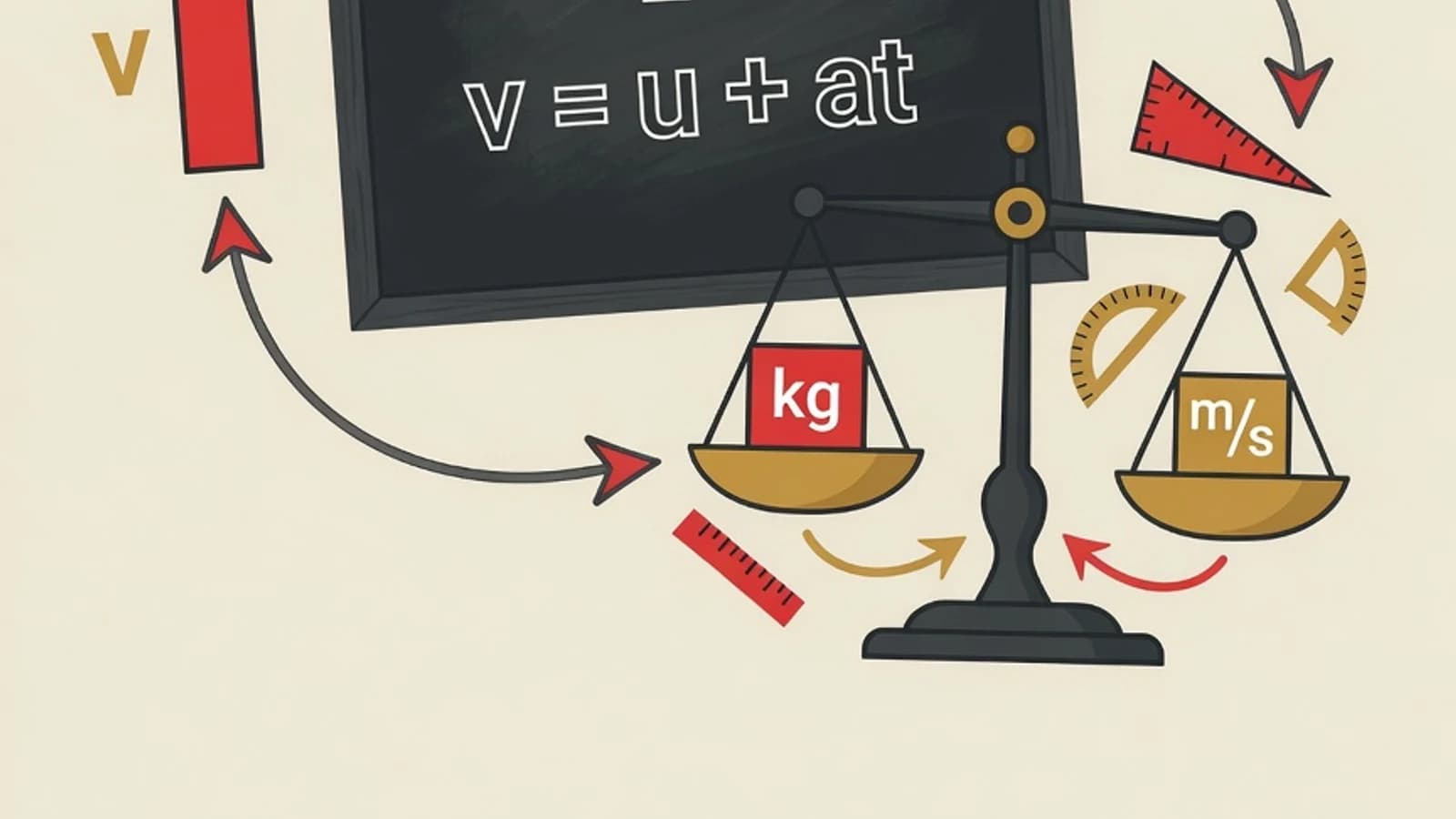
Understanding physics formulas without memorizing begins with reading the meaning and unit of each symbol, then recognizing the relationships between the quantities inside. Trace where the formula comes from, verify it with unit analysis, and group formulas that share the same idea. This approach lets one understood formula replace many that were once memorized separately.
- Read each symbol and its unit before touching any numbers
- Identify which quantity is the cause and which is the effect
- Check every formula with unit analysis as a quick safeguard
- A formula notebook with a meaning column and a unit column
- A list of base physical quantities and their SI units
- A few practice problems to test each formula you study
A snapshot of Indonesian students' grasp of physics
Why memorized physics formulas fade quickly
A physics formula that is only memorized is stored as a string of letters with no anchor of meaning, so it is easy to confuse once the count grows. Before an exam, the brain holds dozens of similar symbol arrangements: v equals s over t, a equals delta v over t, F equals m times a. Without understanding what each quantity means, all three feel identical and get paired incorrectly. Physics education researcher Arnold Arons long noted students' tendency to manipulate mathematical symbols without grasping the physical meaning of the quantities they represent. The Force Concept Inventory developed by Hestenes and colleagues points to the same pattern: many students can plug numbers into a formula smoothly, yet stumble when asked to explain the concept behind it. Understanding physics formulas closes this gap, because each symbol connects to a real picture and holds a clear meaning within the equation.
Six steps to understand a physics formula
Apply this sequence to every new formula. With practice, reading a physics formula starts to feel like reading a sentence that has a subject, a verb, and an object.
- Step 1
Read each symbol along with its unit
Before calculating anything, translate every letter into a word and a unit. In v equals s over t, read v as speed in meters per second, s as distance in meters, and t as time in seconds. This habit turns the formula from a cluster of abstract letters into a statement you can say aloud: speed is the distance covered in each unit of time. Keep a notebook with three columns: symbol, meaning, and unit. Fill those columns every time you meet a new formula. Learning how to understand physics formulas always starts from clarity about what each symbol means, because a quantity with a vague meaning leads to fragile calculation steps.
Tips- Say the formula quietly as a full sentence, for example force equals mass times acceleration
- Distinguish look-alike symbols, such as p for momentum and P for power or pressure
- Step 2
Identify the cause quantity and the effect quantity
Every physics formula tells a story of cause and effect. In F equals m times a, force is the cause and acceleration is the effect, while mass acts as a resistance that sets how large the effect will be. Marking these roles clarifies the logic of a problem: when a question says the force is increased, you immediately know acceleration is what changes. Practice by asking of each formula which quantity we set and which one follows. This cause-and-effect mapping becomes the foundation for understanding the more elaborate physics formulas in later chapters.
Tips- Mark the quantity you can control and the quantity that results from it
- Tie it to everyday experience, such as pushing a heavier cart feeling slower to change speed
Watch out for quantities that stay fixed within a single problem, such as an object's mass. Fixed quantities are often mistaken for ones that change. - Step 3
Test the direct and inverse relationships
The heart of understanding physics formulas lies in reading the relationships between quantities. Ask a simple question: if one quantity is doubled, what happens to the others. In kinetic energy Ek equals one half m times v squared, doubling the speed makes the energy four times larger because v is squared. In pressure P equals F over A, enlarging the contact area lowers the pressure because the two are inversely related. This skill of reading proportions is called proportional reasoning, and physics education research treats it as a key competency for success in the subject. Practice writing a relationship sentence for each formula, for example acceleration is directly proportional to force and inversely proportional to mass.
Tips- Watch the powers: a squared quantity changes far faster than a first-power one
- Make a small table with a column for the doubled quantity and a column for its effect
- Step 4
Trace the formula back to its definition
Many physics formulas are actually derived from a few basic definitions. The distance formula for uniformly accelerated motion, s equals v naught times t plus one half a times t squared, arises from combining the definitions of speed and acceleration. Once you have derived a formula yourself, even a single time, it stops feeling foreign and no longer needs to be memorized whole. Ask your teacher to show the derivation of key formulas, then rewrite the steps without looking. Tracing a formula's origin is the most durable way to understand physics formulas, because you can rebuild the formula if it ever slips your mind mid-exam.
Tips- Collect three to five parent formulas per chapter, then derive the others from them
- Keep one page with the derivations you need most often
- Step 5
Check consistency with unit analysis
Unit analysis is an honest, quick check. A new formula is reasonable only if the unit on the left side matches the unit on the right. In v equals s over t, meters divided by seconds gives meters per second, which is indeed the unit of speed. If you are unsure how to write a formula from memory, assemble its units first: when the units do not match, your arrangement is wrong and needs fixing. The physics teaching literature describes dimensional analysis as a tool that cannot prove a formula is definitely correct, yet reliably catches a formula that is malformed. Make this the closing habit whenever you write a formula down.
Tips- Memorize the units of the base quantities, then derived units can be assembled yourself
- Use unit analysis to guess a formula's shape when you forget, before relying on rote memory
- Step 6
Group formulas that share the same idea
Physics formulas are far lighter to understand when arranged into groups that share one idea. The formulas for uniform motion and uniformly accelerated motion both stand on the same definitions of speed and acceleration. The formulas for kinetic energy, potential energy, and work connect through the idea of energy conservation. By grouping related formulas, you understand one core idea and then see the others as its branches. Build a formula map per chapter that places the parent formula at the center and its branches around it. A map like this turns a pile of formulas into a few families of ideas that are easy to recall.
Tips- Color formulas from one chapter with the same shade so their links are visible
- Write one core-idea sentence above each group of formulas
Memorizing a formula versus understanding it, the difference at the exam desk
| Exam situation | Only memorizing | Understanding the meaning |
|---|---|---|
| A formula suddenly forgotten | The problem stalls with no backup | The formula is rebuilt from a definition or from units |
| A problem with a variable changed | Confusion over which formula fits | The relationship between quantities is read at once |
| Similar formulas get swapped | Uniform symbols are easily mispaired | Each symbol's meaning keeps the formula in place |
| A new chapter of material | The memorization load keeps growing | New formulas connect to ideas already mastered |
Understanding physics formulas does not erase the need to remember them. Memory still plays a part, now supported by meaning so it lasts longer.
Reading the relationships between quantities in common formulas
F = m x a
Force is directly proportional to acceleration. With mass fixed, doubling the force doubles the acceleration. With force fixed, a heavier object changes speed more slowly.
Ek = 1/2 m v^2
Kinetic energy is proportional to the square of speed. Doubling the speed makes the energy four times larger, a much bigger jump than doubling the mass.
P = W / t
Power is work per unit time. Completing the same work in a shorter time means greater power.
rho = m / V
Density compares mass against volume. Two objects of the same mass but different volume have different densities.
“When a student can narrate a physics formula as a cause-and-effect sentence, we know the idea is firmly in hand. A formula that is understood stays with them long after the exam date passes.”
Self-check: understanding or just memorizing
- State the meaning and unit of every symbol without looking at notes
- Explain which quantity is the cause and which is the effect
- State the direct or inverse relationship between its quantities
- Derive or reassemble the formula from a basic definition
- Verify the formula through matching units
- Place the formula within a family of related formulas
- Understanding physics formulas begins with the meaning and unit of each symbol, before touching any numbers.
- The core of understanding is reading the direct and inverse relationships between quantities within a formula.
- Deriving a formula from its definition and checking it with unit analysis lets you rebuild the formula when you forget.
- Grouping related formulas turns a pile of memorization into a few families of ideas that are light to recall.