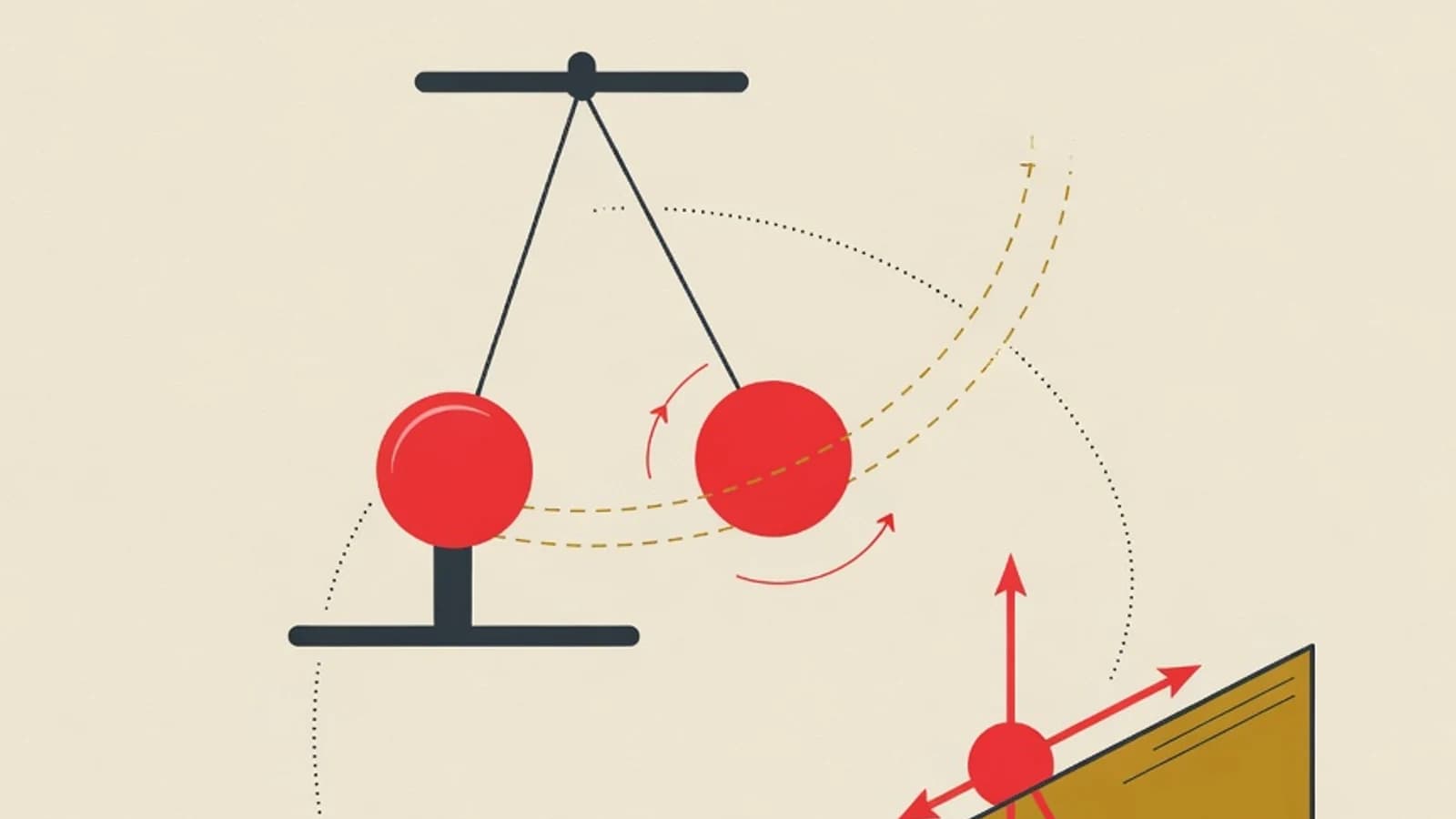
How to solve physics calculation problems starts with reading and sketching the problem situation, writing down the quantities that are known and asked, recognizing the concept that applies, choosing a linking formula, converting units to SI, doing the algebra first, then checking the reasonableness of the result. These seven steps make your work orderly and easy to trace when something goes wrong.
- Working step by step makes a long problem feel light because you handle one step at a time
- Writing the known and asked quantities early saves time and reduces misreading the problem
- Checking units and reasonableness at the end catches mistakes before the answer is handed in
- A grid or plain notebook wide enough to draw the problem situation
- Pen and ruler to sketch the direction of forces, velocities, and axes
- A scientific calculator to compute once the formula is neatly arranged
- A set of graded practice problems, from basic examples to exam questions
Why Method Matters More Than Speed in Physics Calculation Problems
Understand First Why Calculation Problems Feel Hard
Many students find physics calculation problems hard because they jump straight to a formula the moment they finish reading. Numbers from the problem get shoved into whatever formula comes to mind, without confirming that the formula truly fits the situation. When the result feels odd, they have no idea where to fix it, since there is no trail of steps to trace. Physics calculation actually calls for calm, gradual thinking. Every problem tells the story of a situation, such as an object sliding down an inclined plane or a pendulum swinging. Your task is to translate that story into a picture, then into quantity symbols, and only then into a calculation. The seven-step method below arranges that order so your mind has something to hold onto, and mistakes are easy to find when you review your work.
Seven Steps to Solve Physics Calculation Problems
Work through them in order. Each step prepares material for the next, so by the time you reach the calculation, you already know exactly what you are doing and why.
- 1
Step 1: Read the Problem Slowly and Draw the Situation
Read the problem twice calmly before touching any formula. The first reading captures the big story, the second marks the numbers and keywords such as at rest, constant, smooth, or rough. After that, draw the situation in a simple sketch. If an object sits on an inclined plane, draw the plane and the direction of motion. If there is a force, draw an arrow from the object toward where the force acts. A sketch turns long sentences into a map you can see, so you no longer spin the whole problem in your head. Many mistakes are born from imagining the wrong direction, and a simple drawing closes that gap early.
Tips- Mark words that carry a physics condition, for example initially at rest means the starting velocity is zero
- Add arrows and axes to the sketch so the positive and negative directions are clear from the start
- 2
Step 2: Write What Is Known and What Is Asked
Make two small columns, one for Known and one for Asked. Move every number from the problem into the Known column complete with its quantity symbol and unit, such as initial velocity, acceleration, or time. Also write what is asked with its symbol, so the goal of the calculation is clear. This habit forces you to read the problem carefully and often surfaces hidden data you had missed. When all the quantities line up neatly, you can see which ones you already have and which need to be found, before thinking about a formula at all.
Tips- Write standard symbols, for example v for velocity and a for acceleration, so formulas are easy to match
- Watch for implied data such as an object in free fall, which means its acceleration equals gravity
Skipping this step and calculating right away makes it easy to swap quantities, especially on problems that mention many numbers in one long sentence. - 3
Step 3: Recognize the Concept and Law at Work
Before choosing a formula, ask yourself what physics event is taking place. Is the object moving with constant acceleration, is there a force making it move, or is energy changing form. Answering this question points you to the right chapter, such as linear motion, Newton's laws, or conservation of energy. A formula is only a tool, while the concept is the map. Once you know the problem speaks about conservation of energy, you look for a formula from that family, instead of grabbing any formula that happens to contain similar symbols.
Tips- Link the problem's keywords to a chapter, for example the words work and energy point to the energy chapter
- When unsure, state the concept in your own words first before searching for the formula
- 4
Step 4: Choose the Formula That Links Data to the Answer
Once the concept is clear, choose the formula that links the known quantities to the one being asked. Look back at the two columns from the second step, then find a formula whose contents match the quantities in both. If a formula demands a quantity you do not yet have, first find that intermediate quantity with another formula, then continue. Write the formula in its original form first, without rushing to insert numbers. Writing the whole formula helps you confirm that a path to the answer truly exists from the data you have.
Tips- Choose the formula that needs the fewest extra quantities so the path is shorter
- If one formula is not enough, plan two steps, find the intermediate quantity then the final answer
- 5
Step 5: Convert Every Unit to the International System
Before any number enters the formula, convert all units to the International System. Length becomes meters, mass becomes kilograms, and time becomes seconds. A velocity written in kilometers per hour is first changed to meters per second, and a mass written in grams is changed to kilograms. This small step often separates a right answer from a miss, because standard physics formulas work with SI base units. Do the conversion at this stage, apart from the main calculation, so the numbers you use are already uniform and your mind is not burdened with two jobs at once.
Tips- Change kilometers per hour to meters per second by dividing by the fixed conversion figure, which is 3.6
- Write the unit beside each number while calculating, so any unit mismatch shows up immediately
Mixing units, for example mass in grams with length in meters, produces a number that looks tidy yet is badly wrong with no warning at all. - 6
Step 6: Finish the Algebra First, Numbers Later
Work the formula in symbolic form first. If the quantity asked is not yet alone on one side, move terms and rearrange the formula until it stands by itself on one side. Only after the form is neat do you insert the numbers along with their units. This approach keeps the calculation cleaner, reduces errors from copying numbers over and over, and eases review because every line has a reason. Keep your writing orderly from top to bottom, one step per line, so if the final result is wrong you can trace exactly which line needs fixing.
Tips- Rearrange the formula until the quantity you seek stands alone on the left side before inserting numbers
- Write each stage on a new line, avoid stacking several operations into one crowded line
- 7
Step 7: Check the Units and Reasonableness of the Answer
The answer is not finished before it is checked. First, check the unit of the final result, whether it matches what was asked. If you are looking for velocity yet the unit is not meters per second, a step must be wrong. Second, weigh whether the number is reasonable. A car on the road moving at hundreds of meters per second clearly makes no sense, and that is a signal to retrace your steps. Third, reread the original question, making sure the quantity you computed is exactly the one the question asks for. This brief check often saves marks that would otherwise be lost to a small slip.
Tips- Compare the answer against everyday reality to judge whether it is reasonable
- If exam time allows, recompute once with a different route as a cross-check
A calculation that is correct is still marked wrong if you answered an intermediate quantity instead of the one asked, so always return to reading the question at the end.
Three Broad Stages in Solving a Calculation Problem
Translating the Problem
Reading, sketching, and writing what is known and asked. This stage prepares all the material before a formula is touched.
Building the Strategy
Recognizing the concept, choosing a linking formula, and standardizing units to SI. This stage sets the path to the answer.
Calculating and Checking
Finishing the algebra, inserting numbers, then checking the unit and reasonableness of the result. This stage locks in a correct answer.
Three Chapters of Calculation Problems That Appear Most Often
| Problem Type | Its Key Concept | What to Watch For |
|---|---|---|
| Uniformly accelerated linear motion | Velocity, acceleration, and time are linked together | The sign of the acceleration, whether it speeds up or slows down |
| Newton's laws and forces | The total force determines the object's acceleration | Resolving forces on an inclined plane along the axes |
| Work and energy | Energy changes form yet its total stays the same | Choosing the height reference point for potential energy |
Although the chapters differ, all three problem types are solved with the same seven steps, because the method applies generally.
“The students who progress fastest in physics calculations are the ones who write their steps most neatly. That neatness outweighs sheer formula memorization. Orderly work makes mistakes easy to find and fix, so every practice session genuinely adds to their ability.”
Checklist Before Handing In Your Answer
- The problem situation is drawn and the direction of quantities is clearly marked
- The known and asked columns are filled complete with their units
- All units are standardized to the International System before calculating
- The formula is rearranged algebraically before numbers are inserted
- The unit of the result and the reasonableness of the number are checked against the original question
How Much Do Physics Lessons at EduPoint Cost
Guided support for calculation problems stays affordable. Physics lessons at EduPoint start from Rp 110,000 per session for online lessons, and from Rp 140,000 per session for in-person. A small group of two to three students is also available from Rp 95,000 per student. The final price adjusts to the grade level, location, and lesson format you choose. For students who want to practice the seven-step method above with guidance, the mentor watches how you work through a problem, points to the step that still stalls, then gives practice aimed at that weak spot. This approach targets improvement in your working habits, so the practice shows in your accuracy and the speed at which you finish exam problems.
- How to solve physics calculation problems runs from reading and sketching, writing the data, recognizing the concept, choosing a formula, converting units, calculating, then checking
- The three first steps that translate the problem already solve half the difficulty before a formula is touched
- Standardizing units to the International System prevents the mistake that most often derails a correct answer
- Doing the algebra first then inserting numbers keeps the calculation clean and easy to trace
- Checking units and reasonableness at the end catches small slips before the answer is handed in