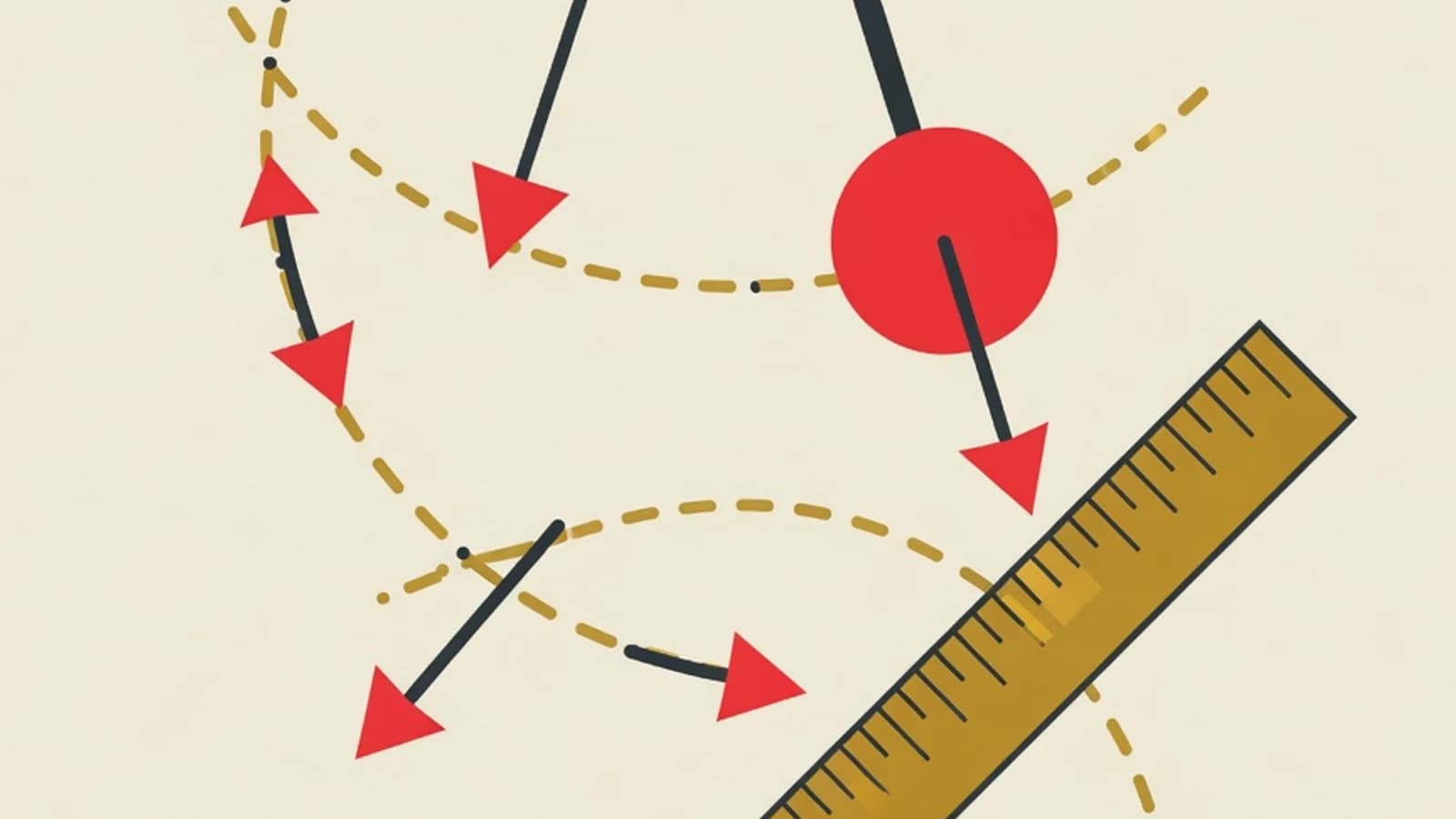
Understanding high school physics from scratch starts by strengthening three foundations first: basic math, quantities together with their units, and the habit of drawing the physical situation in a problem. Once the foundation stands, topics are learned in order beginning with kinematics, mastering one concept through practice before moving on to the next.
- Math and unit foundations are built before touching long formulas
- Topics are sequenced from the most concrete, motion, toward the more abstract
- One concept is mastered through practice before advancing to the next chapter
- Physics textbook matching the grade level
- A dedicated notebook for formulas and definitions
- A scientific calculator and a ruler
- A set of practice problems graded from easy to hard
Numbers that explain why the start of physics feels heavy
Why high school physics often feels hard without a foundation
Many students hit a wall in physics because they jump straight to long formulas before understanding what each quantity inside them means. A formula for acceleration or kinetic energy looks like a row of foreign symbols when the ideas of velocity, mass, and force are not yet clear. The root of the difficulty usually comes from two directions. First, basic math such as rearranging equations, reading ratios, and angle trigonometry is still shaky, even though physics uses it at almost every step. Second, topics are learned in a disconnected way, one chapter memorized for a test then forgotten, leaving the next chapter without footing. Building physics understanding from scratch means closing these two gaps first, so a formula arrives as a short summary of a concept already understood.
Seven steps to build high school physics understanding from scratch
This order runs from the most concrete material toward the more abstract. Work through it gradually and finish one step before climbing to the next.
- Step 1
Strengthen the basic math that physics relies on
Physics rests on a small set of math skills that appear again and again. Master first how to rearrange equations, work with ratios and percentages, read line graphs, use scientific notation for very large and very small numbers, and apply basic trigonometry with sine, cosine, and tangent for standard angles. Practice each skill through pure math problems first, without any physics context, until it feels fluent. This foundation makes the later steps far lighter because the brain no longer carries two burdens at once.
Tips- Set aside one hour for algebra and trigonometry practice before entering any physics chapter
- Keep a summary of basic math formulas on the front page of your physics notebook
- Step 2
Master quantities, units, and dimensional analysis
Every number in physics carries a unit, and that unit tells a lot. Learn the seven base quantities of the International System of Units along with their units, then get familiar with derived quantities such as velocity (meters per second) and force (newtons). Build the habit of writing units at every step of a calculation. This skill is called dimensional analysis, and it becomes a self-check: when the units on the left and right sides of an equation do not match, a step has gone wrong. This habit saves many exam marks before an error has a chance to grow.
Tips- Post a unit conversion table near your study desk
- Always convert units to standard form (meters, kilograms, seconds) before calculating
Wrong units are the most common source of error for beginners in physics. Check the units before pressing equals on the calculator. - Step 3
Practice reading and drawing the physical situation
Before touching a formula, translate the story of a problem into a picture. A simple sketch showing the direction of motion, the direction of forces, and the reference point is enough to make a concept visible. The habit of drawing a free-body diagram, for example, helps separate the forces acting on a single object. The brain understands physics through spatial imagery, so this step turns a problem that looks complicated into a map you can read. Practice by taking any problem and stopping at the drawing first, without rushing to calculate.
Tips- Add arrows and labels to every quantity in the drawing
- Mark what is known and what is asked directly on the sketch
- Step 4
Start with kinematics, the most concrete topic
Motion is the best place to begin because it can be seen and felt every day. Learn uniform motion then uniformly accelerated motion, recognize the relationship between position, velocity, and acceleration, and understand how to read motion graphs. Tie each concept to real experience: a car speeding up, a ball falling, or a person walking at a steady pace. Because kinematics uses the math you strengthened in the first step, this topic becomes a natural bridge toward the more challenging chapters.
Tips- Link motion formulas to position-time graphs so their meaning shows
- Work at least ten straight-line motion problems before stepping into dynamics
- Step 5
Move on to dynamics and Newton's three laws
Once you understand how objects move, study the cause of that motion through dynamics. Newton's three laws explain the relationship between force, mass, and acceleration. Start by understanding force as a push or a pull, then practice drawing a free-body diagram for each situation. This concept leans entirely on kinematics, which is why the order matters. Work simple cases first, such as an object on a flat table, before entering inclined planes and pulley systems that combine many forces at once.
Tips- Always begin a dynamics problem with a complete free-body diagram
- Break forces into horizontal and vertical axes so the calculation stays organized
- Step 6
Build up to work, energy, and momentum
Work, energy, and momentum give another way to understand motion without always tracking force at every instant. Learn the meaning of work as a force that moves an object, then get to know kinetic and potential energy along with their conservation laws. The ideas of energy and momentum conservation often shrink a problem that looks long into just a few lines. This material demands a solid grasp of dynamics, so make sure Newton's laws already feel fluent before entering here.
Tips- Look for a quantity that stays constant, since conservation laws are often the fastest route
- Compare results through the energy approach and the force approach to test your understanding
- Step 7
Finish one concept with graded practice before moving on
Understanding forms through directed repetition. For each concept, work problems from easy, then medium, then hard, and only move to the next chapter when medium problems can be solved without looking at an example. Cognitive psychology research on working memory capacity shows the brain can hold only a little new information at one time, so piling many concepts together actually slows learning down. Finishing one concept clears room in the mind for the next, while strengthening the links between chapters that make physics feel connected.
Tips- Set a simple passing bar: solve three medium problems in a row on your own
- Briefly review older concepts each week so they do not fade
Skipping a chapter that is not yet finished feels like saving time early on, yet the gap in understanding returns in later material.
High school physics topic order by grade under Kurikulum Merdeka
Grade 10 (Phase E)
Physics is still merged into the science subject alongside biology and chemistry. The focus is measurement, quantities and units, straight-line motion, and an introduction to energy. This is where learning physics from scratch is founded.
Grade 11 (Phase F)
Physics stands as its own subject. The material widens into dynamics, work and energy, momentum, oscillation, waves, and fluids, all of which demand a strong grade 10 foundation.
Grade 12 (Phase F)
Electricity, magnetism, and an introduction to modern physics take center stage, along with preparation for university entrance selection. All of it rests on the concepts from grades 10 and 11.
Two ways to start physics from scratch and their different results
| Aspect | Jumping between chapters | Learning in order from the foundation |
|---|---|---|
| Starting point | Straight to the chapter taught in class | Strengthening math and the idea of quantities first |
| When difficulty appears | Copying the flow of an example without its origin | Tracing back to the basic concept at the root |
| Confidence | Rises and falls with each chapter's difficulty | Grows steadily as concepts finish one by one |
| Retention of material | Fades quickly because chapters feel separate | Sticks longer because each chapter leans on the one before |
Building from the foundation asks for more time early on. That time returns when the later chapters feel far lighter.
Signs one physics concept is already mastered
- You can explain the concept in your own words without the book
- You can draw the situation of a problem with the direction of each quantity
- You solve three medium problems on your own in a row
- You know the unit of each quantity and can verify it with dimensional analysis
- You can connect this concept with the previous chapter
- You sense when this concept applies and when another one fits better
“Students who start physics from scratch progress fastest when they stop chasing formulas and begin asking what is actually happening to the object in the problem. That picture is what finally makes the formula make sense.”
- Understanding high school physics from scratch starts with basic math and mastering quantities and units.
- Topics are learned in order from concrete kinematics toward more abstract concepts.
- One concept is finished through graded practice before moving to the next chapter.
- Drawing the situation of a problem first makes formulas feel sensible and easy to remember.