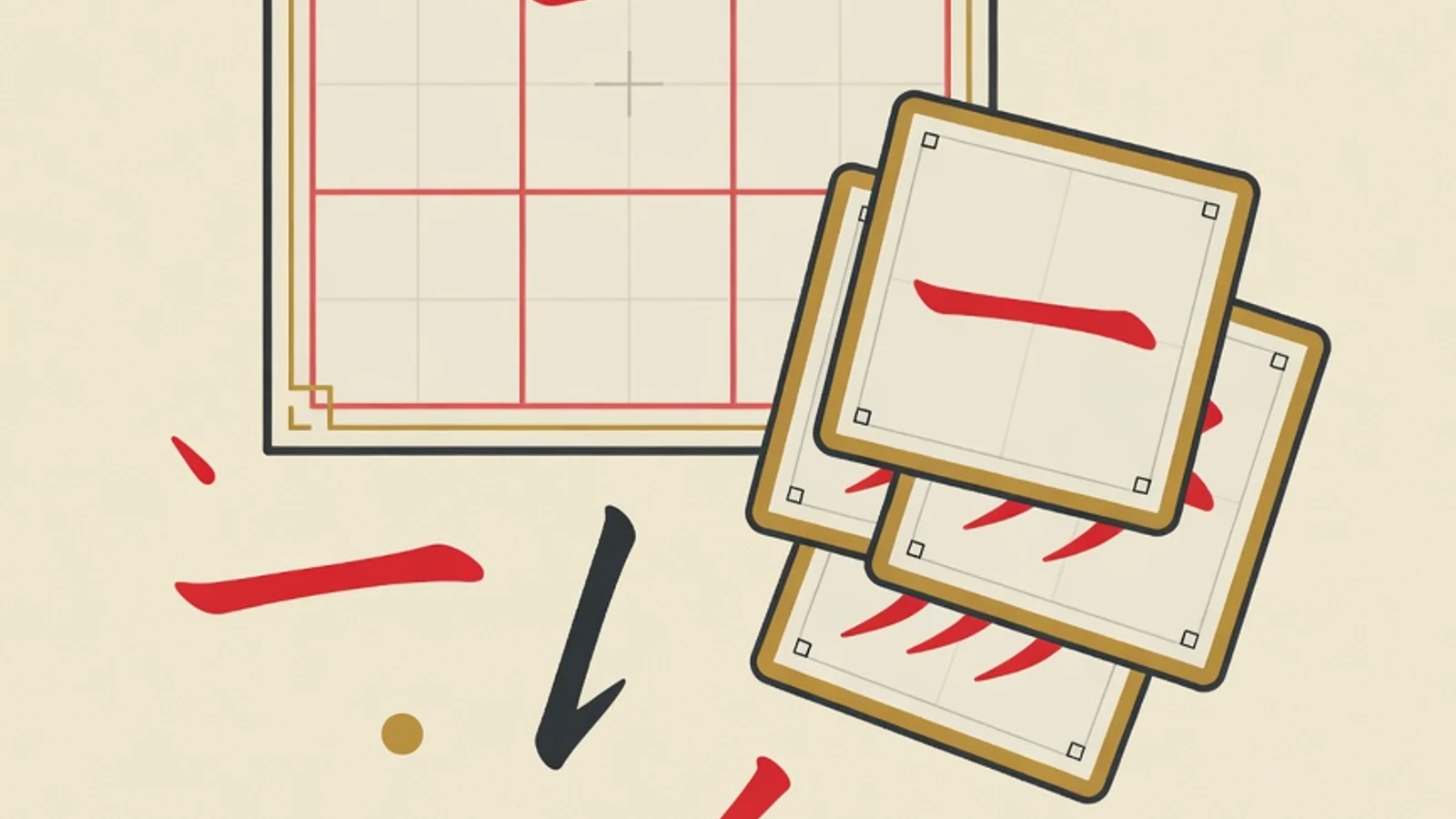
Learning how to write hanzi as a beginner starts with mastering the eight basic strokes, then applying one guiding rule of stroke order: top to bottom, left to right, and horizontal before vertical. Practise each character inside a grid box for ten minutes a day, moving from simple radicals to compound characters.
- The eight basic strokes are the foundation of every Chinese character
- Correct stroke order keeps your writing neat and easier to recall
- Short daily practice works better than long occasional sessions
- A grid workbook (tian zi ge) or squared paper
- A 2B pencil or fine-tip gel pen
- A list of the 20 most frequent HSK 1 characters
The numbers that frame the hanzi-writing journey
Why stroke order shapes the final result
Writing hanzi works like assembling a building from blocks. Each character is made of strokes with a fixed direction and sequence, and that sequence is what keeps the character balanced in proportion. When strokes are drawn in the correct order, your hand builds a consistent movement pattern, so the same character looks similar every time you write it. Research by Li Hai Tan and colleagues published in PNAS shows a close link between handwriting and the ability to recognise Chinese characters. The act of writing builds motor memory that reinforces the visual memory of a hanzi shape. For beginners, this means writing practice helps you remember characters longer than merely reading pinyin on a screen. A neat stroke-order foundation set early makes the next step easier: writing more intricate compound characters.
Steps to write hanzi from scratch
These six steps lay out a beginner's path to writing hanzi, from recognising strokes to writing full characters fluently.
- 1
Learn the eight basic strokes (bihua)
Begin with the smallest units of movement. The eight basic Chinese strokes are the horizontal (heng), the vertical (shu), the dot (dian), the left-falling sweep (pie), the right-falling sweep (na), the hook (gou), the rising stroke (ti), and the turning stroke (zhe). Take squared paper and draw each stroke across a full row while naming it aloud. Watch the direction: horizontals always go left to right, verticals always go top to bottom. This drill feels simple, and this is precisely where long-term neatness is built. Spend the first two or three days on these eight strokes before touching full characters.
Tips- Say the stroke name as you draw it so movement and terminology fuse together
- Compare the left sweep (pie) and the vertical (shu): they are easy to confuse early on
- 2
Understand the seven stroke-order rules
Stroke order follows a predictable pattern. The seven core rules are: horizontal before vertical, left sweep before right sweep, top before bottom, left before right, outside before inside, fill the inside then close the box, and the centre before the two sides. Take the character 十 (shí, ten): draw the horizontal first, then the vertical. Try 木 (mù, tree) to practise the centre-then-sides rule. Write each example while stating the rule you are using, so the logic sticks as genuine understanding of the character.
Tips- Pin the list of seven rules on your desk for the first two weeks
- Test yourself: when unsure, top-to-bottom and left-to-right settle most cases
Memorising a character shape without stroke order makes writing fall apart once characters grow denser. - 3
Use the grid box (tian zi ge)
The tian zi ge box is a square with crossing guide lines through the centre, dividing it into four quarters. This box is a proportion compass for beginners. Place each stroke relative to the centre lines: the left component takes the left half, the right component takes the right half, and the character's centre of gravity sits near the intersection. Write one character per box at full size, without shrinking it into a corner. Once the shape feels stable, move to ordinary lined paper. The habit of arranging proportion in this box carries over when you write in open space.
Tips- Fill the box to about 80 percent of its height so characters look confident
- Check left-right balance before adding the next component
- 4
Start with the most common radicals (bushou)
Radicals are recurring components that act as building blocks for thousands of characters. Mastering around 30 common radicals gives you a key to reading and writing many hanzi at once. For example, 氵 (the water radical) appears in 河 (hé, river) and 海 (hǎi, sea); 木 (the wood radical) appears in 林 (lín, forest) and 树 (shù, tree). When writing a compound character, draw its radical first if it sits on the left or top. Recognising radicals lets you break intricate characters into familiar parts, so writing them feels lighter.
Tips- Group new hanzi by radical so their writing patterns surface quickly
- Radicals often hint at meaning: 氵 signals something related to water
- 5
Practise the most frequent HSK 1 characters
Aim practice at the characters you will actually use. Take the 20 highest-frequency HSK 1 hanzi such as 我 (wǒ, I), 你 (nǐ, you), 是 (shì, to be), 好 (hǎo, good), and 不 (bù, not). For each character, write it five to eight times with full stroke order, say its sound, then build a short sentence with it. Linking the written form to sound and meaning puts three layers of memory to work together. From here you move up to HSK 2 characters gradually without it feeling heavy.
Tips- Write characters in the context of a word, for example 好 inside 你好 (hello)
- Track progress: one character mastered per day is already a healthy pace
- 6
Build a daily routine and periodic review
Consistency beats intensity. Ten minutes of writing every day builds motor memory better than one hour once a week. Split the daily session: three minutes rewriting yesterday's characters, five minutes on new characters, two minutes copying one short sentence. Every weekend, revisit characters whose memory is starting to stall by writing them without looking at an example. This mirrors the principle of spaced repetition, where a nearly forgotten character is reviewed just before it slips away, so memory strengthens with each cycle.
Tips- Keep old workbooks as visible proof of progress
- Flag characters whose stroke order you often mix up for extra practice
Writing by hand versus copying in an app
| Aspect | Writing by hand on paper | Tracing in a screen app |
|---|---|---|
| Motor memory | Built strongly through pen pressure | Partly built, finger movement is lighter |
| Order feedback | Needs manual or teacher checking | Automatically flags wrong strokes |
| Proportion neatness | Fully trained through the grid box | Depends on the app's built-in guide |
| Practice mobility | Needs a book and pen | Possible anywhere via phone |
The two work well together: apps to check stroke order, paper to mature the neatness of your hand.
Supplies and daily habits for practice
- A tian zi ge grid workbook or squared paper
- A 2B pencil or fine-tip gel pen for firm strokes
- A deck of 30 common radical flashcards
- A list of 20 HSK 1 hanzi with pinyin beside them
- A fixed ten-minute slot at the same time each day
- A dictionary app with animated stroke order for verification
“Beginners often want to write long sentences quickly. A foundation of the eight strokes and correct order actually speeds everything up, because the hand no longer has to guess a direction each time it meets a new character.”
Starting from simple characters first
- Stroke-order rules are trained in a clear form
- Confidence grows because characters are mastered quickly
- Basic radicals become familiar, so compound characters are easier to break down
- Writing falls apart because proportion is not yet under control
- Stroke order is often wrong and hard to correct later
- Motivation drops when dense characters feel demanding without a base
- The eight basic strokes and seven stroke-order rules are the foundation of every Chinese character
- The tian zi ge grid box keeps hanzi proportion in check until your hand can judge it alone
- Mastering around 30 common radicals opens the path to thousands of compound characters
- Ten minutes of daily practice with periodic review beats long occasional sessions