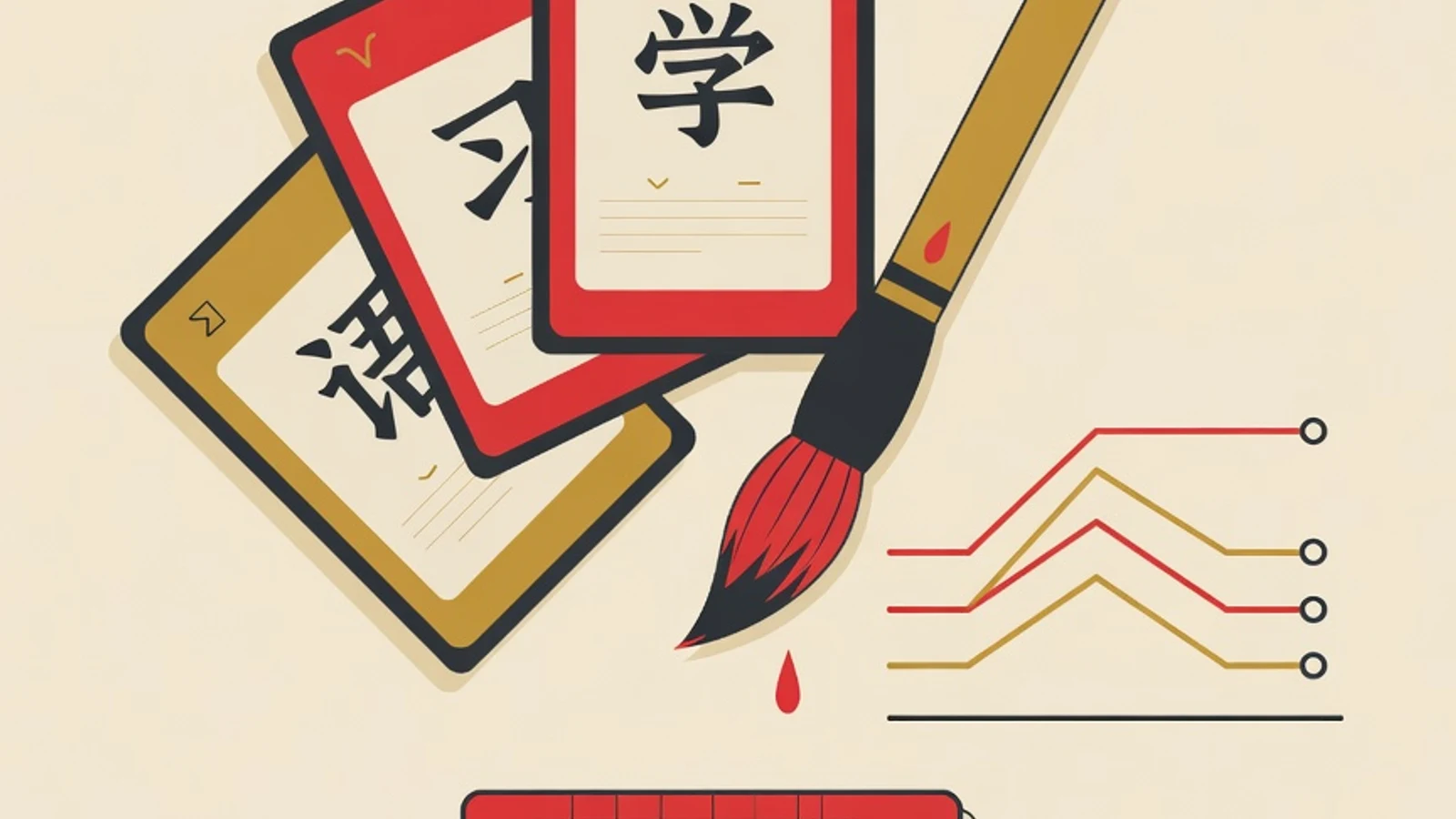
The durable way to memorize Hanzi is to break every character into meaningful radicals and components, then review them on a spaced repetition schedule. For Mandarin tones, train the four tones in pairs while recording yourself and comparing your voice with native speakers each day.
- Learn radicals and components first, since thousands of Hanzi are built from repeating pieces
- Reschedule cards with spaced repetition so your brain reviews them right before forgetting
- Train the four Mandarin tones in pairs and record yourself to correct their pitch contour
- A list of the 50 most frequent Hanzi radicals with their meanings
- A grid notebook (tian zi ge) for practicing stroke order
- A four-tone chart with the example syllable ma
Numbers That Make Memorizing Hanzi and Tones More Reasonable
Why Memorizing Hanzi Feels Hard and Tones Get Confused
Many beginners try to memorize Hanzi as whole pictures, rewriting them dozens of times until their hand aches. That approach is exhausting and fades quickly because the brain has nothing meaningful to hold on to. Hanzi are actually built tidily from repeating components. The character 妈 (ma, mother) contains the radical 女 (woman) on the left and 马 (horse, giving the sound) on the right. Once you recognize these pieces, a single character turns into a small story that is easy to recall. Mandarin tones get confused because ears trained on English or Indonesian are not yet sensitive to pitch that changes meaning. The syllable ma can mean mother, hemp, horse, or to scold depending on its tone. The key is to train tones from your very first sound, while recording and listening back. A trained ear guides the tongue to follow the right pitch contour.
Steps to Memorize Hanzi for the Long Term
The sequence below turns Hanzi memorization from plain copying into building interconnected memory. Work each step until it feels comfortable before adding new characters.
- 1
Master 30 to 50 of the most frequent radicals first
Start from the building blocks of characters, the radicals. A radical is a small piece that appears across hundreds of Hanzi and often hints at meaning. The radical 氵relates to water, so it appears in 河 (river), 海 (sea), and 洗 (to wash). The radical 木 means tree and shows up in 林 (forest) and 树 (tree). Learn around 30 to 50 of the most frequent radicals first, along with their meaning and position within a character. Once this foundation is in place, every new Hanzi feels like assembling pieces you already know, which sharply reduces memorization time compared with memorizing unfamiliar strokes.
Tips- Pin ten radicals on your study wall and swap them every week
- Group radicals by theme such as water, hand, heart, and mouth
Avoid chasing hundreds of characters before radicals settle in, because without the component handles your recall will feel random and fade fast. - 2
Break each character into a mnemonic story
Once radicals are mastered, meet each new character by taking apart its components, then weave them into a short, vivid story. The character 好 (hao, good) is made of 女 (woman) and 子 (child). Picture a mother holding her child, an image that feels good, so the meaning and shape stick together. A funny, odd, or personal story is easier to recall than a flat definition. Write that story on the back of your flashcard. When you see the character again, your brain replays the story and pulls out both the meaning and the shape. This technique turns memorization into a meaningful act of understanding.
Tips- One short story per character is enough, keep it simple
- Use the sound-giving component as a reminder of pronunciation
- 3
Write with the correct stroke order
Handwriting helps muscle memory lock in the shape of a Hanzi, as long as the stroke order is correct. The basic rules are top to bottom, left to right, and horizontal strokes before vertical ones. The character 十 (ten) is written with the horizontal stroke first, then the vertical. Consistent stroke order makes your handwriting faster, neater, and easier for dictionary apps to recognize when you draw a character. Use a tian zi ge grid notebook so the proportions of each part stay balanced. Write each new character five to eight times with full attention, then move on to scheduled review. Writing it a hundred times without focus loses to a few mindful repetitions.
Tips- Check stroke order in a dictionary like Pleco before memorizing it wrong
- Say the pinyin and tone each time you write the character
Once an incorrect stroke order is ingrained, fixing it is much harder, so get it right from the start. - 4
Reschedule review with spaced repetition
This step decides whether your Hanzi survive or evaporate. Spaced repetition is the technique of reviewing a card just before you forget it, with the gap widening each time you recall it successfully. Apps such as Anki or the flashcard feature in Pleco compute this schedule automatically. Difficult characters appear more often, while well-learned ones appear more rarely. This pattern fights the Ebbinghaus forgetting curve, which shows new information decays quickly without review. Make two-way cards: see the Hanzi and guess the meaning and sound, then see the meaning and guess the Hanzi. Set aside ten to fifteen minutes daily to clear the cards that are due, and this daily discipline beats rare marathon sessions.
Tips- Cap new cards at about ten per day so the review pile stays manageable
- Add one example sentence per card so the context is memorized too
Meeting the Four Mandarin Tones and How to Remember Them
First Tone (mā)
High and flat like a straight line. Imagine holding a steady, level note like the aaa a doctor asks for. Example: 妈 means mother.
Second Tone (má)
Rising from mid to high, like the questioning intonation in huh? when surprised. Example: 麻 means hemp.
Third Tone (mǎ)
Falls first then rises, forming a dip. The voice is slightly creaky at the lowest point. Example: 马 means horse. Beginners overlook this tone most.
Fourth Tone (mà)
Sharp and falling quickly from high to low, like a short bark. Example: 骂 means to scold. Hold the energy to the end.
Steps to Train Mandarin Tones Until They Sound Natural
Tones stick through ears and mouth trained together with regular spoken practice. The four steps below build tone sensitivity from the ground up.
- 1
Train tones in pairs to mirror real speech
In real speech, tones almost always appear in a row, so practicing them in pairs is closer to actual conditions. Start with two-syllable pairs such as first tone then fourth tone, or third tone then second tone. Say each pair repeatedly until the transition feels smooth. This tone pair approach trains your tongue to move between tones, a skill more useful than holding a single tone perfectly in isolation. Make a list of a dozen everyday word pairs, such as 中国 (Zhongguo, China) and 老师 (laoshi, teacher), and use them as daily practice material.
Tips- Spend longer on the tone pairs you most often confuse
- Record your favorite word pairs and listen while commuting
- 2
Use hand gestures to feel the tone contour
Linking tones to body movement helps your brain remember their pitch contour. Move your hand flat for the first tone, up for the second tone, curving down then up for the third tone, and diving sharply for the fourth tone. This involves motor memory, so the tone feels more real than a mark above a letter. Children usually take to this method quickly because it feels like a game. Do it while saying the syllable, so your eyes, hand, and voice work together and reinforce one another.
Tips- Stand in front of a mirror so gesture and voice stay aligned
- Invite family members to move along so practice feels fun
- 3
Record yourself then compare with native speakers
Ears often deceive, feeling a tone is right when it has slipped. Record yourself on your phone, then play it side by side with native audio from an app or study material. Listen for whether your third tone truly dips then rises, or whether your fourth tone is sharp enough. Note one main error each session and fix it the next time. Comparing recordings makes correction concrete and measurable. Do this record-and-compare ritual at least three times a week so progress feels real.
Tips- Start with short words before moving up to full sentences
- Keep old recordings to see your progress after a month
The third tone is most often simplified into a falling tone only, so check your recordings carefully on this part. - 4
Understand common tone changes (tone sandhi)
Some tones change when they meet other tones, and these rules are called tone sandhi. Two consecutive third tones turn the first into a second tone, so 你好 (ni hao, hello) is actually said with a rising ni. The word 不 (bu) changes from fourth tone to second tone before another fourth tone, as in 不是 (bu shi). The word 一 (yi) also shifts tone depending on what follows. Learn a few of these most common patterns as a package, then practice them in real phrases. Understanding tone sandhi makes your speech sound natural and easier for native speakers to follow.
Tips- Learn tone sandhi through ready-made phrases you often hear
- Mark tone changes in your notes with a different color
Comparing Memorization That Fades and Memorization That Lasts
| Aspect | Old Way (fades fast) | Recommended Way (lasts) |
|---|---|---|
| Hanzi approach | Copying whole characters dozens of times | Breaking into radicals and mnemonic stories |
| Review schedule | Cramming right before an exam | Daily scheduled spaced repetition |
| Tone practice | Reading tone marks without speaking | Tone pairs, recording, and comparing voice |
| Feedback | Guessing alone without correction | Comparing recordings with native speakers |
The biggest difference lies in scheduled review and real feedback, the two things that keep memory durable.
“The learners who become fluent fastest are the ones who consistently review a little every day while speaking aloud. Tones and Hanzi stick when both are trained together as one memory package.”
A 30-Minute Daily Routine for Hanzi and Tones
- Ten minutes clearing the spaced repetition cards that are due
- Five new characters broken into radicals and mnemonic stories
- Five tone pairs practiced out loud
- One short recording compared with native audio
- One tone-sandhi phrase repeated until it feels natural
- Hanzi are easiest to memorize by breaking them into meaningful radicals and mnemonic stories
- Spaced repetition reschedules review right before forgetting, fighting the Ebbinghaus forgetting curve
- The four Mandarin tones stick fastest through pair practice, hand gestures, and record-and-compare
- Understand common tone sandhi, such as two consecutive third tones, so your speech sounds natural