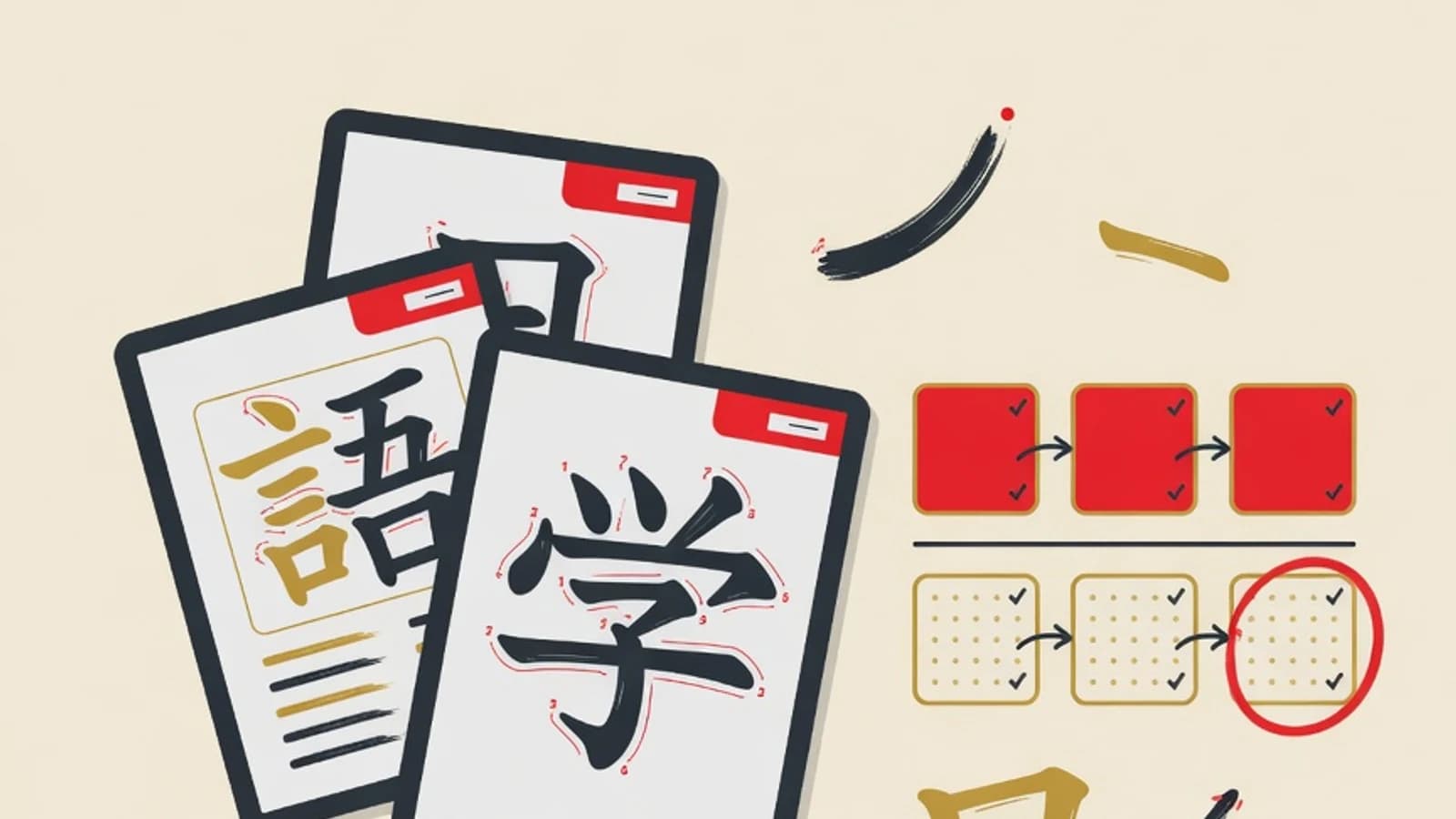
How to memorize N5 kanji for beginners works best through three moves: group the roughly one hundred N5 kanji by theme, break each character into components and build a short mnemonic story, and review with spaced repetition before memory fades. Prioritize recognizing meaning and reading, because the JLPT N5 tests reading ability.
- A finite target: about one hundred N5-level kanji
- A beginner's main goal is recognizing meaning and reading
- Spaced repetition holds back the forgetting that arrives quickly
- A list of the roughly one hundred N5 kanji, already grouped by theme
- A physical flashcard set or a spaced-repetition app to schedule reviews
- Notes on each kanji's components and radicals with your own mnemonic stories
- Sample N5 vocabulary and short sentences where each kanji appears
Key Numbers for N5 Kanji
Why the N5 Kanji Target Has a Clear Boundary
Memorizing N5 kanji feels far lighter once you see that the count is finite. Analysis of exam materials places the N5 level at around one hundred basic kanji, even though the JLPT organizers publish no official list. Because the boundary is measurable, your memorization target is clear from day one. The official N5 description from the organizers points to the ability to read and understand expressions and sentences written in hiragana, katakana, and basic kanji. Notice the word read. Every JLPT question is multiple choice, so at N5 you are asked to recognize a kanji's meaning and reading, with no section that asks you to write characters by hand. That direction shapes the smartest way to study. For an N5 beginner, the first priority is recognition: seeing a kanji and instantly knowing its meaning and how it is read inside a word. Writing from memory can come later for those who want it, without adding weight in the early stage.
Six Steps to Memorize N5 Kanji So They Stick
This sequence builds your N5 kanji memorization from gathering materials to using them in sentences. Work through it in order, one small batch a day, so your first hundred characters settle in neatly.
- 1
Gather the N5 kanji list and split it by theme
Start with one reference list of roughly one hundred N5-level kanji, then re-sort it into related themes. Groups such as numbers and time, direction and position, people and family, nature and weather, and basic verbs bring characters of similar meaning together in one place. The brain stores connected items more easily than a random list. Themes also hand you a small win each time one group is done, and that keeps a beginner's momentum alive.
Tips- Cap each theme at about ten to fifteen kanji so it never piles up
- Flag high-frequency kanji such as 日, 人, and 中 to learn first
Memorizing all one hundred kanji at once from a single long list leaves memory full and jumbled. - 2
Break each kanji into components and build a mnemonic story
Almost every kanji is made of repeating pieces called components or radicals. The kanji 休, meaning rest, is built from a person component on the left and a tree on the right, so it is easy to picture as a person leaning against a tree to rest. A small story like this ties shape to meaning, and that tie is what makes a character stick for a long time. Build your own version of the story, because an image you invent clings harder than someone else's rote explanation. An online dictionary such as Jisho helps reveal the components inside each kanji.
Tips- The sillier and more vivid the story, the easier it is to recall
- Reuse the same component to build the story for the next kanji
- 3
Lock in the meaning and one main reading first
Many kanji have more than one reading, and that feels heavy at the start. For N5, first lock in the character's meaning together with the single reading that appears most often in basic vocabulary. The kanji 人 is enough to hold through a word like 人 (hito, person) at this stage, while other readings arrive as new words appear. Holding back from chasing every reading at once keeps the load light and speeds up your sense of progress. Extra readings actually stick more easily after you meet them inside real words.
Tips- Note one example word for the reading you choose
- Add a second reading only when new vocabulary calls for it
Forcing all on'yomi and kun'yomi readings at the start tires a beginner quickly. - 4
Set up spaced repetition with cards or an app
Human memory fades fast after study. Hermann Ebbinghaus's classic research shows that much new information can be forgotten within hours to a day if it is not reviewed. Spaced repetition answers this by scheduling reviews at widening intervals, for example one day, three days, one week, then two weeks. An SRS app such as Anki calculates that schedule for you and brings a kanji back just before you would forget it. Physical flashcards can do the same with a tiered-box system. The key to success is daily consistency, even if it is only ten to fifteen minutes.
Tips- Review at the same time each day so it becomes a habit
- Do not pile up missed reviews, simply continue from today
- 5
Test yourself with active recall by covering the answer
Rereading notes feels productive, yet memory strengthens most when you try to summon it back. Practice active recall by covering the meaning and reading, looking at the kanji, then saying the answer from memory before you reveal the key. This works both ways: from kanji to meaning, and from meaning to kanji. Every attempt to recall, even one that misses, deepens the memory trace more than merely seeing the answer. Weave in context guessing too by reading short sentences that contain the kanji.
Tips- Set aside cards you miss often to review at tighter intervals
- Say the reading out loud so the sound memory is trained as well
- 6
Attach the kanji to real N5 vocabulary and sentences
Kanji memorized detached from context evaporate easily. As soon as a character starts to feel familiar, attach it to simple N5 vocabulary and sentences. The kanji 食 comes alive through the word 食べる (taberu, to eat) inside a daily sentence far better than when memorized alone. Reading short N5-level texts makes the kanji recur naturally, and each appearance acts as a free review. This step also prepares you for the reading portion of the exam, where kanji always appear inside full sentences.
Tips- Pick everyday themes such as schedules, family, and weather
- Collect favorite example sentences as a personal practice bank
Split N5 Kanji Into Related Themes
Numbers and Time
Characters such as 一, 二, 三, 日, 月, 年, 時, and 半 appear most often and make a strong opening theme.
Direction and Position
The kanji 上, 下, 左, 右, 中, 前, and 後 have contrasting shapes, so they are easy to remember in pairs.
People and Family
Characters 人, 男, 女, 子, 父, 母, and 友 tie kanji to everyday terms of address.
Nature and Weather
The kanji 山, 川, 水, 火, 木, 空, 雨, and 天 often picture the real object, which makes them mnemonic-friendly.
Basic Verbs
Characters 行, 来, 見, 聞, 食, 飲, 話, and 読 go straight into daily N5 sentences.
Places and Study
The kanji 学, 校, 駅, 店, 国, and 道 attach to place words that appear often in N5 texts.
Recognizing Versus Writing N5 Kanji
| Aspect | Recognizing (reading) | Writing by hand |
|---|---|---|
| Needed for the JLPT N5 | Yes, all questions | Not tested |
| Early memory load | Lighter | Heavier |
| Beginner priority | Primary | Later, if desired |
| Practice form | Flip cards, guess from a sentence | Copying in grid paper |
Writing by hand still helps some people remember shapes. To pass N5, the main target remains recognizing meaning and reading.
“N5 kanji feel far tamer once a beginner stops memorizing dead strokes and starts reading each character as a set of meaningful components. A small story for every component makes the first hundred characters stick for far longer.”
Checklist Before Starting a New Kanji Batch
- Hiragana and katakana can be read fluently without hesitation
- The theme list for today's batch is chosen
- Each kanji's components are identified and given a story
- A review schedule is written or active in an SRS app
- One example word is ready for each kanji
- A realistic daily target, about two to three new kanji
Learning N5 Kanji With Guidance at EduPoint
Some beginners feel calmer with a mentor who checks readings and watches the review schedule. Japanese lessons at EduPoint start from Rp 90,000 per hour, with the final price adjusting to the lesson format, location, and your learning goal. There is a convenient online option as well as in-person lessons for those who prefer face-to-face guidance. To focus on memorizing N5 kanji, a mentor helps choose the kanji list, reviews the mnemonic stories you build, and paces your repetition so it never piles up. Payment accepts bank transfer, Virtual Account, QRIS, e-wallets, cards, and even Alfamart and Indomaret outlets, so it fits your family's habits.
- N5-level kanji number around one hundred characters, so your memorization target is finite and measurable.
- The N5 exam tests reading, so recognizing meaning and reading takes priority over writing by hand.
- Component-based mnemonic stories make characters easier to remember than memorizing loose strokes.
- Spaced repetition holds back forgetting by recalling a kanji right before memory fades.