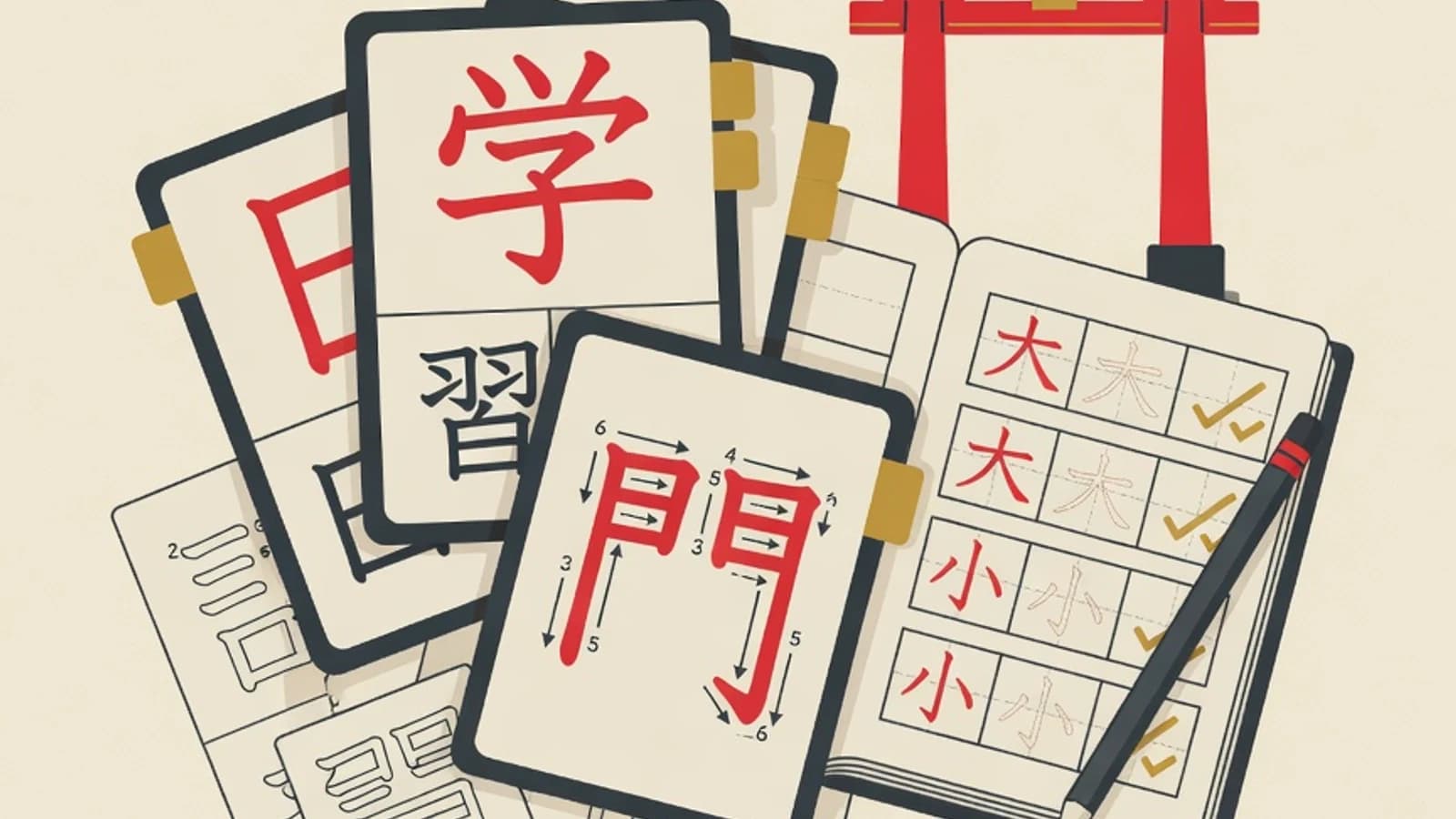
How to learn basic kanji for beginners starts with making sure hiragana and katakana are fluent, then understanding radicals as the pieces that build kanji, learning the on'yomi and kun'yomi readings, practicing stroke order, building everyday kanji vocabulary, using spaced repetition, and finally reading kanji in real sentences. These seven stages usually take six to twelve months with regular practice.
- Radicals come first, since complex kanji are assembled from small pieces that repeat
- Each stage has a measurable target, such as finishing the roughly one hundred JLPT N5 kanji
- It ends in the ability to read everyday kanji inside sentences, well beyond flashcard memory
- A full hiragana and katakana chart as the reading foundation before touching kanji
- Grid practice paper (genkouyoushi) to train stroke order with neat proportions
- Flashcards or a spaced-repetition app to hold readings and meanings in memory
- A fixed study schedule, around five to seven hours spread across the week
The Big Picture of Kanji Worth Knowing Early
Understand First What Kanji Is and How It Works
Kanji is a script in which each character carries meaning, absorbed into Japanese from Chinese characters centuries ago. Together with hiragana and katakana, kanji forms the three writing systems used side by side within a single Japanese sentence. Hiragana writes particles and word endings, katakana writes foreign loanwords, while kanji holds the core meaning of nouns, verbs, and adjectives. One kanji commonly carries more than one reading. The on'yomi reading comes from the Chinese pronunciation and often appears when a kanji pairs with another kanji. The kun'yomi reading is the native Japanese pronunciation and often appears when a kanji stands alone with a hiragana ending. Grasping this pattern early calms beginners who panic at seeing one character with many sounds. The roadmap below lays out the order for learning kanji step by step, so you climb from the simplest pieces toward denser characters.
Seven Stages to Learn Basic Kanji From Scratch
Move through them in order. Each stage rests on the one before it, and each leaves behind one real ability that supports the next.
- 1
Stage 1: Make Hiragana and Katakana Fluent First
Kanji stands on a foundation of kana. Before touching a single kanji character, make sure you read hiragana and katakana fluently without sounding them out. The reason is simple: kanji readings are written in hiragana, and verb or adjective endings attach in hiragana. When kana still stumbles, every kanji drill slows down with it. Spend two to three weeks firming up both kana by reading short words, until your eyes recognize each shape instantly. A solid foundation here makes the whole kanji journey feel far lighter.
Tips- Test fluency by reading a list of random kana words, aiming for no pause to sound them out
- Drill look-alike kana in pairs, such as shi and tsu, so they stop getting mixed up
- 2
Stage 2: Meet Radicals as the Building Pieces
A radical, or bushu, is a small component that repeats to build more complex kanji. A character that looks intimidating is really a string of several radicals you already know. The water radical, the hand radical, and the heart radical, for instance, appear across hundreds of kanji and hint at meaning. Memorizing a hundred complex kanji one by one is exhausting, while recognizing thirty core radicals lets you take apart new characters calmly. Start collecting the radicals that appear most often, then notice how each one contributes meaning to the whole kanji. This habit of decomposing is what separates beginners who advance quickly from those who burn out fast.
Tips- Learn the names and meanings of core radicals first, such as person, tree, and fire
- When you meet a new kanji, get into the habit of breaking it into radicals before memorizing the whole
Memorizing complex kanji without recognizing their radicals leaves each character feeling like random strokes that get confused and forgotten quickly. - 3
Stage 3: Understand On'yomi and Kun'yomi Readings
One kanji commonly carries more than one reading, and the usage pattern can be learned. The on'yomi reading is absorbed from the Chinese pronunciation and generally appears when a kanji joins another kanji to form a compound word. The kun'yomi reading is the native Japanese pronunciation and generally appears when a kanji stands alone followed by a hiragana ending. Take the kanji for mountain, read yama when alone, then san when it joins a name such as Fujisan. Instead of memorizing each reading in isolation, learn kanji through whole words that appear often, so the correct reading sticks together with its context. This ties sound, shape, and meaning into a single memory.
Tips- Memorize kanji through living example words, away from a standalone table of readings
- Mark the most frequent reading first, and leave rare readings for later
- 4
Stage 4: Practice Stroke Order by Writing by Hand
Every kanji is written following a fixed stroke order, generally top to bottom and left to right. Following the correct order keeps a kanji balanced, keeps handwriting legible, and builds muscle memory so the character becomes easier to recall. Write on grid paper so the proportion of each part stays even. As you write, say the reading and the meaning aloud, so hand, eye, and ear work together. Start with number kanji and simple characters such as one, two, three, person, and tree, then rise gradually. Writing with attention turns a kanji from a foreign picture into a pattern your hand remembers.
Tips- Write each new kanji several times while voicing its reading, avoid copying it silently
- Use a stroke-order animation as your model, then imitate its direction exactly on grid paper
- 5
Stage 5: Build Everyday Kanji Vocabulary
Kanji stick best when learned as part of a useful word. Assemble themed vocabulary close to daily life: numbers, days and time, directions, family, and core verbs. JLPT N5 kanji make an ideal first collection because their content is exactly the words used most often. For characters that resist sticking, weave a small story from their radicals as a memory bridge, such as picturing the water radical and a motion in a related kanji. A story you invent yourself sticks far better than an explanation you merely read. Aim for a reasonable pace of roughly five to ten new kanji a week, so you stay on top of reviews.
Tips- Group kanji by theme so they reinforce each other, such as one group for time and days
- Build a memory bridge from radicals for stubborn kanji, the sillier the more it sticks
- 6
Stage 6: Use Spaced Repetition to Make It Last
Kanji memory fades when rarely revisited. Spaced repetition schedules a review right before you are about to forget, so study time is spent efficiently. An app such as Anki manages this schedule automatically: kanji that are already strong appear less often, kanji that wobble appear more often. Build cards that link the kanji shape to its reading, meaning, and one example word at once. Set aside a short daily session, fifteen to twenty minutes, and keep it from piling up. Small consistency every day outperforms long practice done rarely. This rhythm carries kanji from fleeting memory into memory that lasts.
Tips- Study a little every day, far more effective than cramming hundreds of cards in one sitting
- Slip an example word onto each card, so the kanji is recalled alongside its real usage
Letting overdue card reviews pile up over several days makes a session feel heavy and often makes beginners quit midway. - 7
Stage 7: Read Kanji in Real Sentence Context
Kanji live inside sentences, so the final stage takes you out of flashcards toward genuine reading. Start with graded material for beginners: easy readers, manga with furigana, or simple signage. Furigana, the small hiragana above a kanji, acts as a training wheel that helps you guess the reading while still seeing the kanji shape. As you read, recognize the kanji you already own, guess the fuzzy ones from radicals and context, then check the truly new ones. Regular reading sharpens your recognition speed while enriching vocabulary naturally. This is where all the earlier stages merge into genuine reading ability.
Tips- Choose material slightly above your level, challenging enough without pushing you to give up
- Mark new kanji as you read, then move them into your review cards to reinforce them
Time Estimate for Each Stage for Beginners
Kana & Radical Foundation
Firming up hiragana katakana, then recognizing core radicals and the on'yomi and kun'yomi reading patterns. Roughly one to two months of regular practice.
Stroke Order & Vocabulary
Practicing stroke order through handwriting while building everyday JLPT N5 basic kanji. Around three to five months.
Repetition & Reading
Maintaining memory with spaced repetition, then reading kanji in real sentences. Roughly two to five months running while adding kanji.
On'yomi and Kun'yomi, Two Reading Paths for Kanji
| Reading | When It Generally Appears | Quick Example |
|---|---|---|
| On'yomi (Chinese-derived) | When a kanji joins another kanji to form a compound word | The mountain kanji is read san in the name Fujisan |
| Kun'yomi (native Japanese) | When a kanji stands alone, often followed by a hiragana ending | The mountain kanji is read yama when it stands alone |
| Special name readings | In personal names and place names with their own readings | Learned along the way as you meet real names |
This pattern is a general guide and a soft rule. The safest way is still to learn the correct reading through frequently used example words.
“Beginners who read kanji fluently the fastest are the ones who keep breaking characters into radicals and learn through whole words. Memorizing strokes without understanding the pieces makes every new kanji feel heavy from the start.”
A Checklist for a Solid Base in Kanji
- You read hiragana and katakana fluently without sounding them out
- You recognize about thirty core radicals and can decompose kanji with their help
- You understand the difference between on'yomi and kun'yomi and when each appears
- You write number kanji and basic kanji with the correct stroke order
- You have grasped about one hundred JLPT N5 kanji through everyday words
- You read short kanji sentences comfortably with the help of furigana
How Much Does Learning Japanese Cost at EduPoint
Guided learning stays affordable. Japanese lessons at EduPoint start from Rp 90,000 per hour, with the final price adjusting to your lesson format, location, and learning goal. There are online lessons for convenience and face-to-face lessons for those who prefer direct, in-person guidance. For beginners who want to follow the kanji roadmap above with guidance, the mentor adjusts the emphasis to your starting point. If kana still wobbles, the mentor firms it up first. If the foundation is already there, the mentor steers practice toward radicals, stroke order, and JLPT N5 kanji vocabulary, so your study time is spent on the part you need most.
- Learning kanji from scratch runs from fluent kana, radicals, on'yomi and kun'yomi readings, stroke order, vocabulary, spaced repetition, then contextual reading
- Radicals are the first key, since breaking complex kanji into small pieces makes them far easier to remember
- One kanji carries several readings, and the safest way to master them is through frequently used example words
- Handwriting with correct stroke order builds muscle memory, while spaced repetition keeps that memory durable
- The roughly one hundred JLPT N5 kanji make a measurable first target toward everyday reading ability