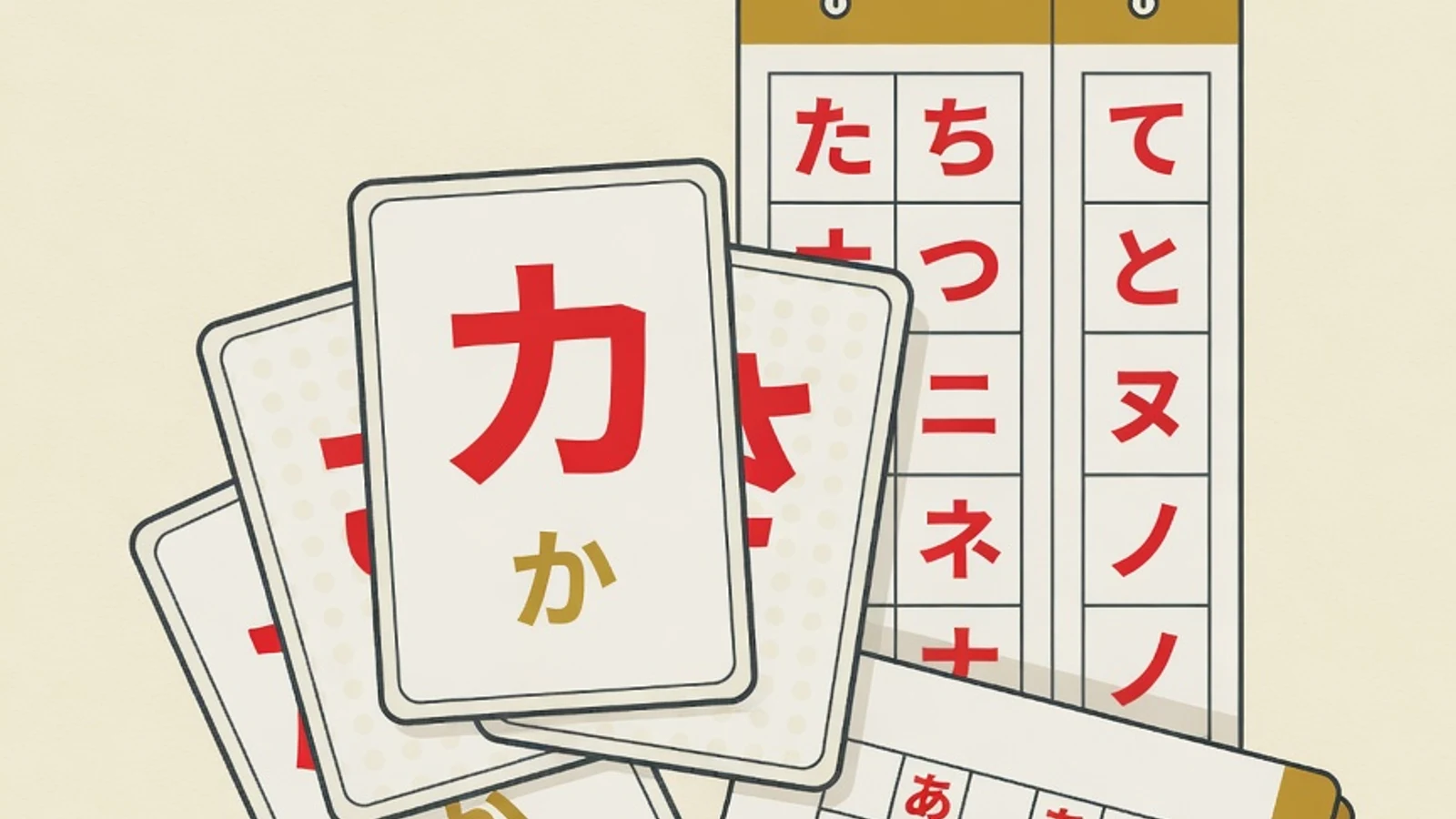
How to memorize hiragana and katakana fast starts by splitting the 46 characters into ten sound rows (a-i-u-e-o), attaching each shape to a picture mnemonic, then writing it repeatedly with correct stroke order. A daily 20-minute habit over two to four weeks locks both scripts into memory.
- Hiragana for native Japanese words, katakana for foreign loanwords
- Picture mnemonics speed up shape recall
- Correct stroke order makes writing and reading handwriting easier
- Grid notebook (genkouyoushi) or graph paper
- Printed flashcards or an app such as Anki
- A full hiragana and katakana chart of all 46 characters
Key numbers to know
Why hiragana and katakana come first
Hiragana and katakana are two Japanese syllabic scripts where each symbol represents one syllable, for example か reads "ka" and き reads "ki". Hiragana covers native Japanese words, grammatical endings, and sentence particles. Katakana spells loanwords from foreign languages, foreign names, and sound effects. They share the exact same sounds and differ only in shape, so once you know the sounds of one row, the matching row in the other script only needs its shape remembered. Mastering kana early opens the door to everything that follows. Popular textbooks such as Genki and Minna no Nihongo write vocabulary in pure kana in their opening chapters, and the JLPT N5 exam requires fluent reading of both hiragana and katakana. Romaji, the writing of Japanese sounds in Latin letters, only helps in the first few days. Learners who lean on romaji for too long tend to read native text slowly and mispronounce long vowels.
Five steps to memorize hiragana and katakana fast
Follow this order over two to four weeks. Each step builds on the previous one so your kana sticks firmly and the characters stop blending together.
- 1
Split the 46 characters into ten sound rows
Start by arranging hiragana into the gojuuon chart, ten rows based on consonants (none, k, s, t, n, h, m, y, r, w) crossed with five vowels (a, i, u, e, o). The first row is pure vowels: あ a, い i, う u, え e, お o. Master one row per study session and leave the rest for later. The brain stores small patterned chunks far better than 46 random symbols. After a row sticks, say each sound aloud while pointing at the character so the audio and visual memories connect.
Tips- Tape a kana chart somewhere you look often, such as the fridge door
- Finish two hiragana rows per day so half the chart is done in five days
- 2
Attach a picture mnemonic to each character
Turn every abstract shape into an easy-to-recall image. For instance き (ki) looks like a key, さ (sa) like a person standing with a stick, and め (me) hints at an eye. This technique, used by popular sources like Tofugu, speeds up shape recognition because the brain holds visual images more strongly than meaningless strokes. Katakana shapes are more angular and sharp, for example カ (ka) which looks like a stiff version of か. Build a short story linking the image to the sound. The funnier or stranger the story, the more it sticks.
Tips- Use your own mnemonic when the standard one does not click
- For confusing pairs such as さ sa and ち chi, make a mnemonic that deliberately separates them
Avoid memorizing through romaji alone without looking at the actual shapes. You will struggle to read native Japanese text later. - 3
Practice stroke order by hand
Writing characters by hand strengthens muscle memory and helps the brain distinguish similar shapes. Write each character in a grid notebook (genkouyoushi) following standard stroke order, generally left to right and top to bottom. Correct order keeps your handwriting legible and makes recognizing characters that others write easier. Do ten repetitions per character while saying its sound. Memory research shows writing engages neural pathways different from reading alone, so the memory trace runs deeper.
Tips- Find stroke order diagrams on The Japan Foundation site or an official kana app
- Write simple words like すし (sushi) so characters appear in context right away
- 4
Use flashcards with spaced repetition
Once a row is recognized, move it into a spaced repetition flashcard system such as Anki or a similar app. This method shows a character you are about to forget just before it slips away, following the forgetting curve described by Hermann Ebbinghaus. The card front holds the character, the back its sound. Review for five to ten minutes daily. The system schedules hard characters more often and fluent ones less often, keeping your study time efficient.
Tips- Shuffle the card order so what sticks is each character itself, independent of its place in the chart
- Keep separate hiragana and katakana decks in the first week to avoid mixing them
Do not pile on hundreds of new cards at once. Add at most one new row per day so daily reviews stay light. - 5
Read pure kana text and add derived sounds
The key to keeping memory alive is using it to read. Begin with short kana words and sentences, such as a Japanese restaurant menu, signage, or chapter one of a textbook. As reading flows, add derived sounds: dakuten that turns か ka into が ga, handakuten that turns は ha into ぱ pa, and small combinations (youon) like きゃ kya. These derived sounds are just variations of base characters you already know, so learning them feels light. Finish by reading the katakana on product packaging and advertisements, which carry plenty of loanwords.
Tips- Read aloud so your ears get used to telling long and short sounds apart
- Note new words you meet so vocabulary grows alongside kana recall
Hiragana vs katakana: when to use which
| Aspect | Hiragana | Katakana |
|---|---|---|
| Shape | Rounded and flowing | Angular and sharp |
| Main use | Native words, particles, endings | Foreign loanwords, foreign names |
| Example word | ねこ (neko, cat) | テレビ (terebi, television) |
| How often it appears | Very frequent in general text | Common in ads and products |
Both share 46 base characters with identical sounds, so you memorize the sounds once and simply recognize two different shapes.
Three mistakes that slow memorization down
Sticking with romaji
Reading through Latin letters constantly makes the eye reluctant to recognize real kana, and long-vowel pronunciation often goes wrong.
Random memorizing without pattern
Learning characters haphazardly without the a-i-u-e-o rows removes the pattern anchor, so characters keep blending together.
Ignoring stroke order
Writing in random order makes handwriting hard to read and makes recognizing characters written by others harder.
“Learners who write kana by hand from day one usually read far more smoothly after a month than those who only stare at a screen. The hand movement plants character shapes into lasting memory.”
Ready-to-start kana checklist
- Print a full hiragana and katakana chart of all 46 characters
- Prepare a grid notebook and pencil for stroke practice
- Install a flashcard app or make manual flashcards
- Set a fixed schedule of 20 minutes per day
- Tape the kana chart somewhere you see often
Once kana is fluent, what comes next
When hiragana and katakana read automatically, focus shifts to basic vocabulary and kanji in stages. Kanji are characters borrowed from China that carry meaning, and a JLPT N5 learner only needs around one hundred of the most common ones. Learning kanji feels lighter once kana is strong, because their readings are written in the kana you already know (furigana). At this stage, guided lessons help keep practice consistent, correct stroke order, and shape a schedule that fits your goal, whether JLPT preparation, study in Japan, or work through the SSW pathway.
- Split the 46 characters into ten a-i-u-e-o sound rows so recall follows a clear pattern
- Picture mnemonics and handwriting plant character shapes deeper into memory
- Hiragana is for native words, katakana for loanwords, and both share the same sounds
- Spaced repetition flashcards keep hard characters remembered efficiently
- A daily 20-minute habit over two to four weeks locks both scripts into memory