Private Online Lessons
Online German Lessons: One Tutor, One Student, All the Way to C1
Der, die and das make a lot more sense when someone explains them directly to you. In EduPoint's online German lessons, a single tutor works with a single student over video call: umlaut pronunciation gets corrected on the spot, grammar is unpacked step by step, and the curriculum bends toward your goal, whether that is a Goethe-Zertifikat, an Ausbildung placement, or a degree in Germany. Tutors come from 60+ cities across Indonesia, and you set the schedule.
20,000+
tutors
70,000+
students
4.9
rating · 952 reviews
60+
cities
What is What Are Online German Lessons?
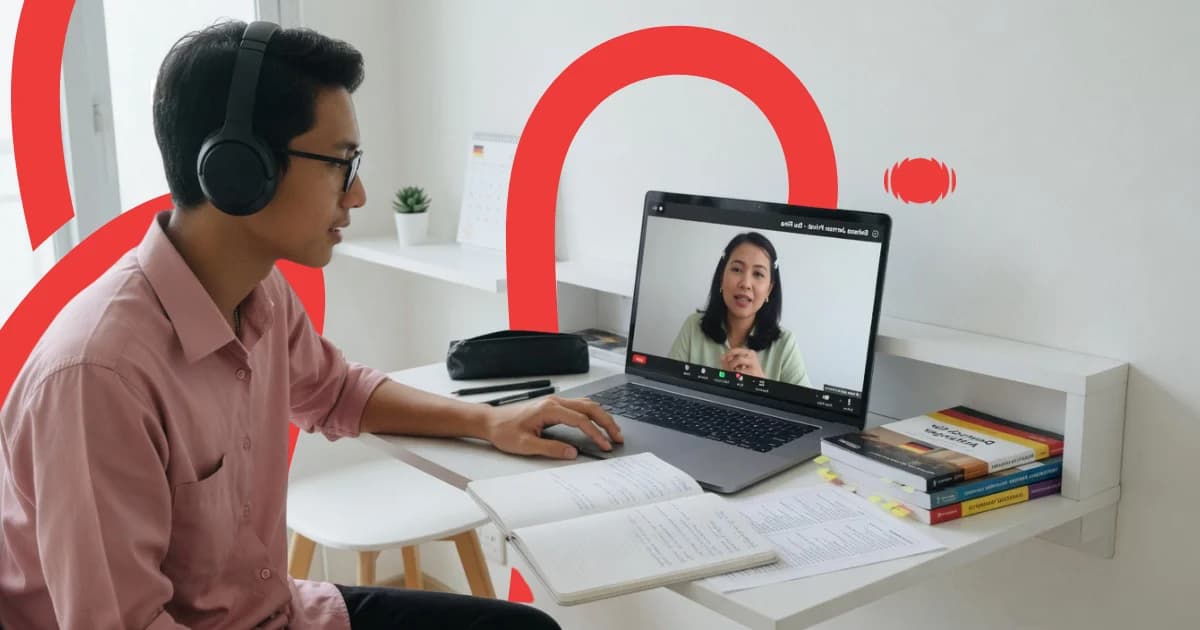
EduPoint's online German lessons run entirely over video call and pair one tutor with one student, covering CEFR levels A1 through C1. Pick a 60-, 90-, or 120-minute session and book it any hour from 6 AM to 11 PM WIB, seven days a week. From there your tutor steers the curriculum toward whatever you are working for: a Goethe-Zertifikat or OSD exam, an Ausbildung application, or university study in Germany.
- A private setup by design, with one tutor teaching one student over interactive video call
- German curriculum mapped to the CEFR framework, from A1 up to C1
- Focused preparation toward Goethe-Zertifikat and OSD exams as your target
- Choose your session length: 60, 90, or 120 minutes
- Flexible daily scheduling between 6 AM and 11 PM WIB
- The learner app keeps everything for later: self-study materials, session recordings, and a running progress report
Services
Session Lengths for Online German Lessons
One student gets one tutor's full attention over video call in every session offered here. The three options differ only in how long they run, so choose based on how long your focus holds up and what you are aiming for.
60-Minute Session
A light rhythm that suits school students and A1 beginners who are still building the habit of studying German.
Rp 126.000/ 60-minute session
Price on the 28-session monthly plan, 60-minute sessions. Fewer meetings, higher price per session.
- One tutor's full attention on one student
- Works well at 2-3 sessions per week
- Pronunciation corrected live during the session
- A material recap after every session
90-Minute Session
The most balanced length for B1-B2: enough room for theory plus conversation practice in a single meeting.
Rp 159.000/ 90-minute session
Price on the 28-session monthly plan, 90-minute sessions. Fewer meetings, higher price per session.
- Theory and speaking practice in one sitting
- A good fit for Goethe-Zertifikat B1-B2 preparation
- Homework review and writing practice included
- Progress logged in the learner app report
120-Minute Session
The intensive option for deadline chasers: a full exam simulation, deep question review, or Ausbildung interview practice from warm-up to debrief.
Rp 204.000/ 120-minute session
Price on the 28-session monthly plan, 120-minute sessions. Fewer meetings, higher price per session.
- Fits a four-module exam simulation in one go
- Ideal in the run-up to an exam date or departure
- In-depth evaluation at the end of each session
- Session recordings replayable in the app
Online and in-person cost the same — the gap between these cards is session length, nothing else.
German Lesson Levels Aligned with the CEFR
Every student starts with a placement assessment, then climbs level by level against measurable targets.
Beginner (A1-A2)
Starting from zeroFor students meeting German for the first time. The focus is speaking from session one, so the fear of making mistakes never gets a chance to settle in.
Subjects:
Pronunciation and the alphabetArticles and nounsEveryday conversationPresent tense and Perfekt
Focus Areas:
- Confidence to speak early
- Your first 1,000 words
- Grammar foundations done right
Intermediate (B1)
The Ausbildung benchmarkThe reference level for most Ausbildung programs and visa paperwork. Training shifts toward independent communication: narrating, arguing a point, and writing letters.
Subjects:
All four grammatical casesNebensatz and conjunctionsFormal letters and emailsIntermediate reading comprehension
Focus Areas:
- Independent everyday communication
- Readiness for the B1 exam format
- Workplace vocabulary
Upper Intermediate (B2)
The professional standardMany German employers, especially in healthcare, ask for B2. Here students practice extended discussions and work through more complex texts.
Subjects:
Discussion and argumentationProfessional and news textsPassiv and complex structuresWriting short reports
Focus Areas:
- Fluency with accuracy
- German for your field of work
- Readiness for the B2 exam format
Advanced (C1)
The gateway to German universitiesThe level German universities commonly require. The material turns academic: reading scholarly texts, writing essays, and giving structured presentations.
Subjects:
Academic GermanKonjunktiv and nominalizationEssays and academic summariesFormal presentations
Focus Areas:
- Readiness for lectures taught in German
- Preparation for C1, TestDaF, or DSH
- Natural, idiomatic style
German Curriculum from A1 to Exam Preparation
Material builds level by level along the CEFR framework, then your tutor tailors it to your destination: a certificate, an Ausbildung placement, or a German university.
The order and weight of topics follow your initial assessment. If you have studied German before, you skip straight to where you actually are, with no forced restart at A1.
Foundations A1-A2 (Grundstufe)
Your first real handshake with German: sounds, basic sentence structure, and everyday conversations you can use immediately.
- Pronouncing umlauts (a-u-o), the Eszett, and the distinctive German R
- The articles der, die, das, plus practical strategies for remembering them
- Conjugating regular and irregular verbs in the present tense
- Introducing yourself, family, numbers, telling time, and shopping
- +2 more
Intermediate B1-B2 (Mittelstufe)
The levels most often written into official requirements: visas, Ausbildung programs, and many job postings ask for proof of B1 or B2.
- All four grammatical cases: Nominativ, Akkusativ, Dativ, Genitiv
- Subordinate clauses (Nebensatz) with the verb pushed to the end
- Separable verbs (trennbare Verben) in real conversation
- Writing formal letters and emails for work and administrative matters
- +2 more
Advanced C1 (Oberstufe)
The bridge into academic and professional German, the level most German universities expect for full degree programs.
- Konjunktiv I and II for reported speech and hypotheticals
- Passive voice and nominalization, the signature moves of academic texts
- Reading scholarly texts and distilling their core arguments
- Delivering long, well-structured presentations and discussions
- +1 more
Exam Preparation and Special Goals
Targeted drills for the official Goethe-Zertifikat and OSD formats, plus the language groundwork for an Ausbildung or study plan.
- Full simulations of all four exam modules: Lesen, Horen, Schreiben, Sprechen
- Timing strategy and question patterns for Goethe-Zertifikat A1 through C1
- Ausbildung vocabulary: nursing, engineering, hospitality, gastronomy
- Mock job interviews in German with prospective employers in mind
- +1 more
Who It Is For
Who These Online German Lessons Are For
Four groups of students we coach most often, each on a different material track.
Future Students in Germany
German universities generally ask for C1-level proof through TestDaF or DSH. Sessions steer toward academic German from level B1 onward.
Recommended:
A staged B2-C1 target90-120 minute sessionsAcademic text and presentation practice
Ausbildung Candidates
Ausbildung programs typically require B1, and nursing tracks often ask for B2. Material zooms in on trade vocabulary and interview practice.
Recommended:
A B1-B2 targetNursing, engineering, and hospitality vocabularyMock interviews conducted in German
School Students and Language Enthusiasts
Starting from zero for German class at school, an exchange program, or a second foreign language you want to take seriously.
Recommended:
Start at A160-minute sessions, 2-3 times a weekLight conversation practice every session
Professionals and Relocating Families
For a work posting, joining a spouse, or an au pair year. The focus is practical conversation: bureaucracy, the doctor, your children's school, and the neighbors.
Recommended:
Practical everyday conversationEvening slots, 7-11 PM WIBMaterial built from your real situations
Why Us
Why Take Online German Lessons with EduPoint
A language with grammar as demanding as German deserves a dedicated guide, and our way of guiding looks nothing like a crowded classroom.
One Tutor, One Student, Zero Queueing to Ask
In a group class, a question about Dativ waits for its turn. In a private session, every point of confusion gets answered the moment it appears, and the tutor stays on it until it clicks.
A CEFR Curriculum with a Real Destination
You study from A1 to C1 along a clear map. Your tutor charts the route to your specific goal: a Goethe-Zertifikat, OSD, an Ausbildung requirement, or readiness for a German lecture hall.
A Schedule That Follows Your Life
The schedule stays open every day from 6 AM until 11 PM WIB, wide enough for working professionals to study at night and students to grab an afternoon slot, with rescheduling just a WhatsApp message away.
Free Tutor Replacement Guarantee
We handle the matching, pairing you with a German tutor suited to your needs. Should the connection not click after all, a replacement tutor is arranged at no extra charge.
Learning Continues After the Call Ends
Once the call ends, the EduPoint learner app keeps hold of self-study materials, recorded sessions, and your progress report, so article drills and vocabulary stay open for review any time between sessions.
Online German Lesson Fees
Every rate is calculated per hour and matches the figure you will see on the registration form, no hidden markup. Packages are flexible too, spanning anywhere from 4 to 28 sessions a month at 60, 90, or 120 minutes each.
Starting from
Rp 102.000 / hour
Final price is set at registration.
This is the lowest hourly rate, derived from the 28-session monthly plan at 120 minutes per session. Per-session prices (60, 90, or 120 minutes) appear in the format options above.
Register & Get a QuoteFlexible payment — QRIS, Virtual Account, Alfamart, Indomaret, transfer & e-wallets.
Every common payment channel works here, from card and bank transfer to QRIS, e-wallet, Virtual Account, or a cash payment at an Alfamart or Indomaret counter. And if the first tutor match is not quite right, a free replacement guarantee kicks in.
Private Online Lessons vs Group Courses vs Apps
Each way of learning German has its own strengths. This table lays them out honestly so you can choose well.
| Feature | EduPoint Private Tutoring | Online Group Course | Self-Study App |
|---|---|---|---|
| Live private sessions, one tutor per student | |||
| Pronunciation and grammar corrected the moment you speak | |||
| Study materials open any time through an app | |||
| Lively group conversation practice with many classmates | - | ||
| Fully self-paced with no schedule commitment | - |
Where Online German Lessons Are Available
Online Tutoring
Online WorldwideBecause everything happens over video call, EduPoint's online German lessons work from any city. With tutors based in 60+ cities, finding a slot that matches your schedule gets a lot easier.
- Interactive video call sessions with a digital whiteboard
- Daily scheduling from 6 AM to 11 PM WIB
- Session recordings stored in the learner app
- Tutors based in 60+ cities across Indonesia
Student Achievements
Student Journeys in EduPoint German Lessons
Three stories with three different starting lines: from zero, from A2, and from B1. Every student's pace depends on study hours and consistency.
Success
From Zero to B1 for a Nursing Ausbildung
Nadia, 21
Before
A0
After
B1
3 CEFR levels
14 months
“In the beginning I kept mixing up der, die and das. My tutor built a color system for the articles, and slowly they started sticking on their own. I am now preparing my Ausbildung paperwork.”
Success
Chasing C1 for an Engineering Degree in Germany
Raka, 18
Before
B1
After
C1
2 CEFR levels
16 months
“We used the 120-minute sessions to dissect academic texts and rehearse presentations. Nebensatz used to give me headaches; now it is what I lean on when I write essays.”
Success
Interviewing with Confidence for a Job in Munich
Sinta, 27
Before
A2
After
B2
2 CEFR levels
10 months
“I have an office job, so all my sessions ran at 8 PM WIB. My tutor put me through German-language mock interviews again and again until the answers came out without long pauses.”
FAQ
Online German Lessons: Questions and Answers
The questions parents and students ask most often before signing up.
Yes, genuinely private. Every video call seats exactly one tutor across from exactly one student, keeping the tutor's attention undivided so pronunciation and grammar slips get corrected the instant you speak. Session length is your choice: 60, 90, or 120 minutes.
You start at A1, the most basic level in the CEFR framework. The first session usually covers an assessment and a study plan. For beginners, 2-3 sessions a week at 60 minutes each tends to be the most comfortable rhythm.
Yes, and it is one of our most common requests. Tutors drill the four exam modules, Lesen, Horen, Schreiben, and Sprechen, complete with question simulations and timing strategy. Passing still depends on each student's readiness, so we treat the exam as a target we prepare for together, with progress tracked in your report.
As a rough guide, the CEFR framework estimates hundreds of cumulative study hours to reach B1, so many students get there in 12 to 18 months with 2-3 sessions a week plus self-study. Everyone moves at a different pace, and your tutor will build a realistic estimate from your initial assessment.
You share your schedule and goals in a short consultation, for instance Ausbildung preparation or a B1 exam. Our team then finds the tutor who fits best, and sessions begin. If the teaching style feels off, the free tutor replacement guarantee applies.
Guides & Tips
Supporting articles to help you decide and maximize learning outcomes.
How to Learn German from Scratch for Beginners to Basic Conversation
Seven ordered steps take you from recognising umlaut sounds to confidently building and speaking everyday sentences, complete with taming der die das articles and the verb-second word order.
Preparing for the Goethe-Zertifikat A1: A Complete Map of Start Deutsch 1
Four modules, one 60-point threshold. This guide breaks down the Goethe A1 exam structure and lays out a preparation path a complete beginner can follow.
Other Online Language Programs
Weighing another foreign language, or adding a second one? These three programs also run privately, one tutor with one student.
Start Your Online German Lessons This Week
Tell us your target: zero to C1, a Goethe-Zertifikat, an Ausbildung placement, or a degree in Germany. We find the tutor who fits, and you get straight to learning.
One tutor, one student, sessions 6 AM to 11 PM WIBFree tutor replacement guarantee if the match feels offMaterials, recordings, and reports in the learner app