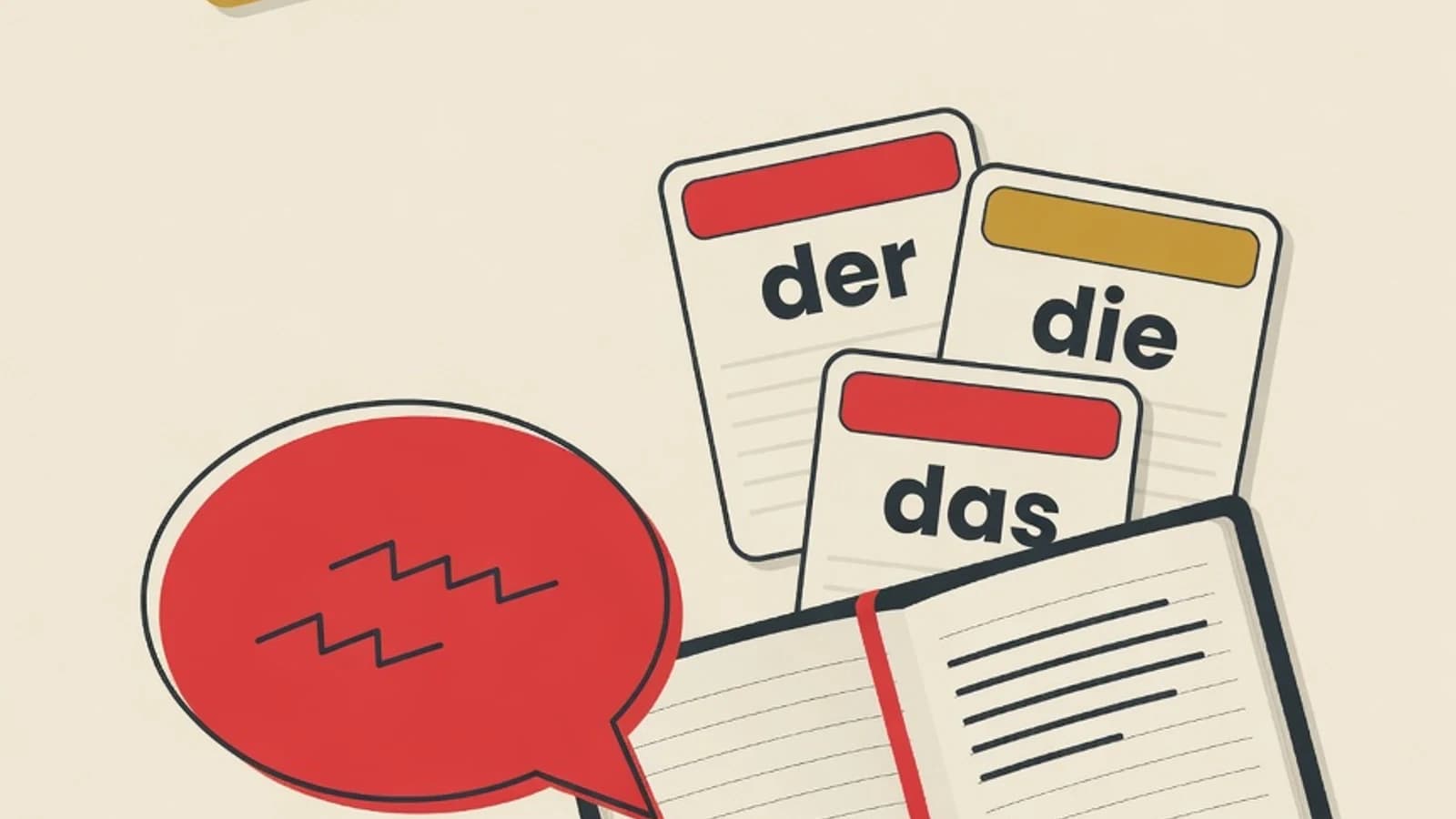
Learning German from scratch begins with mastering the alphabet and the three umlaut sounds, then memorising vocabulary together with its article der, die, or das, and using it right away for everyday sentences like greetings and introductions. Steady practice over eight to twelve weeks carries you from recognising letters to holding a basic conversation at roughly A1 level.
- The German alphabet uses the familiar Latin letters plus three umlauts and one eszett
- Every noun is learned together with its article from the very start to avoid piling up memory work
- Everyday sentences become practice material once you grasp the verb-second pattern
- A full German alphabet chart including the three umlauts a-umlaut, o-umlaut, u-umlaut, and the letter eszett
- A colour-coded notebook to separate nouns by their article der, die, and das
- A list of everyday sentences with native-speaker audio to imitate pronunciation
Reassuring numbers before you begin
Why German feels familiar from the first page
German is written with the same Latin letters as English and Indonesian, so you do not need to learn a new writing system from scratch. The only additions are four special characters: the three umlauts a-umlaut, o-umlaut, u-umlaut, and the letter eszett, which sounds like a sharp s. Many German words are also close cousins of English words you may already know, such as Haus for house, Wasser for water, and Buch for book, because both languages come from the Germanic family. That resemblance gives you a reassuring head start. What sets German apart rests on three distinctive features: every noun carries a gender marked by der, die, or das, the main verb usually sits in the second position of a sentence, and some words change form according to their role (case). These three traits sound complicated at first, yet each follows a regular pattern that can be trained gradually. The sound and vocabulary foundation you build first is exactly what makes the grammar rules feel sensible, because you already have words to arrange.
Seven steps to learn German from scratch to basic conversation
Follow this order over eight to twelve weeks toward A1-level ability. The first three steps build sounds and vocabulary, and the next four move that material into your ears and mouth for conversation.
- 1
Master the alphabet sounds and four special German characters
Start by saying the German alphabet out loud, because several letters sound different from English habits. The letter w is read like a v, the letter v often sounds like f, the letter z sounds like ts, and the combination ei is read as eye while ie is a long ee. Once the basic alphabet feels familiar, meet the four extra characters: a-umlaut, which is close to the e in bed, o-umlaut and u-umlaut, which are pronounced with rounded lips, and eszett, read as a sharp s as in Straße. Say each sound while pointing at its shape so that sound memory and visual memory link up. Getting the sounds right from the start spares you pronunciation habits that are hard to correct later.
Tips- Tape the alphabet and umlaut chart near your desk so you see it often without trying
- Record yourself saying each letter, then compare it with native-speaker audio
- 2
Learn every noun together with its article der, die, das
This is the single most important habit that separates smooth beginners from stumbling ones. In German every noun has a gender: der for masculine, die for feminine, das for neuter. Never memorise a bare noun. Learn der Tisch (table), die Lampe (lamp), das Buch (book) as one complete package from the very first second. Support your memory with colour, for example blue for der, red for die, green for das, then write new vocabulary using that colour in your notes. There are a few patterns that help you guess gender, such as nouns ending in -ung and -heit usually being die, but remembering the article together with the word is far more reliable than guessing it afterwards.
Tips- Colour-code your notes: one colour for each article der, die, and das
- When you add a new word to your flashcards, write its article on the front alongside the word
Avoid memorising nouns without their article, because chasing the gender later is far heavier work. A wrong gender makes the word changes in a sentence go astray too. - 3
Gather themed everyday vocabulary from around you
Beginner conversation grows from words you actually use every day. Arrange vocabulary in themed groups: family (die Familie, der Vater, die Mutter), food (das Brot, das Wasser, der Kaffee), numbers one to twenty, days, and household objects. Aim for about fifteen new words per session, always complete with their article, and review them with flashcards so they move into long-term memory. Use words that resemble English to speed up the early stretch, then flag the truly different ones for extra practice. Themed vocabulary gives you material for sentences quickly, because words within one theme often appear together in real conversation.
Tips- Stick small paper labels with the German name on the furniture in your home
- Group vocabulary by theme so it is easy to recall when building simple sentences
- 4
Build your first sentences with the verb-second pattern
German has one arrangement rule that helps beginners enormously: in a normal statement, the main verb always sits in the second position. Ich trinke Kaffee means I drink coffee, with trinke as the verb in second position. Even when a sentence begins with a time expression, the verb stays in second position: Heute trinke ich Kaffee (today I drink coffee), so the subject ich moves behind the verb. Learn the two most frequently used verbs as well, sein (to be) and haben (to have), with their forms for ich, du, and er/sie. With this second-position pattern, you can build many simple sentences just by swapping the subject, verb, and object.
Tips- Practise by changing just one part of a sentence, such as swapping the object Kaffee for Wasser
- Master the forms of sein and haben first, since they appear in nearly every conversation
- 5
Memorise whole everyday conversation phrases
Conversation flows faster through whole phrases than through loose words memorised one by one. Start with greetings Hallo and Guten Morgen (good morning), the thanks Danke, and the polite Bitte. Continue with the introduction Ich heiße ... (my name is ...) and the opener Wie geht es dir? (how are you?). Add functional phrases that come up often when ordering or shopping, such as Ich möchte einen Kaffee, bitte (I would like a coffee). Say each phrase until it feels automatic, then swap the part that can hold another word, such as the name of a drink or your own name. This way one phrase pattern grows into many different sentences without memorising them all from zero.
Tips- Draw up a list of ten everyday phrases and review them while commuting or waiting in line
- Picture a real setting such as ordering at a cafe while saying the phrase out loud
- 6
Get to know the basics of case and word changes
German changes the form of articles and some words according to their role in a sentence, which is called case. For basic conversation, it is enough to recognise the two most frequent: nominative for the subject and accusative for the object. The change is most visible in the masculine gender, for example der Mann (nominative) becoming den Mann when it is the object: Ich sehe den Mann (I see the man). Feminine and neuter tend to stay the same: die Frau and das Kind do not change from subject to object. You do not need to memorise the whole case table at once at the beginner stage. Recognise the pattern from sentences you hear often, then let the full rules follow gradually once basic conversation flows.
Tips- Focus first on der turning into den, since that is the change you will see most
- Do not delay speaking to wait until you understand every case, learn it while practising sentences
Delaying all speaking practice until you have memorised the full case table often makes beginners quit halfway. Understand case little by little through real sentences. - 7
Practise speaking with a real conversation partner
Reading and memorising give you supplies, while fluency is born from two-way speaking. Look for chances to speak German to other people, whether a classmate, a study community, a language exchange partner, or a tutor. Practising with a partner gets you used to responding spontaneously, hearing umlaut pronunciation corrections directly, and closing the gap between understanding in your head and being able to say it. Begin with simple roleplay situations such as introducing yourself, ordering food, or asking the way to the station. Mistakes at this stage are useful, because each correction sharpens the right habit before it hardens into a wrong one. Regular speaking sessions speed up the shift from slowly assembled sentences into flowing responses.
Tips- Record your speaking practice and listen back to mark the sounds that need work
- Set aside five minutes each session purely for speaking without reading any text
The three German articles and how to memorise them calmly
| Article | Gender | Example with meaning | Beginner hint |
|---|---|---|---|
| der | Masculine | der Tisch (table), der Mann (man) | Colour-code it; often becomes den when it is the object |
| die | Feminine | die Lampe (lamp), die Frau (woman) | Words ending in -ung and -heit are usually die |
| das | Neuter | das Buch (book), das Kind (child) | Many small words and -chen endings take das |
Memorising the article together with the word from the start is far more reliable than guessing gender later, because the word changes in a sentence depend on having the right article.
Five first conversation phrases you will use most
Greeting: Hallo and Guten Tag
Hallo is used casually any time, while Guten Tag (good day) sounds more polite when meeting someone new or entering a shop.
Asking how someone is: Wie geht es dir?
It means how are you. The usual reply is Gut, danke (fine, thanks), so this one exchange already forms a short, complete conversation.
Introducing yourself: Ich heiße ...
Read as ikh hai-se to state your name. This pattern lets you swap in the name part, so it works across many different introductions.
Asking for something: Ich möchte ..., bitte
It means I would like ..., please. Very handy when ordering food or shopping; just fill in the name of the thing you want.
“Beginners who memorise nouns together with their article der, die, or das from the first session are usually far smoother at building sentences, because half the grammar work is already settled in their head. Delaying the article piles up a burden that is heavy to repay later.”
Your checklist to start learning German today
- Print or save a German alphabet chart with the three umlauts and eszett
- Prepare a notebook and three colours to separate the articles der, die, and das
- Gather native-speaker audio for the letter sounds, umlauts, and basic phrases
- Set a fixed schedule of 20 to 30 minutes of study every day
- Draw up a list of ten everyday phrases you want to master first
Once basic conversation flows, where does learning head next
Once the sounds feel comfortable, basic vocabulary is gathered, and everyday phrases flow, the focus shifts to widening conversation themes and tidying up grammar. This stage carries you from simple sentences toward describing your routine, expressing what you want, and understanding longer dialogues, the hallmarks of A2 and B1 in the CEFR framework. For those aiming at university, an Ausbildung programme, or working in a German-speaking country, the next direction is preparing for an official certificate such as the Goethe-Zertifikat, which spans levels A1 to C2. At this point guided support helps a great deal. A tutor keeps practice consistent, corrects umlaut pronunciation and verb placement before mistakes become habits, and lays out a learning path that fits your goal, whether for travel, an academic requirement, or a career move. Private one teacher one student lessons give you room to practise speaking as much as you like at a pace that follows your own speed, so the beginner stage is cleared neatly on the way to the certificate you are aiming for.
- The German alphabet uses familiar Latin letters plus three umlauts and one eszett
- Memorise every noun together with its article der, die, or das from the first session
- Build statement sentences with the main verb in the second position
- Memorise whole everyday phrases, then expand them by swapping their contents
- Get to know case basics little by little while keeping up speaking practice
Common questions about learning German from scratch
With steady practice of around 20 to 30 minutes a day, most beginners start building and speaking simple everyday sentences within eight to twelve weeks, roughly early A1 level. Everyone moves at a different pace, so this figure is an estimate and depends heavily on consistency and how many chances you get to speak.
German uses the familiar Latin alphabet and much of its vocabulary is related to English, so the early steps feel approachable. The parts that take longer are usually the der, die, das articles and the case patterns, but both follow regular rules you can train gradually. That is exactly where a tutor's guidance helps.
Der, die, and das mark the gender of German nouns: masculine, feminine, and neuter. They matter because they drive how words change inside a sentence. The most reliable approach is to memorise every noun together with its article from the start, for example das Buch for book, keeping the article attached to the word.
Speaking is best started early, alongside learning the sounds and vocabulary. Delaying speaking practice until you have memorised the full case table often makes beginners quit halfway. Get to know grammar rules little by little through real sentences, while continuing to practise pronouncing everyday phrases.
Start with the greetings Hallo and Guten Tag, the thanks Danke, the how-are-you Wie geht es dir?, the introduction pattern Ich heiße ..., and the functional Ich möchte ..., bitte for ordering something. These whole phrases are quick to use and can be expanded by swapping the words inside them.
A1 is the earliest level in the CEFR framework, marking basic conversational ability such as introducing yourself and asking simple questions. The Goethe-Zertifikat is the official German proficiency certificate from the Goethe-Institut, spanning levels A1 to C2, often used as a requirement for university, an Ausbildung, or work in a German-speaking country.
Guided lessons keep practice consistent, correct umlaut pronunciation and verb placement from the start, and get you used to two-way speaking. A tutor also arranges a schedule to fit your goal, from travel to Goethe-Zertifikat preparation, so the beginner stage is cleared neatly and with direction.