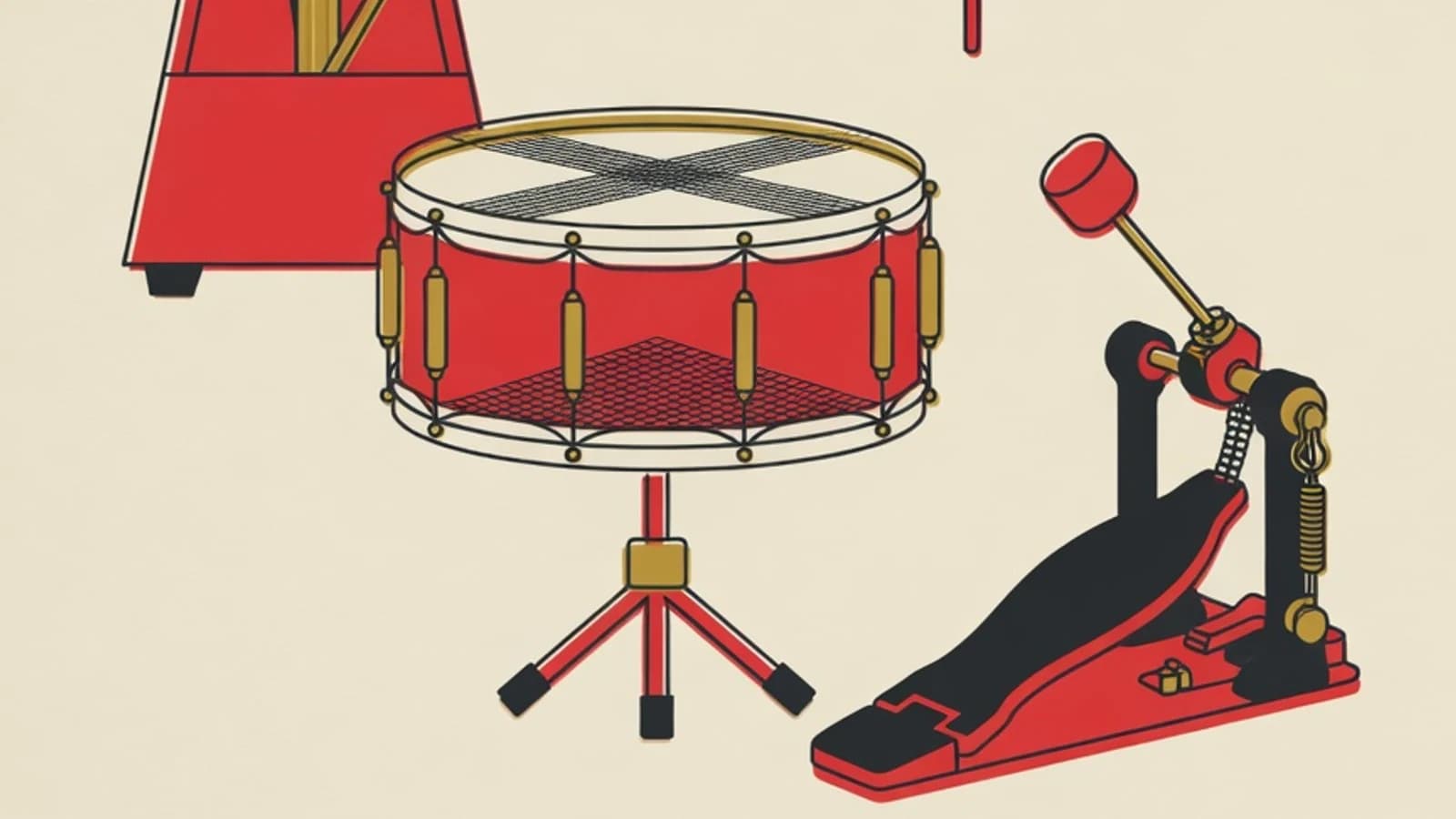
The basic drum beat for beginners is built by stacking three layers in order: a hi-hat running evenly on eighth notes, the snare on beats two and four, then the bass drum on beats one and three. Start slow with a metronome, master one groove until it is steady, then raise the tempo gradually.
- The first groove is built from hi-hat, snare, and bass drum practised one at a time
- A slow metronome at 60 to 70 BPM becomes your steadiness guide from the start
- Steadiness comes before speed
- A drum set, electronic kit, or practice pad plus a pillow to simulate the kick
- A pair of 5A drum sticks
- A metronome app on your phone
The Numbers That Guide Basic Drum Beat Practice
What a Groove Is and the Anatomy of the Basic Drum Beat
A groove is a repeating drum pattern that runs through a song and becomes the pulse that makes listeners tap their feet. The basic drum beat for beginners, often called the eight beat or rock beat, is built from three sounds that each have a distinct job. The hi-hat acts as the timekeeper. Played with the right hand, it strikes evenly on eighth notes, counted one-and-two-and-three-and-four-and. The snare adds an accent on beats two and four, and that firm sound is what drummers call the backbeat. The bass drum, pressed with the right foot, fills beats one and three so a low foundation sits underneath the pattern. When all three layers run together at the same tempo, a tidy beginner drum groove takes shape. Understanding each sound's role makes stacking them clear, so practice feels purposeful from the very first minute.
6 Steps to Build the Basic Drum Beat for Beginners
This order stacks one layer at a time, giving your brain and hands room to absorb the pattern before the load grows. Work each step until it feels light, then move on.
- 1
Turn on the metronome and count in four four
Set the metronome to 60 BPM and listen until your body settles into it. Count out loud: one, two, three, four, over and over. While counting, tap your thigh with every click so the feel of the bar enters your body first. Steady basic drum beat practice always begins with the ability to feel a level pulse. Spend two to three minutes on this before touching a stick, because the counting foundation decides how tidy the groove sounds later.
Tips- Count out loud, never silently in your head
- If the clicks feel fast, drop to 55 BPM without hesitation
- 2
Play the hi-hat on eighth notes
Hold the sticks in a matched grip, then strike the closed hi-hat following one-and-two-and-three-and-four-and. Every metronome click gets two evenly spaced hi-hat strikes. Focus on evenness: each strike should carry a similar volume. This hi-hat layer is the timekeeper for the whole beginner drum groove, so its quality shapes the overall feel. Play it for a full minute without stopping so your right hand finds its own flow.
Tips- Keep the stick height consistent
- Shoulder and arm relaxed, the motion mainly from the wrist
- 3
Add the snare on beats two and four
With the hi-hat still running, bring in the snare with your left hand exactly on beats two and four. This is the spot that often feels awkward because two hands work different patterns. Slow the tempo if needed, say to 50 BPM, and say two and four out loud to help placement. A snare that lands right on the backbeat gives the basic drum beat for beginners its firm character. Repeat until the hi-hat and snare sound as one, joined into a single rhythm.
Tips- Slow and accurate beats fast and off
- Record ten seconds and listen for whether the snare lands on time
If the snare rushes ahead of or drags behind the click, that brief stall is normal. Lower the tempo and repeat without forcing speed. - 4
Bring in the bass drum on beats one and three
Now add the right foot on the bass drum pedal, landing with beats one and three. At first the coordination of three limbs feels demanding because hands and foot act at once. Break it down if it stalls: play only hi-hat and bass drum without the snare for a few rounds, then rejoin. The bass drum fills the low foundation that makes the groove feel full. Once all three sounds run together, you are playing a complete 8 beat rock drum groove.
Tips- Press the pedal with a relaxed ankle motion
- If your heel lifts stiffly, try the heel-down technique first
- 5
Lock the groove to the metronome until steady
With three layers running, the next task is to make it steady. Play the same groove for a full minute with the metronome, watching whether your beat stays glued to the click from start to finish. Steadiness is measured by holding the same tempo without slowing down or speeding up. Raise the tempo by only five BPM each time the groove is truly tidy. Consistent counting of drum beats will feel more automatic with each repetition.
Tips- Raise the tempo gradually, never in big jumps
- One unbroken minute is worth more than many short attempts
- 6
Play the groove along to a simple song
Pick a mid-tempo song with a clear four four beat, then play your basic groove along with the music. Playing with a song trains your ear to read a real tempo beyond the metronome. Start with a slow song, and do not worry if it is imperfect on the first try. The experience of placing the basic drum beat inside a full song closes the gap between technical practice and real music-making.
Tips- Choose a song where the bass and drums are clearly audible
- Slow the song down in your player app if the option exists
Four First Grooves That Build a Beginner's Vocabulary
The Eight Beat Rock
The standard groove: eighth-note hi-hat, snare on two and four, bass drum on one and three. The core foundation that must be steady before you move on.
Four on the Floor
The bass drum lands on every beat (one, two, three, four) with the snare staying on the backbeat. It feels solid and appears often in dance and pop songs.
Added Bass Variation
Adding one extra kick just before beat three brings a new colour without changing the hands. A first step toward a livelier groove.
Half-Time Beat
The snare moves to beat three only, so the groove feels looser and slower. Great for training your sense of space between beats.
The Subdivision Map: How to Count Drum Beats
| Subdivision | How to count | Role in the groove |
|---|---|---|
| Quarter notes | One, two, three, four | The main pulse, where the foot taps |
| Eighth notes | One-and-two-and-three-and-four-and | The hi-hat layer of the basic beat |
| Sixteenth notes | One-e-and-a-two-e-and-a | Fills and later variations |
Master eighth-note counting first, because that is where the basic drum beat for beginners lives. Sixteenths come after your first groove is steady.
“A steady beat at a slow tempo is worth more than a fast beat that wobbles. The metronome is an honest friend that shows where your time drifts, and patient repetition mends it.”
A Weekly Practice Routine for Your First Groove
- Five minutes warming up the eighth-note hi-hat with the metronome
- Five minutes joining the hi-hat with the snare on two and four
- Five minutes adding the bass drum until three layers merge
- Five minutes holding the full groove for one unbroken minute
- Five minutes playing along to one mid-tempo song
- Note the highest tempo that still felt steady at the end of the session
Practising with a Metronome from Day One
- An accurate sense of tempo forms, so the groove locks easily into a song
- Progress is measurable through the BPM increases logged each session
- The habit of steadying a beat carries over to more complex patterns
- The click feels stiff on day one, so start from a very slow tempo
- It is tempting to raise the tempo too quickly before the groove is tidy
- Holding a full minute takes discipline, which a clear time target solves
- The basic drum beat for beginners is built from three layers: eighth-note hi-hat, snare on two and four, bass drum on one and three
- Stacking one layer at a time keeps coordination purposeful and light
- A slow metronome at 60 to 70 BPM holds steadiness from the very first minute
- Steadiness is measured by holding the groove for one full minute before raising the tempo