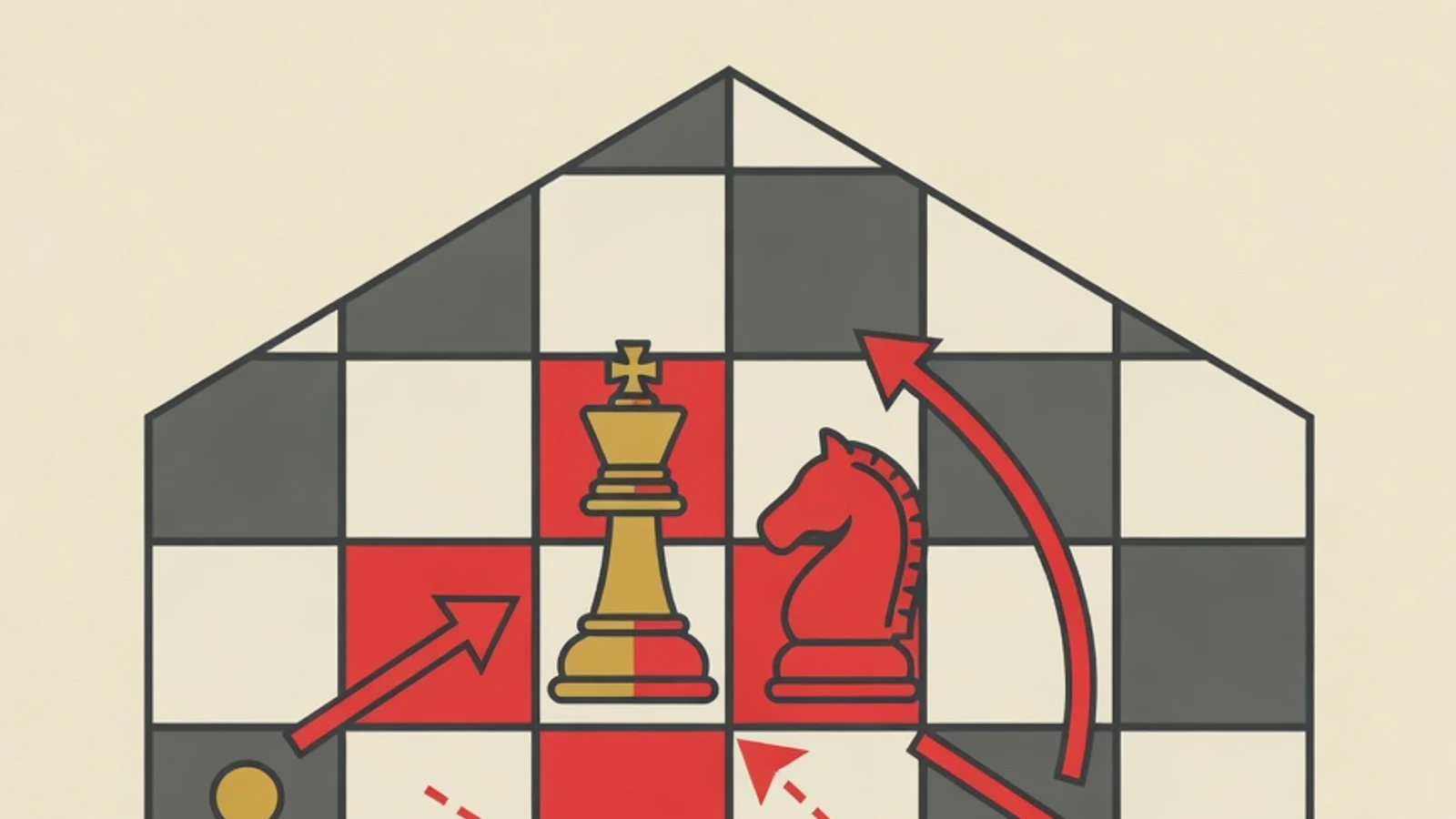
Chess strategy for beginners rests on five foundations: controlling the center, developing your pieces to active squares, castling to secure the king, tending your pawn structure, and building a plan from your opponent's weaknesses. Master these five principles and every move gains direction, long before you memorize any lengthy opening line.
- Control of the center decides the mobility of your whole army
- A long-term plan serves you better than memorized theory
- Pawn structure is the framework that guides where the game flows
- A physical chessboard or an app such as Lichess and Chess.com
- A notebook to record plans and mistakes from each game
- 20 to 30 minutes of practice every day
Chess in numbers that explain why strategy matters
Strategy and tactics: two layers of thinking on the board
Chess strategy is the long-term plan for where the game should head, such as pressing an open file or attacking a king stuck in the center. Tactics are the short calculations of a few moves that yield an immediate gain, such as a knight fork or a pin. Beginners often fixate on tactics because the results appear quickly, while strategy provides the framework that lets those tactics appear. Think of strategy as a route map and tactics as the sharp turns along the way. Without a map, every turn feels random and easily leads to a dead end. With a clear map, a beginner knows which piece to activate, which file is worth contesting, and when the moment has come to trade pieces. This strategic foundation is what separates a purposeful move from a trial-and-error one.
A six-step strategic framework for beginners
Apply this order in every game until it becomes a habit. The framework guides your moves without forcing you to memorize hundreds of opening variations.
- 1
Control the center from the very first move
The four central squares (d4, d5, e4, e5) are the heart of chess strategy for beginners. A piece placed in the center controls more squares and can shift quickly to either side. Begin by pushing a central pawn, such as e4 or d4, then support it with a second pawn or a knight. Central control gives your whole army room to breathe and limits your opponent's movement. When your opponent neglects the center, take the chance to build two side-by-side central pawns as a strong core.
Tips- Prioritize the d and e pawns to open lines for your queen and bishop
- Central control need not mean occupation; pressing the center from afar with a fianchettoed bishop is equally valid
Avoiding the center with a flank pawn (a or h) in the early moves usually hands the initiative to your opponent. - 2
Develop your pieces to the most active squares
Development means moving your knights and bishops out of the back rank to squares where they control the center. Knights aim ideally for f3, c3, f6, or c6, while bishops seek a square with an open diagonal. A simple rule: activate a new piece every move, and avoid moving the same piece twice in the opening without a strong reason. Develop knights before bishops, since a knight's direction is easier to decide early. The more pieces you activate, the more plans open up. Bring the queen out later so it does not become a target for the opponent's quickly developing minor pieces.
- 3
Secure the king by castling early
A king left in the center is vulnerable the moment lines open. Castling moves the king to a safer corner while activating a rook toward a central file. As a strategic principle, complete castling within the first ten moves, usually short castling to the kingside. Before castling, make sure the three squares between king and rook are empty and no enemy piece watches that path. After castling, keep the shielding pawns in front of the king intact so no gap appears. Delaying king safety to chase an opponent's pawn often ends in a position that is hard to defend.
- 4
Tend your pawn structure as the frame of your plan
Pawns are the pieces that cannot retreat, so every pawn push changes the shape of the position permanently. A healthy pawn structure guides where your plan should flow. Avoid creating doubled or isolated pawns without compensation, since both become long-term weaknesses. A passed pawn free of blockers, by contrast, can grow into a major strength in the endgame. Before pushing a pawn, ask which square becomes weak afterward and who will occupy it. Reading pawn structure is the strategic skill that separates a purposeful beginner from one who plays by trial and error.
- 5
Read your opponent's weaknesses and set one clear plan
Once the opening is settled, the next strategic step is to assess the position: count material, check the safety of both kings, and look for weak squares the opponent's pawns can no longer guard. From that assessment, pick one concrete plan, such as placing a knight on a weak square, opening a file for a rook, or attacking a pawn minority on the queenside. One plan carried out consistently is far stronger than switching intent every move. Fix the plan in your mind before you move, then check whether the move you chose truly supports that plan.
- 6
Simplify toward the endgame when ahead in material
When you are up material, the best strategy for a beginner is to trade pieces so the position becomes simple and easy to control. Trading minor and major pieces lowers your opponent's chance of creating complications, while raising the relative value of the advantage you hold. Steer the trades toward a favorable endgame, such as a king-and-pawn ending where a passed pawn can march to promotion. When behind in material, keep pieces on the board and seek complications so chances stay alive. This principle completes the framework from opening to the close of the game.
Telling strategy from tactics during practice
| Aspect | Strategy | Tactics |
|---|---|---|
| Time span | A plan several moves ahead | Calculation of one to five moves |
| Goal | Steering the position toward a gradual edge | Winning an immediate gain at once |
| Example | Controlling an open file for a rook | A knight fork or a bishop pin |
| How to train | Assessing positions and forming plans | Daily puzzle practice |
Strategy sets the stage; tactics harvest the result when the chance appears.
Five pawn-structure types worth recognizing
Isolated pawn
A pawn with no friendly pawn on an adjacent file. It can become weak, yet it sometimes gives active room to the pieces around it.
Doubled pawns
Two same-color pawns on one file. Their forward movement is hampered and they often become a target of long-term pressure.
Passed pawn
A pawn with no enemy pawn blocking its path to promotion. A major strength in the endgame.
Pawn chain
A diagonal line of pawns protecting one another. It decides which flank is worth attacking.
Backward pawn
A pawn that can no longer be protected by a friendly pawn and stands on a half-open file. A natural target for enemy rooks.
“Even a bad plan is better than no plan at all, because a plan gives direction to every move.”
A strategic thinking checklist before you move
- Does this move strengthen my control of the center?
- Is there an undeveloped piece I could activate first?
- Is my king safe, and does my opponent's king have a gap?
- Does this move support the one plan I have already chosen?
- Chess strategy for beginners stands on five foundations: center control, piece development, king safety, pawn structure, and plan-building
- A long-term plan lets tactics appear on their own, while opening memorization without understanding collapses when the opponent leaves theory
- Pawn structure is the permanent frame that guides the direction of your plan from opening to endgame
- One plan carried out consistently is far stronger than switching intent every move