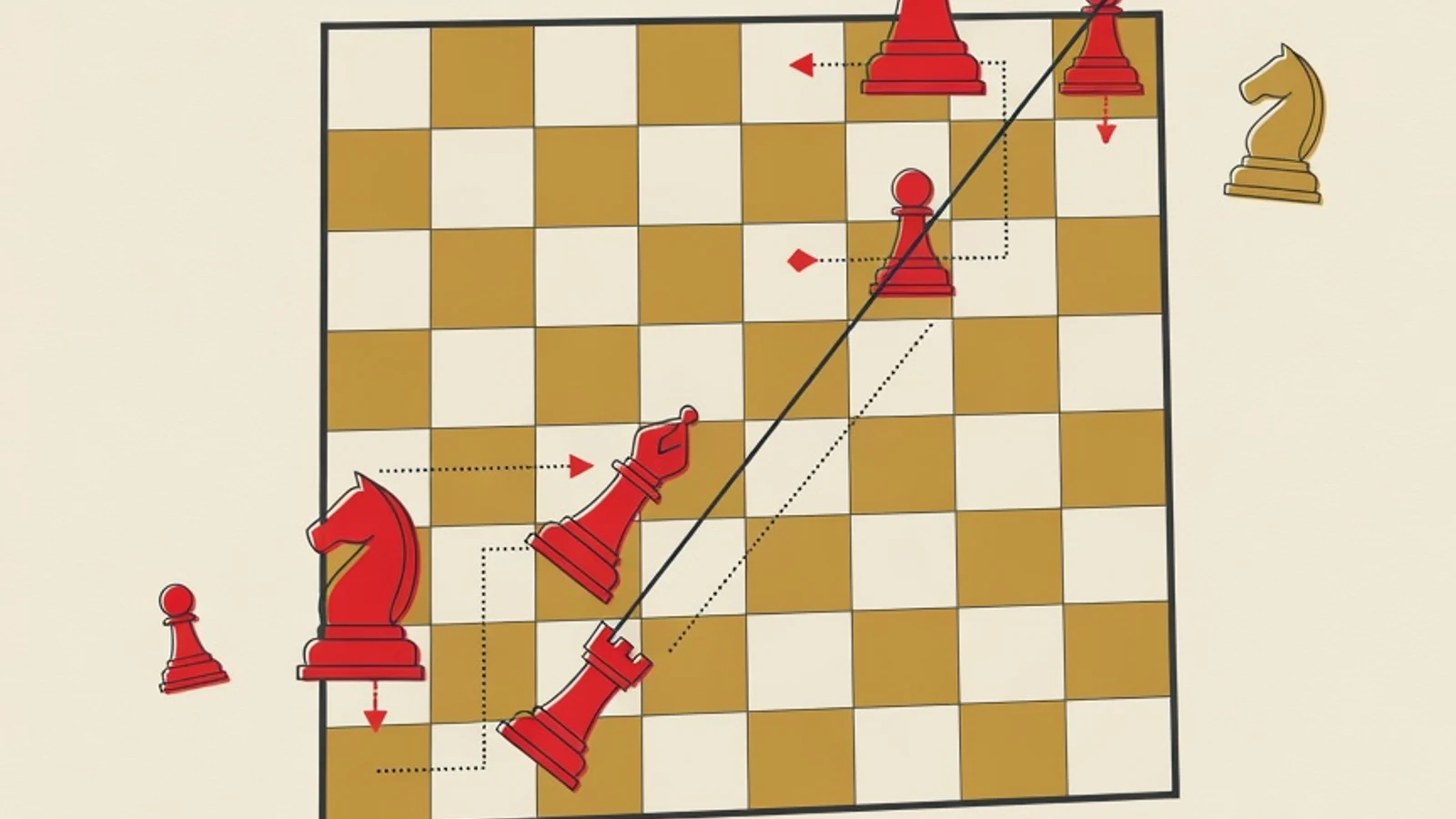
The most reliable way to train chess tactics is to master the four core motifs (pin, fork, skewer, discovered attack), solve puzzles every day on free platforms such as Lichess or Chess.com, then analyse your own games after playing. Most games at beginner level end through tactical blunders, which makes tactical sharpness the fastest route to a higher rating.
- 4 core tactical motifs: pin, fork, skewer, discovered attack
- Free daily puzzles on Lichess and Chess.com
- Analyse your own games after every session
- Two rating ladders: international Elo and Indonesia's Percasi national rating
- A physical chess set or a chess app on your phone
- A free Lichess or Chess.com account
- A small notebook for logging blunders and missed patterns
Chess Tactics Training by the Numbers
Why Tactics Decide Ratings at Beginner Level
Watch a sample of games in the beginner-to-early-intermediate range and a clear pattern emerges: most of them end through tactical blunders. A queen left hanging, a rook lost to a knight fork, a king caught by a two-move combination that was there for anyone to see. The player who blunders less, and punishes the opponent's blunders more often, wins the majority of those games, and the rating simply follows the results. That makes the training priority obvious. Ten moves of memorised opening theory only pay off if you survive into the middlegame, while tactical sharpness earns points in every phase of the game. If you want the most efficient path to a higher chess rating, give tactics the largest share of your study time first, add basic endgames second, and let deep opening theory wait its turn.
The Four Tactical Motifs Every Player Must Know
The Pin
An enemy piece is frozen because moving it would expose a more valuable piece behind it, often the king or queen. Bishops and rooks are the classic pinning pieces. A pinned piece loses its defensive power, and that weakness is exactly where you pile on pressure.
The Fork
One piece attacks two or more targets at the same time, so the opponent can only save one of them. The knight fork against king and queen is the most feared version at club level, though pawns and queens deliver deadly forks too.
The Skewer
The mirror image of the pin: the more valuable piece stands in front and is forced to move aside, after which the piece behind it falls. A textbook example is a rook attacking a king that shares a line with its queen; the king must step away and the queen is lost.
The Discovered Attack
A piece steps aside and unmasks an attack from the piece behind it, creating two threats in a single move. The fiercest version is discovered check: while the opponent deals with the king, the piece that moved is free to grab material elsewhere.
How to Increase Your Chess Rating: A 6-Step Routine
This routine is built for busy schedules: 30-45 minutes a day is plenty, provided you keep the order intact and stay consistent for at least eight weeks.
- 1
Learn the four motifs one at a time
Study pins, forks, skewers, and discovered attacks from simple positions, and stay with one motif until it truly sticks before moving on. The goal is pattern recognition: training your eyes to grow suspicious of aligned pieces, undefended pieces, and a king sharing a line with its queen.
Tips- In your first month, give each motif a full week of attention
- Use the puzzle theme filter on Lichess so the exercises match the motif you are studying
- 2
Solve tactics puzzles every day
Lichess and Chess.com both offer free puzzle training that adapts to your level. A 15-20 minute daily session beats a two-hour marathon once a week, because pattern recognition is built through closely spaced repetition.
Tips- Treat every puzzle like a real game: calculate the full line in your head before touching a piece
Guessing moves to chase a puzzle score trains a bad habit. A wrong answer backed by full calculation teaches you more than a lucky correct one. - 3
Play games at a sensible time control
Fresh tactical knowledge needs testing in real games. Choose rapid games of 10 minutes or more per side, so there is time to calculate lines, check your opponent's threats, and apply the motifs you are training. Two or three focused rapid games a week already give you plenty of material to analyse.
Bullet chess forces reflex decisions, so the tactical patterns you are building never get a chance to run. - 4
Analyse your own games after playing
This is the most skipped step and the one with the biggest payoff. After each game, replay it move by move: find your blunders, find the opponent's blunders that slipped past you, and label the tactical motif involved in each one. A mistake you have consciously identified rarely repeats itself.
Tips- Analyse on your own first, then switch on the engine to check your findings
- Write one sentence per game in your notebook: which pattern did I miss today?
- 5
Revisit the puzzles you failed
Set aside one session each week to redo the puzzles you got wrong the week before. This simple spaced repetition moves the patterns into long-term memory, so when a similar position appears over the board, your hand already seems to know the answer.
Tips- Lichess automatically keeps your failed puzzles in the training dashboard
- 6
Measure progress on the rating ladders
Use your online rating as a daily barometer, then step onto the official stage: regional tournaments under Percasi to start building a national rating, and internationally rated events for FIDE Elo. A healthy rating climbs like a staircase, rising, pausing, then rising again; judge your progress by the month, never by the day.
A rating dip after a losing streak is a normal part of the process. Turn the lost games into analysis material and keep going.
Time Controls and Their Value for Tactics Training
| Time control | Time per player | Value for tactics training |
|---|---|---|
| Bullet | 1-2 minutes | Close to zero; every decision is reflex, so careless habits get reinforced |
| Blitz | 3-5 minutes | Fun as a side dish, though full calculation rarely gets finished |
| Rapid | 10-30 minutes | The sweet spot for rating growth: enough time to calculate, short enough to finish in one sitting |
| Classical | 60 minutes and up | The standard for Percasi and FIDE rated tournaments; trains deep calculation in full |
While you are chasing rating gains, make rapid your main course and keep blitz as entertainment.
“Students who grind puzzles yet stay stuck at the same rating are almost always missing one habit: they rarely replay the game they just finished. Ten minutes of post-game analysis is worth dozens of puzzles, because those mistakes are yours, drawn from your own thinking under pressure.”
Weekly Chess Tactics Checklist
- Daily puzzles completed on at least 5 of 7 days
- Two or three rapid games played with full focus
- Every game analysed, with each blunder moment marked
- One tactical motif revisited through simple training positions
- Last week's failed puzzles solved again until correct
- One reflection note written: which pattern do I keep missing?
Understanding Elo and Indonesia's Percasi National Rating
Elo is a rating system that estimates playing strength from game results: beating a higher-rated opponent earns a large gain, while losing to a much lower-rated one costs you dearly. FIDE uses it for international ratings, and online platforms run similar formulas for their internal ratings. In Indonesia, the official ladder is managed by Percasi (Persatuan Catur Seluruh Indonesia), the national chess federation. You earn a national rating by competing in official tournaments under the Percasi umbrella, starting at city and regency level. Keep in mind that online ratings, FIDE Elo, and Percasi ratings live on separate ladders, so the raw numbers cannot be compared directly. For students, the natural path looks like this: build habits through puzzles and online games, treat the online rating as your training barometer, then test yourself at the nearest official Percasi event to open your national rating record. The recipe for climbing all three ladders turns out to be identical: reduce your own blunders and punish your opponent's.
- Master the four core motifs first: pin, fork, skewer, and discovered attack; every combination grows from them.
- A daily 15-20 minute puzzle session on Lichess or Chess.com is enough, as long as each puzzle is fully calculated and the habit never breaks.
- Most beginner games are decided by tactical blunders, which makes tactics the most efficient use of study time for rating growth.
- Analysing your own games after playing multiplies the value of every training hour; consciously identified mistakes rarely repeat.
- Know the three rating ladders: online ratings as a daily barometer, the Percasi national rating through official tournaments, and FIDE Elo from internationally rated events.