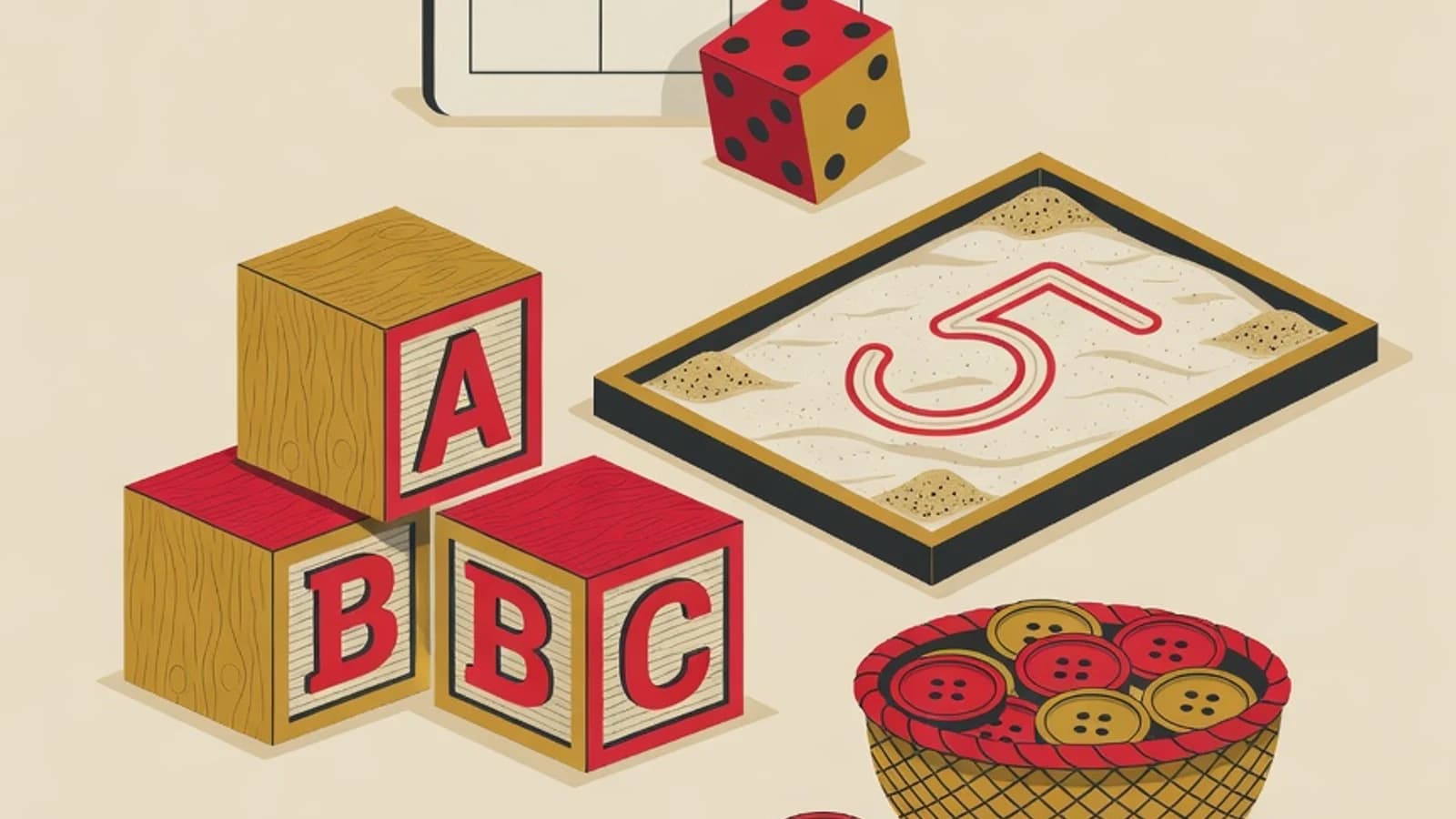
The most effective calistung games to play at home are a linear number board, a letter hunt, writing in a sand tray, guessing initial sounds, and counting while cooking. All five use everyday objects, take just 15 to 20 minutes, and build reading, writing, and counting without making a child feel like they are studying.
- Every game uses things already in the house
- Just 15 to 20 minutes per session keeps a child focused
- Each game touches one of the three calistung skills
- Paper and a large marker
- Rice, flour, or kinetic sand in a tray
- Homemade letter and number cards
- Everyday objects to count (buttons, spoons, fruit)
BWhy games work for young children
Children aged four to six learn fastest through direct experience that engages their body and their curiosity. When they slide a token along a number board, their finger touches the sequence of numbers while their mouth says each one, so the counting concept is recorded through movement and sound at the same time. Indonesia's Merdeka Curriculum for early childhood calls this principle play is learning, because children absorb letters and numbers precisely when the mood is light. A playful mood also keeps a child calm when facing something new. When an activity feels like a game, a child dares to try, make mistakes, and repeat without fear. That sense of joy is what makes home calistung sessions last longer and happen more often, and enjoyable repetition is the foundation of solid reading and counting skills.
Five calistung games you can play today
Play one game per session and stop while your child is still enjoying it. Rotate the games every few days so all three calistung skills get their turn.
Linear number board (practicing counting)
Draw ten boxes in a straight row on a sheet of paper, number them one to ten, then prepare one token and a die. Your child rolls the die, says the number, then slides the token while counting the boxes out loud: one, two, three. This simple game practices number order, forward counting, and numeral recognition in a single turn. The Ramani and Siegler study of preschoolers showed that a number board laid out in a straight line helps children grasp how large or small numbers are, and the effect was still visible nine weeks later. Keep the line truly straight, because that straight shape is what helps a child picture numbers as a distance that grows farther away. Once your child is fluent to ten, extend the board to twenty.
- Ask your child to say each number clearly every time the token moves
- Use a token made from your child's favorite object, like a toy car or a mini doll
- Celebrate each turn with applause so your child wants to play again
Letter hunt around the house (practicing letter recognition)
Say one letter, for example the letter B, then invite your child to walk around the house finding objects whose names start with it: ball, book, bottle. Your child brings each find to a single basket while saying the object's name. A letter hunt turns letter recognition into a small adventure that gets a child moving and observing their surroundings. For a child who does not know all the letters yet, start with the first letter of their own name because that letter matters most to them. Stick large letter cards in a few corners of the room so your child can match objects to their letter symbol. Vary it by looking for the same letter on food packaging or book covers, so your child gets used to seeing letters in real life.
- Limit it to one or two letters per session so your child is not overwhelmed
- Say the sound of the letter along with its name, so your child is ready to blend words
- Place letter cards at your child's eye level so they are easy to reach
Writing in a sand or rice tray (practicing writing)
Pour a thin layer of rice, flour, or kinetic sand into a flat tray. Your child writes letters and numbers with their index finger, then smooths the surface to erase and repeat. Writing in a textured medium exercises the finger muscles and introduces letter shapes without the pressure of staying neat like in a workbook. This activity suits a child whose pencil grip is not yet strong, because the finger feels lighter and freer. Start with simple straight and curved lines, move on to the letters in your child's name, then to the numbers one to five. Say the name of the letter or number together each time your child finishes, so its shape and sound connect in their memory.
- Choose a dark-colored tray so the writing shows up clearly
- Model it once with your own finger before your child tries
- Store the rice in a sealed container so it can be reused
Guessing initial sounds and rhymes (building reading readiness)
Invite your child to guess objects that share the same initial sound, for example asking them to name another word that begins like the sound of mama, then move on to finding words that rhyme. Sensitivity to the sounds of language is the foundation of reading, and the United States National Reading Panel found that children trained to recognize sounds are more ready to read and spell. This game needs no tools and can be played anywhere, including in the car or while waiting in a queue. Sing a nursery rhyme full of rhyming words, then stop at the last word and let your child fill it in. Repeated sounds sharpen a child's ear for syllables, and that sharpness carries over when they begin to blend letters into words.
- Start with clear rhymes in a nursery song your child already knows
- Clap once per syllable to break a word into sounds
- Meet a wrong guess with a smile, then say the sound slowly
Counting while cooking and shopping (applied counting)
Involve your child in home activities full of numbers: counting five eggs, sharing six slices of fruit among the whole family, or reading prices on a shelf. Counting in real activities gives numbers meaning, because a child sees firsthand what numbers are used for. While cooking, ask your child to measure two spoons, then add one, and ask how many there are now. When shopping, invite them to count simple change or pick the right number of items from a list. Everyday activities like these turn the kitchen and the market into a natural space for learning to count, and a child feels they are helping, so they are both proud and practiced.
- Start with small numbers one to five before increasing the amount
- Give your child a counting task that the family really uses
- Ask counting questions casually during the activity, keeping the tone of a normal chat
Choosing a game for the skill you want to practice
For reading
The letter hunt and initial-sound guessing introduce letter symbols along with their sounds, the two main foundations before a child blends words.
For writing
Writing in a sand tray exercises the finger muscles and letter shapes with no pressure to be neat, ideal before a child holds a pencil steadily.
For counting
The number board and counting while cooking build number order and the meaning of numbers through movement and real activities.
Children learn most when they enjoy the game. A few small habits keep home calistung sessions light and worth repeating.
- Stop while your child is still happy, do not wait until they are bored
- Follow your child's interest that day, letters can wait if they love numbers right now
- Praise their effort and courage to try, as much as the correct answer
- Keep sessions short and frequent, fifteen minutes daily beats one hour once a week
Homemade games versus paid educational toys
| Aspect | Homemade | Paid |
|---|---|---|
| Cost | Almost nothing, from what you have | Tens to hundreds of thousands of rupiah |
| Prep time | Five minutes | Ready to use |
| Customizable | Easy to adjust to your child | Bound by the product's content |
| Parent involvement | High, played together | Depends on the product |
Paid toys may complement, while homemade games are already enough to practice the basics of calistung.
“When parents sit down for a moment and play numbers or letters with their child every day, we see the child arrive at calistung sessions with far greater confidence. A warm home is the first and most influential place to learn.”
Simple supplies from around the house
- Scrap paper and a large marker for the number board and letter cards
- One flat tray of rice or flour for writing
- A die or a paper spinner numbered one to six
- A small basket to hold objects from the letter hunt
- Safe everyday objects to count, such as buttons or spoons
- Five core games practice calistung from things around the house: a number board, a letter hunt, tray writing, sound guessing, and counting while cooking.
- Short 15 to 20 minute sessions that are frequent and joyful work better than long infrequent ones.
- Research proves a straight-line number board made of paper can improve preschoolers' counting skills, and the effect lasts for weeks.
- A parent's warm involvement while playing together matters more than the price of an educational toy.