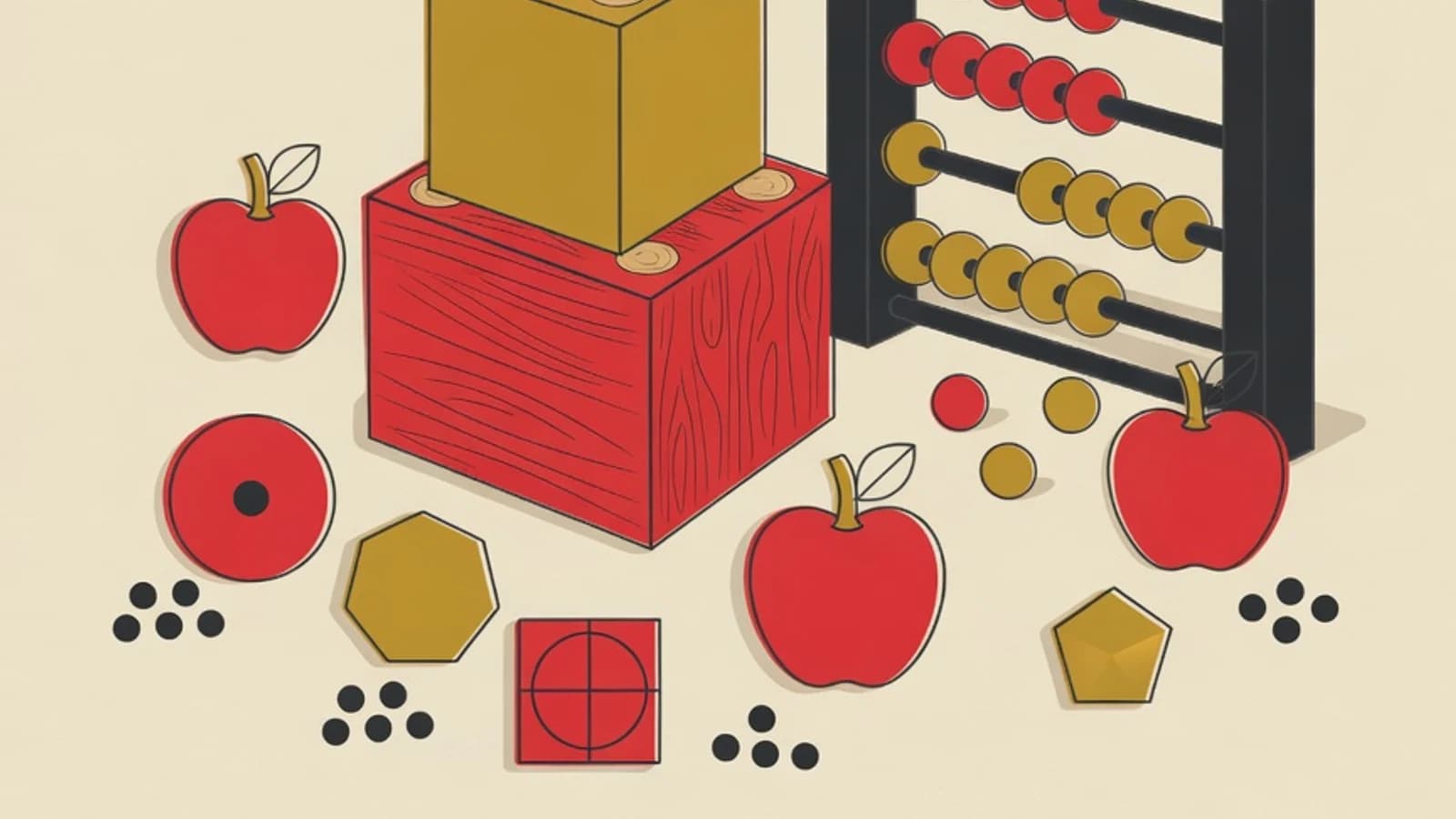
Introducing numbers to a child starts from number sense, not rote sequence. Have your child count objects they hold, say the total, then show the matching number symbol. Children aged 3 to 7 grasp counting fastest through real objects and short daily games.
- Number sense first, symbols later
- Count objects the child can hold and move
- Weave counting into daily routines
- Everyday counting objects (buttons, stones, spoons, fruit)
- Homemade number cards from 1 to 10
- Bowls or plates to separate groups
- Counting songs or a number picture book
Early Number Skills Shape Later Learning
What Number Sense Is and Why It Comes First
Number sense is a child's understanding that a number stands for a real quantity of objects. A child with number sense knows that the number 3 means three apples on the table, not just a sound said after two. This understanding grows as the child holds, arranges, and moves objects while naming the amount. Many children recite one through ten before they truly grasp its meaning. That recitation helps as a warm-up while the child is guided toward the quantity behind it. When you ask a child to bring four spoons and they stop exactly at the fourth, that signals number sense has taken root. This foundation later makes addition, subtraction, and word problems in the early grades feel light. Teaching counting to a child becomes effortless once quantities are something the child has felt through everyday objects.
Steps to Introduce Numbers and Counting to a Child
This sequence moves from quantities a child can hold toward number symbols and simple operations. Follow your child's readiness, repeat any wobbly step, and keep sessions short and playful.
- 1
Count real objects the child can hold
Start with objects already at home: buttons, pebbles, fruit pieces, or spoons. Place three objects in front of the child, touch each one while saying one, two, three, then state the total is three. Touching while naming trains the child to match one word to one object, a counting basic that is often skipped. Ask the child to copy with small quantities first, one to five. Vary the objects so the child understands a quantity is not tied to one item. Three stones and three spoons both make three. This repetition with different objects is what plants the meaning of numbers in a child.
Tips- Touch each object as you say its number so none gets skipped
- Stay within one to five until the child is fully confident
Avoid pushing a child to count all the way to ten while small quantities still trip them up. - 2
Practice recognizing quantities at a glance (subitizing)
Show a dotted card or a die, then ask how many without giving the child time to count one by one. A child who instantly knows two dots or three dots is practicing subitizing, the ability to recognize small quantities directly. This skill speeds up counting because the child does not always start from one. Play it quick and light, like a guessing game. Use the same dot pattern each time, such as a die pattern, so the child recognizes the shape. Once one to four are easy, slowly raise it to five and six. This short activity fits into the wait while a meal cooks.
Tips- Use a consistent die-dot pattern so it is easy to recognize
- Keep it to five minutes, treat it as a quick guessing game
- 3
Match the number symbol to its quantity
Once the child feels a quantity, introduce the number symbol. Make number cards from 1 to 10, then ask the child to place the matching count of objects under each card. Under the card 4, the child places four buttons. This links the abstract symbol to a quantity the child has already felt. Invite the child to spot numbers around them: the house number, a book page, the lift button, a price on a package. Linking number symbols to real-world objects shows the child that numbers are useful. Write a large number on paper and let the child trace it with a finger while naming it to learn its shape.
Tips- Match numbers 1 to 5 first before moving on
- Point out real numbers around the home whenever you can
Neat number writing need not be chased at this stage. Focus first on meaning and shape recognition. - 4
Compare more, fewer, and the same
Set out two groups of objects, then ask which group has more. The child can pair one object from the left group with one from the right to see what is left over. This comparing activity grows the idea that numbers can be ordered from small to large. Use the words more, fewer, and the same in everyday talk. When sharing a snack, ask who got more. When two children have toys, count and compare them. This kind of number talk strengthens counting without feeling like a lesson.
Tips- Pair objects one to one to see the difference
- Slip in the words more and fewer while sharing food
- 5
Introduce adding and subtracting through stories
Addition and subtraction are easiest for a child to grasp through stories with real objects. For example: there are two pieces of bread on the plate, Mum adds one more, now how many are there. The child counts real objects and finds the answer themselves. A story gives number operations a flow that makes sense to a child. Use everyday situations: marbles that increase, a cake that is eaten, a toy a friend borrows. Let the child move the objects while counting before asking them to count in their head. This step closes the arc of introducing numbers and counting to a child, from felt quantities to simple operations they understand.
Tips- Always start with real objects before mental counting
- Keep numbers small, quantities under ten first
Hold off on written sums with plus and minus signs until the child grasps the story.
Counting Stages by Child's Age
Ages 3 to 4
Recites the number sequence while playing, counts objects to five by touching one at a time, recognizes quantities of one to three at a glance.
Ages 4 to 5
Counts objects to ten, matches the number symbol to its quantity, compares which group has more.
Ages 5 to 6
Adds and subtracts small quantities through object stories, orders numbers, begins recognizing simple patterns.
Ages 6 to 7
Counts to twenty and beyond, solves short word problems, grasps the basic place value of ones and tens.
Reciting the Sequence vs Understanding Quantity
| Aspect | Reciting Sequence | Understanding Quantity |
|---|---|---|
| What the child masters | Says one through ten | Knows a number stands for a quantity of objects |
| How to check it | Child recites with no objects | Child fetches the requested amount |
| When counting | May skip or repeat | Stops exactly at the last object |
| Moving to addition | Often stalls | Smoother because quantity is already felt |
Reciting the sequence stays useful as a warm-up, while the child is guided toward the quantity behind it.
“A child builds number understanding gradually along observable learning trajectories. A caregiver who recognizes the child's stage can offer just-right activities, so number sense grows before number symbols are introduced.”
Ready to Introduce Numbers at Home
- Provide counting objects that are safe for the child to hold
- Make number cards 1 to 10 in large writing
- Set a short session of five to ten minutes a day
- Start within one to five before going higher
- Praise the child's effort, not only the right answer
- Repeat any wobbly stage without rushing
Introducing Numbers at Home on Your Own
- Uses objects already at home, with no special tools to buy
- Can be slipped into daily activities at any time
- Parents read the child's readiness stage directly
- A relaxed setting makes the child comfortable exploring
- Needs steady daily consistency from parents
- Calls for patience when the child repeats the same stage
- Hard to judge whether the stage order is right
- A child who lags at one stage may need guided support
- Number sense grows first through real objects, then number symbols are introduced
- Touching one object for one number trains a counting basic that is often skipped
- Subitizing, recognizing small quantities at a glance, speeds up a child's counting
- Addition and subtraction are easiest to grasp through everyday object stories
- Short enjoyable daily sessions work better than long forced ones