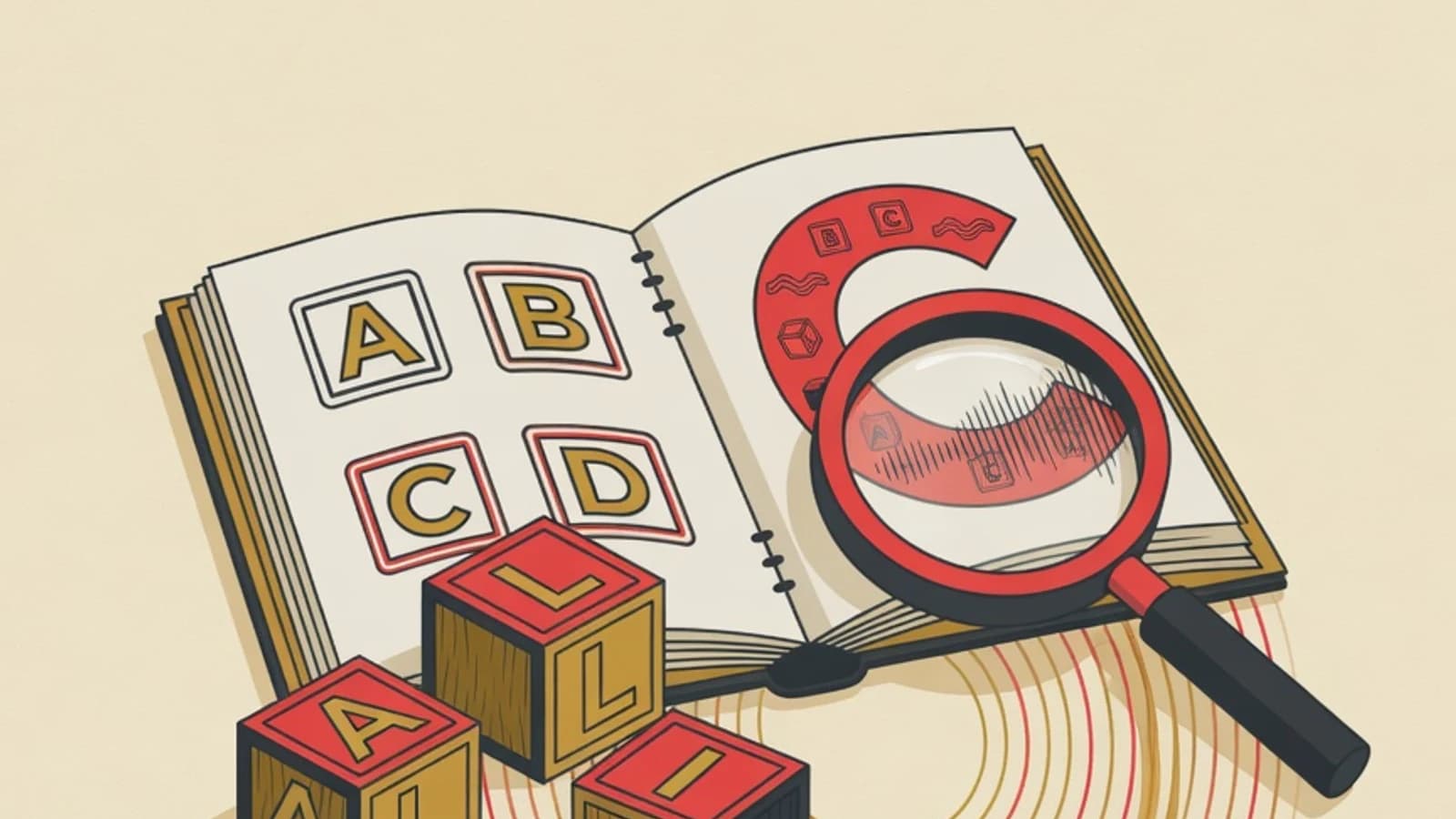
A child is ready to learn to read when curiosity about letters and books begins to show, when rhymes and word sounds become easy to notice, and when listening to a story right through feels enjoyable. These reading readiness signs appear gradually, usually between the ages of four and seven, and each child moves at a different pace.
- Reading readiness shows through interest and behaviour, well before a child knows every letter
- Awareness of sounds and rhymes forms the early foundation of reading skill
- Every child has an individual pace, so observing beats relying on a single age marker
- Your child's favourite picture books
- Letter cards or fridge magnet letters
- A small notebook to record what you observe
Reading readiness in numbers
What being ready to read really means
Being ready to read means a child holds the language and interest that make learning letters feel meaningful. Researchers call this foundation emergent literacy, the set of skills and attitudes that grow long before a child reads a first word. Whitehurst and Lonigan (1998) mapped this foundation into two supporting sides. The first is the inside-out set of skills, such as sensitivity to language sounds and letter knowledge. The second is the outside-in set, such as rich vocabulary and story comprehension. The two sides grow from different experiences and strengthen at different times. For that reason, reading readiness is best seen as a whole picture, observing interest, language, and habits together. No single magic age fits every child. Some show the signs at four, while others feel comfortable at six or seven. A different pace is perfectly normal.
How to read the signs of reading readiness
Observe the six areas below in a relaxed way over two to three weeks. Note the signs already present and those still growing, keeping it light and playful as a game the child enjoys.
- Step 1
Listen to the richness of spoken language
Notice how fluently your child recounts the day, names objects, and builds longer sentences. Rich vocabulary and the ability to retell events are important fuel for reading. A child who hears and uses many words usually finds it easier to understand the words later read on a page. Invite two-way chats at mealtimes or on the road, then listen for whether full-sentence answers come to simple questions. Mature spoken language is an early sign that the foundation for reading is forming well.
Tips- Swap closed questions for open ones, asking why and how
- Read a story every day so new vocabulary and rhythm become familiar
- Step 2
Test sensitivity to sounds and rhymes
Phonological awareness is the ability to hear and play with the sounds inside words, and Reading Rockets calls it one of the strongest markers of reading readiness. Try a few light games. Say rhyming words such as cat, hat, and mat, then see whether your child finds the match. Clap the syllables of a name, three claps for Na-di-a. Ask for the first sound of a word, such as the sound at the start of ball. A child who begins to enjoy these sound games, laughing at a funny rhyme, is showing a cheering sign of reading readiness.
Tips- Slip rhyme games into bath time or bedtime so they feel fun
- Start with syllables first, then single sounds, which are more challenging
A child who struggles to find simple rhymes or shows little interest in word play is best given more time to play with sounds, without rushing into formal decoding. - Step 3
Watch print awareness when opening a book
Print awareness is a child's understanding of how writing works. Notice whether the book is held the right way up, whether pages turn one at a time, and whether the story is understood to flow from page to page. Watch too for whether the difference between pictures and text is clear, and whether writing around them is seen to carry meaning, such as a shop name or a favourite snack. A child who points along a line of letters while pretending to read is showing an understanding that text can be read. This simple habit signals reading readiness taking root.
Tips- Point to words as you read so your child sees the left-to-right direction
- Invite your child to spot writing on streets, packaging, and signs
- Step 4
Notice curiosity about letters
Letter knowledge is the ability to link names and sounds with letter shapes, and the National Early Literacy Panel places it among the strong predictors of reading skill. Readiness often begins with curiosity, such as a child asking what letter is that, or proudly pointing to the first letter of a name. A few letters may start to be recognised in books, toys, or on a screen. Follow the interest first, because letters learned with joy tend to stick. A child need not know every letter to be called ready. Interest and recognising some letters already form a meaningful sign.
Tips- Begin with the most meaningful letters, the ones in the child's name
- Introduce letter sounds, such as buh for B, to make words easier to grasp
- Step 5
Gauge attention span and interest in stories
Reading readiness also shows in a child's willingness to sit calmly and enjoy a story. Notice whether a picture book is followed to the end, whether the same story is asked for again and again, or whether a book is brought over to be read unprompted. This interest keeps a child motivated when learning to read grows challenging later on. Attention spans in the early years are still short, so a few minutes of full focus already counts as a good sign. A child who enjoys shared reading is building a warm bond with books, and that bond is a precious asset.
Tips- Choose books on themes your child loves so listening feels easy
- Stop while it is still fun so the next session is looked forward to
- Step 6
Check fine motor and social-emotional readiness
Learning to read moves alongside the maturity of the hands and the feelings. Notice whether a pencil or crayon is held comfortably, whether drawings grow more controlled, and whether letters in a name are attempted. On the emotional side, watch for willingness to follow a simple activity, take turns, and bounce back after a mistake. The Indonesian Ministry of Education emphasises six foundational abilities during the early-years to primary transition, covering emotional maturity, social skills, and motor development, and calistung tests are no longer a condition for enrolment. Social-emotional readiness helps a child enjoy learning calmly and with confidence.
Tips- Offer threading, cutting, and squeezing activities to strengthen hand muscles
- Praise the effort and the courage to try, so trying feels safe
Home activities to grow each sign
Two-way chats
Invite your child to talk at meals and on trips to enrich vocabulary and sentences.
Rhyme games
Say rhyming words and clap the syllables of names to sharpen sound awareness.
Reading and pointing
Point to words while reading so your child sees the reading direction and how print works.
Letters on the fridge
Stick magnet letters and play with the letters in a name to introduce letter shapes.
A daily reading ritual
Read one book each night so interest and attention span keep growing.
Threading and drawing
Hand activities such as threading and colouring prepare the muscles for writing letters.
Already showing or still growing
| Readiness area | Sign already present | Step at home |
|---|---|---|
| Spoken language | Tells stories in full sentences | Add more open-ended chats |
| Sound awareness | Finds rhyming words | Play daily rhyme guessing |
| Print awareness | Knows book reading direction | Read while pointing to words |
| Letter knowledge | Asks for letter names | Introduce letters in the name |
| Reading interest | Asks to be read to | Make reading a calm ritual |
| Fine motor | Holds a pencil comfortably | Offer threading activities |
A sign not yet present means that area is still growing, and it can be supported through play without pressure.
“The most honest signs of reading readiness show while a child plays freely. Follow the interest, nurture the joy of books, and letters will feel inviting to learn.”
A quick reading readiness checklist
- Tells about daily events in increasingly complete sentences
- Finds or makes rhyming words during play
- Claps or counts the syllables in names and simple words
- Holds a book correctly and turns pages one at a time
- Asks for letter names or recognises the letters in a name
- Asks to be read to and listens right through
- Pretends to read while pointing along a line of letters
- Holds a pencil comfortably and tries to write letters
- Reading readiness shows through interest, spoken language, and sound awareness, before a child knows every letter
- Phonological awareness and letter knowledge are strong predictors of reading skill in literacy research
- Calistung tests are no longer a condition for primary enrolment, so reading is introduced to suit the child's readiness
- Relaxed observation over a few weeks helps more than relying on one single age