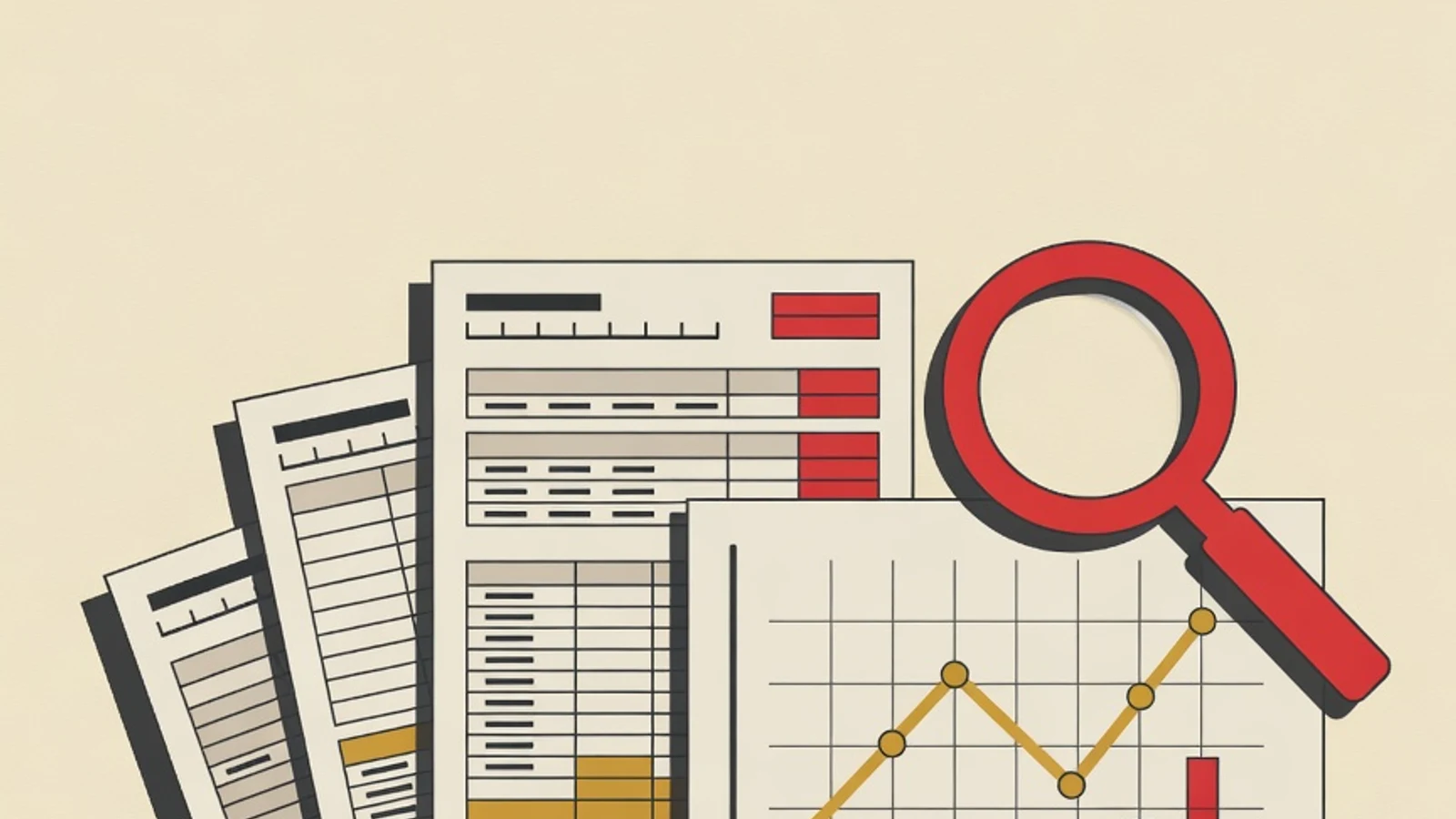
Reading basic financial statements starts by recognizing three core documents. The income statement shows profit or loss over one period, the balance sheet captures the position of assets and debts on a single date, and the cash flow statement tracks money moving in and out. Understand all three in order, then connect their figures.
- Read the income statement from revenue down to net profit
- Confirm the balance sheet balances: assets equal liabilities plus equity
- Trace cash flow to separate operating, investing, and financing activities
- One set of financial statements (income statement, balance sheet, cash flow)
- A calculator or simple worksheet
- Notes to the financial statements for reference
Basic financial statements in numbers
Four statements to recognize before reading the figures
Before diving into how to read financial statements, get to know each statement so the numbers make sense. The income statement summarizes revenue minus expenses over one period, for example a month or a year, and closes with net profit or loss. The balance sheet, now often called the statement of financial position, presents three groups on a specific date: the assets owned, the liabilities owed, and the owner's equity. The cash flow statement explains the actual movement of cash, split into operating, investing, and financing activities. The statement of changes in equity narrates the rise and fall of owner capital, including additional contributions and profit distributions. The notes to the financial statements complete the picture with details of policies and assumptions. For micro and small businesses, SAK EMKM only requires three parts, namely the statement of financial position, the income statement, and the notes, which keeps the preparation burden lighter.
How to read basic financial statements step by step
These five steps make reading financial statements orderly, from the first page to a conclusion you can use for business decisions.
- Step 1
Start with the income statement, read top to bottom
Open the income statement and trace its lines from top to bottom. The top line is revenue or sales, a picture of how much money comes in from business activity. Below it, the cost of goods sold is subtracted to arrive at gross profit. Further down, operating expenses such as salaries, rent, and electricity are deducted to reveal operating profit. After accounting for other income, interest, and tax, you reach net profit on the bottom line. Reading the income statement means understanding one period's story: from the money coming in to the amount that truly becomes profit.
Tips- Compare gross profit and net profit to see how heavy operating costs are
- Watch the trend across two or three periods for a fuller picture
- Step 2
Move to the balance sheet and confirm it balances
The balance sheet captures the business on a single date. The asset side lists cash, receivables, inventory, and equipment or buildings, ordered from the easiest to convert into cash. The other side lists liabilities, meaning short-term and long-term debt, plus the owner's equity. Reading a balance sheet correctly begins by checking its core equation: total assets must equal total liabilities plus equity. When both sides balance, the records are consistent. After that, study the composition, for example how much of the assets is cash versus receivables that remain uncollected.
Tips- Current assets and current liabilities usually fall within a one-year horizon
- Steadily growing equity signals that owner capital is expanding
If total assets do not equal liabilities plus equity, an entry was missed and the statement needs to be traced again. - Step 3
Trace the cash flow statement by activity
The cash flow statement answers a simple question that is often forgotten: where does cash actually flow. Read it group by group. Operating cash flow comes from day-to-day business, such as receipts from customers and payments to suppliers. Investing cash flow covers the purchase or sale of assets like machines and vehicles. Financing cash flow relates to capital contributions, loans, and installment payments. The operating section usually matters most to beginners, since healthy operating cash flow shows the business can generate cash from its core activity.
Tips- Consistently positive operating cash flow is a sign of a healthy business
- A large gap between net profit and operating cash flow deserves a closer look
- Step 4
Connect all three statements through linking figures
Financial statements work as one interconnected chain. Net profit from the income statement flows into the statement of changes in equity, then adds to the equity balance on the balance sheet. The ending cash balance on the cash flow statement must equal the cash reported on the balance sheet for the same date. When reading, check that these linking figures agree. Their match proves the three statements were built from the same records and can be trusted. Practicing this linking trains your eye to see the statements as one whole picture, from profit and loss to the position of assets and the flow of cash.
Tips- Find the same net profit in the income statement and the statement of changes in equity
- Match the ending cash balance in the cash flow with the cash item on the balance sheet
- Step 5
Compute a few simple ratios to gauge health
Once you understand each statement's contents, compute brief ratios to translate the numbers into an assessment. The current ratio compares current assets with current liabilities, signaling the ability to pay short-term debt. The net profit margin divides net profit by revenue, showing what percentage of sales becomes profit. The debt-to-equity ratio reveals how much the business leans on borrowing. There is no need to compute dozens of ratios at once. These three or four already give beginners a sufficient first picture for judging financial health.
Tips- A current ratio above 1 means current assets exceed short-term debt
- Compare ratios with the previous period to see the direction of change
Comparing the three main statements
| Statement | Question it answers | Period | Key figure |
|---|---|---|---|
| Income statement | Is the business profitable or loss-making? | Over one period | Net profit |
| Balance sheet | What is owned and owed? | On a single date | Total assets |
| Cash flow | Where does cash flow? | Over one period | Net cash |
Reading all three together gives a more honest picture than relying on a single statement.
Simple ratios for reading financial health
Current ratio
Current assets divided by current liabilities. Shows the business's ability to settle short-term debt with easily converted assets.
Net profit margin
Net profit divided by revenue, expressed as a percentage. Reveals how much of every unit of sales remains as profit.
Debt-to-equity ratio
Total liabilities divided by total equity. Describes how much the business relies on borrowing versus owner capital.
Operating cash ratio
Operating cash flow compared with current liabilities. Assesses whether the core activity generates enough cash for near-term obligations.
“Beginner readers often stop at the net profit line. Better decisions come when the income statement, balance sheet, and cash flow are read as one story that explains itself.”
A checklist for reading your first financial statements
- Check the period and date of the statements to read the right context
- Read the income statement from revenue down to net profit
- Confirm the balance sheet balances between assets and liabilities plus equity
- Separate cash flow into operating, investing, and financing
- Match net profit and cash balances across statements
- Compute the current ratio and net profit margin
- Read the notes to the financial statements to understand the assumptions
- Reading basic financial statements rests on three documents: income statement, balance sheet, and cash flow.
- Read the income statement from revenue to net profit, check the balance sheet for balance, and trace cash flow by activity.
- Net profit, cash balances, and equity are the linking figures that prove the three statements are consistent.
- The current ratio and net profit margin give a quick read on liquidity and profitability.