Online Program · One Coach, One Student
Online Public Speaking Lessons: Train Where You Actually Perform
Work meetings, thesis defenses, investor pitches, and speech competitions increasingly happen on camera. EduPoint's online public speaking lessons train you in that exact medium: private video-call sessions, recorded practice reviewed with your coach, and a schedule that fits around your day.
292+
tutors
3,600+
students
4.9
rating · 1,083 reviews
60+
cities
What is Online Public Speaking Lessons?
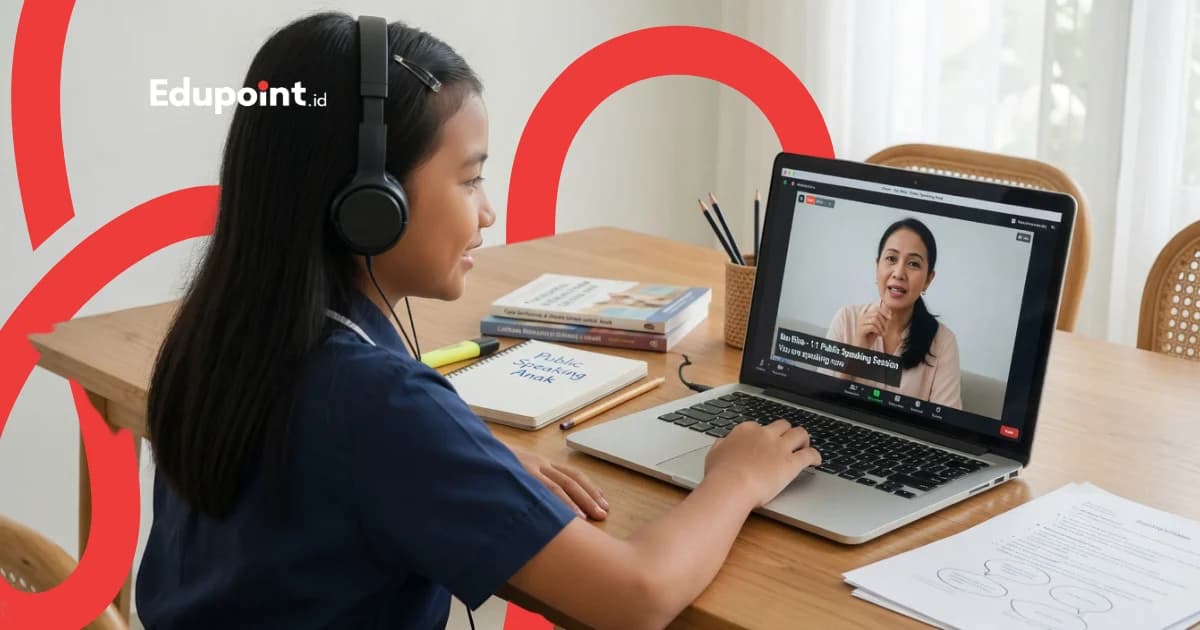
Online public speaking lessons are private speaking training delivered over video call, one coach per student, in sessions of 60, 90, or 120 minutes. The curriculum builds step by step, from managing stage fright to delivering a full speech, every practice run is recorded for review, and rates start from IDR 90,000 per hour.
- Fully private video-call format: the coach's attention belongs to one student for the whole session
- The EduPoint Public Speaking Mastery Framework spans 5 levels, from Foundation Speaker to Keynote & Media Speaker
- Progress is measured against 5 criteria: confidence, structure, voice & delivery, body language, and audience engagement
- Practice runs are recorded and replayed with your coach, a review method that fits the online format naturally
- Open from around age 10: middle and high schoolers, university students, professionals, and executives
Services
Session Options for the Online Public Speaking Course
Every session is private and held over video call. Pick the duration that matches your training needs; prices below are per session.
60-Minute Private Session
A compact format for regular practice: one technique per meeting, such as diaphragmatic breathing or the PREP structure, practiced on camera right away.
Rp 111.000/ 60-minute session
Price on the 28-session monthly plan, 60-minute sessions. Fewer meetings, higher price per session.
- Well suited to kids and beginners
- One training focus per session
- Session recording for solo replay
90-Minute Private Session
The most balanced duration: a short theory segment, a full speaking drill, then a recording review with your coach within the same session.
Rp 140.000/ 90-minute session
Price on the 28-session monthly plan, 90-minute sessions. Fewer meetings, higher price per session.
- Practice plus recording review in one meeting
- Ideal for high school and university students
- Simulated audience Q&A
120-Minute Private Session
A full run-through format: rehearse a work presentation, pitch, or competition speech from opening to Q&A, recorded and dissected end to end.
Rp 179.000/ 120-minute session
Price on the 28-session monthly plan, 120-minute sessions. Fewer meetings, higher price per session.
- Complete presentation simulation via screen share
- Minute-by-minute recording breakdown
- Great in the run-up to a big moment
Online and in-person cost the same — the gap between these cards is session length, nothing else.
5 Levels of Private Public Speaking Coaching
The EduPoint Public Speaking Mastery Framework maps the journey into 5 levels. Your starting point is set by an assessment in the first session, so you begin exactly where you should.
Level 1 · Foundation Speaker
Speak comfortably to a small audienceFocused on taming nerves and building structured speaking habits in front of 3-5 people. Typically takes 8-12 sessions, around 2 months.
Subjects:
Diaphragmatic breathingManaging glossophobiaStructured self-introductions
Focus Areas:
- Confidence
- Graduated exposure
Level 2 · Structured Speaker
A complete 5-7 minute speechLearn to build and deliver a 5-7 minute speech with a clear skeleton using PREP and the rule of three. Typically 10-16 sessions, around 3 months.
Subjects:
The PREP frameworkRule of threeStrong openings and closings
Focus Areas:
- Structure
- Voice & delivery
Level 3 · Dynamic Speaker
Bring an audience of 20-50 to lifeTrain vocal variety, gesture, and interaction so a presentation stays alive in front of 20-50 people, including virtual audiences in webinars.
Subjects:
Pitch, pace, pausePurposeful gesturesReading audience response
Focus Areas:
- Voice & delivery
- Audience engagement
Level 4 · Persuasive Speaker
Speaking that moves decisionsMaster Ethos-Pathos-Logos rhetoric and Monroe's Motivated Sequence for persuasive work presentations, negotiations, and pitches.
Subjects:
Ethos-Pathos-LogosMonroe's Motivated SequencePersuasive storytelling
Focus Areas:
- Persuasion
- Structure
Level 5 · Keynote & Media Speaker
Big stages and the media spotlightPreparation for keynote slots, podcast appearances, and media interviews, including techniques for handling hard questions.
Subjects:
Keynote craftMedia interviewsBridging and parking lot
Focus Areas:
- Audience engagement
- Presence
7 Curriculum Modules, from Mindset to Specialty Stages
The online public speaking course is organized into 7 modules. Your coach sequences them around your level and goals, so two students rarely follow the exact same path.
Every module ends with a recorded practice run. Progress is scored across 5 weighted criteria: confidence 25, structure 20, voice & delivery 20, audience engagement 20, and body language 15.
Confidence & Mindset
How to overcome stage fright step by step: understanding glossophobia, controlling your breath with diaphragmatic technique, then climbing through graduated exposure from camera-off practice to a live audience.
- Glossophobia and its triggers
- Diaphragmatic breathing
- Graduated exposure
Message & Speech Structure
Organize what you say so it is easy to follow, using proven frameworks: PREP (Point-Reason-Example-Point), STAR, and the rule of three.
- The PREP framework
- The STAR method
- Rule of three
Voice & Delivery
Work the five vocal elements: pitch, pace, pause, projection, and articulation. Session recordings let you hear your own change from meeting to meeting.
- Pitch and pace
- Pause and projection
- Articulation drills
Body Language
Body language that carries the message: power poses, eye contact (including how to look into a camera), purposeful gestures, and stage movement.
- Power poses
- Eye contact on screen and stage
- Stage blocking
Storytelling & Persuasion
Weave stories and arguments that move people: Ethos-Pathos-Logos rhetoric, Monroe's Motivated Sequence, and a simplified Hero's Journey.
- Ethos-Pathos-Logos
- Monroe's Motivated Sequence
- A simplified Hero's Journey
Audience & Q&A
Stay composed under questions and interruptions with bridging and parking-lot techniques, drilled through live Q&A simulations in your online sessions.
- Bridging techniques
- The parking lot
- Handling interruptions
Specialty Tracks
Deep-dive tracks matched to your goal: investor pitching, MC work for weddings, corporate events, or TV, podcasts and interviews, speech and debate competitions, or thesis defense presentations. Online MC practice runs on real event rundowns.
- Investor pitching
- MC work and online MC practice
- Thesis defense presentations
Who It Is For
Who Are These Online Public Speaking Classes For?
The program is open from around age 10. Coaches adapt the material, case examples, and training pace to each student's world.
Kids & Middle Schoolers
Public speaking classes for kids from around age 10: storytelling, school presentations, and speech competitions, taught through kid-friendly role play.
Recommended:
Level 1 Foundation Speaker60-minute sessionsSpeech competition track
High School & University Students
A public speaking course for university and high school students: class presentations, student organizations, debate, and thesis defense rehearsals with screen-share simulations.
Recommended:
Levels 2-390-minute sessionsThesis defense track
Professionals
Online presentation skills training for employees and founders: management reports, client meetings, and investor pitches, practiced in the same medium as your daily calls.
Recommended:
Levels 3-490-120 minute sessionsInvestor pitching track
Executives & Public Speakers
Keynote, media interview, and podcast preparation for leaders who regularly speak on behalf of their organization, including drills for hard questions.
Recommended:
Level 5 Keynote & Media Speaker120-minute sessionsPodcast & interview track
Why Us
Why Take Online Public Speaking Lessons with EduPoint
The online format is designed as this program's strength, backed by a measurable learning system.
A private coach, fully 1-on-1
Every session belongs to one student. Each practice run gets immediate correction, with zero waiting for your turn in a crowded class.
Recorded practice makes review objective
Video-call sessions are easy to record. You and your coach dissect the footage together, so progress shows up in replayable evidence.
Coaches across cities, no location limits
292+ coaches from across Indonesia are reachable from your home. Specific needs like TV MC work or investor pitching are far easier to match.
A structured 5-level curriculum
The Mastery Framework guides the journey from Foundation Speaker to Keynote & Media Speaker, with clear session estimates at every level.
Progress measured on 5 criteria
Confidence, structure, voice & delivery, body language, and audience engagement are scored regularly, keeping every training target concrete.
Tutor replacement guarantee
If a coach's style turns out to be a poor fit, the EduPoint team finds you a replacement at no extra cost.
Specialty tracks for your target stage
The seven modules close with Specialty Tracks: investor pitching, MC work, podcasts, speech competitions, and thesis defenses. Drills run on real material from the event you are preparing for.
Zero commute, practice from anywhere
With no travel to a tutoring venue, practice slots fit neatly between lectures or work calls. All it takes is a device with a camera and a steady connection.
Testimonials
What Students Say After Training
Voices from professionals and university students who took online public speaking lessons from their own cities.
I expected speaking practice over video call to feel stiff. Instead, the session recordings showed me a filler-word habit I had never heard in myself. The bridging techniques my coach drilled now come out in almost every weekly meeting I run.
Rendra W.
Working professional, project manager • Balikpapan
Rehearsing my defense over screen share felt exactly like the real online hearing. My coach played the examiner and threw in trick questions, so when defense day arrived the whole setting already felt familiar. I entered that virtual room far calmer.
Salsa K.
Final-year university student • Semarang
The minute-by-minute recording breakdowns were embarrassing at first, and they changed my pitching style more than anything else. Monroe's Motivated Sequence gave my product story a much cleaner arc, and evening sessions suit a founder's rhythm.
Dimas P.
Working professional, startup founder • Jakarta
My hands used to go cold whenever I had to speak at student association forums. My coach started me on camera-only practice with no audience, then stepped it up slowly to simulated crowds. These days I volunteer to MC campus events.
Nadia F.
University student, association officer • Padang
Online Public Speaking Lesson Fees
Hourly cost bottoms out at IDR 90,000 with the two-hour format or a monthly package, while a 60-minute session runs IDR 111,000 per hour and the 90-minute length sits between the two.
Starting from
Rp 90.000 / hour
Final price is set at registration.
This is the lowest hourly rate, derived from the 28-session monthly plan at 120 minutes per session. Per-session prices (60, 90, or 120 minutes) appear in the format options above.
Register & Get a QuoteFlexible payment — QRIS, Virtual Account, Alfamart, Indomaret, transfer & e-wallets.
These are private 1-on-1 session rates from EduPoint's official pricing engine. Your total depends on the session count and duration agreed during consultation; no hidden fees.
FAQ
Online Public Speaking Lessons FAQ
Straight answers to what future speakers usually ask before enrollment.
Two-hour blocks or a monthly package put the hourly figure at IDR 90,000, while a one-hour session runs IDR 111,000 per hour and ninety minutes sits between the two. Every session is private, one coach per student, over video call.
Yes, especially since so many high-stakes speaking moments now happen online: meetings, webinars, and interviews. Practice runs are recorded and reviewed with your coach, presentations are simulated via screen share, and physical-stage techniques are still taught for students preparing offline events.
The first module covers glossophobia and diaphragmatic breathing, then your coach applies graduated exposure: speaking to a camera with no audience, stepping up to a small group of 3-5 people, and eventually simulating a large audience. The pace follows each student's readiness.
Yes. The program is open from around age 10. For kids, coaches use role play and 60-minute sessions to keep focus sharp, covering storytelling, school presentations, and speech competition preparation.
Four steps: consult with the EduPoint team about your needs, agree on a schedule and learning goals, the team hunts down the coach whose background matches your stage, and coaching opens with a level assessment happens in the opening meeting.
Complete Guide
A Complete Guide to Starting Online Public Speaking Lessons
Your first online public speaking lesson opens with an assessment: the coach asks you to speak briefly, records it, and scores it against the 5 criteria. The best preparation is to bring something real.
Pick one speaking moment you are genuinely facing, say a work presentation next month, a thesis defense, or a school speech competition. Real material makes the assessment instantly relevant, and your coach can design the training path around that exact need. Also prepare a 1-2 minute self-introduction as your baseline recording.
- 1Write an outline of key points only; full sentences can take shape during practice itself
- 2Test your microphone, camera, and connection about 10 minutes before the session
- 3Choose a room where the light faces you, so your coach can read your expressions
- 4Be honest about your history with nerves; it is essential input for the assessment
Recordings are the most honest learning material in an online public speaking course. Beyond the review with your coach, replay them on your own with three viewing passes: once in full to judge the flow, once with your eyes closed to focus on voice, and once on mute to study body language.
Log what you find in a simple practice journal: filler words that slip in, tempo that races when nerves hit, gestures that repeat. Bring the journal to your next session so your coach can weigh the change from one recording to the next.
- 1Keep recordings in order, then compare the first against the fifth to see the distance covered
- 2Count filler words per minute as a personal training benchmark
- 3Mark your best minute in every recording; strengths deserve recognition too
The four patterns below show up most often in new students' recordings. All of them are normal and all of them are trainable; your private public speaking coach will flag which ones appear in your baseline.
Memorizing a script word for word until it sounds like reading aloud
Memorize the skeleton instead, such as PREP: point, reason, example, back to the point. Let sentences form naturally in each run-through, so the message stays intact even when the wording shifts.
Tempo racing away the moment nerves arrive
Practice diaphragmatic breathing before speaking and plant deliberate pauses at the end of each point. A pause gives the audience time to digest while easing your own tension.
Eyes glued to slides or notes for the whole presentation
Treat slides as signposts holding keywords. In online sessions, train yourself to look into the camera lens at key moments so the audience feels addressed directly.
Treating the Q&A as a threat and rushing every answer
Prepare bridging techniques to steer answers and a parking lot for off-topic questions. Q&A simulations with your coach turn both habits into reflexes.
Guides & Tips
Supporting articles to help you decide and maximize learning outcomes.
How to Overcome Public Speaking Nerves: 7 Calm Steps
A practical guide to easing public speaking nerves through preparation, breath work, and a mindset anyone can train.
How to Structure a Coherent Speech: 7 Steps to Build the Outline
A guide to arranging the opening, body, and closing so every point in your speech flows and stays easy to follow.
Storytelling Techniques for Presentations: 7 Steps to Craft a Story That Sticks
A guide to setting a core message, building the arc from what is now to what could be, shaping characters and conflict that feel close, and closing in a way that connects, so your presentation is easy to follow and remember.
Vocal Technique and Intonation for Public Speaking: 7 Drills for a Voice People Enjoy Hearing
A guide to training your breath, articulation, projection, and pitch so every sentence you speak sounds clear, alive, and easy for the audience to follow.
Book Your First Speaking Practice
Describe the stage you are facing, set your practice hours, our team finds a coach who fits that need, and the first practice records your baseline on camera.
A consultation on the stage you facePractice hours around your work agendaA coach matched to your speaking formatA recorded baseline from session one