Online Program
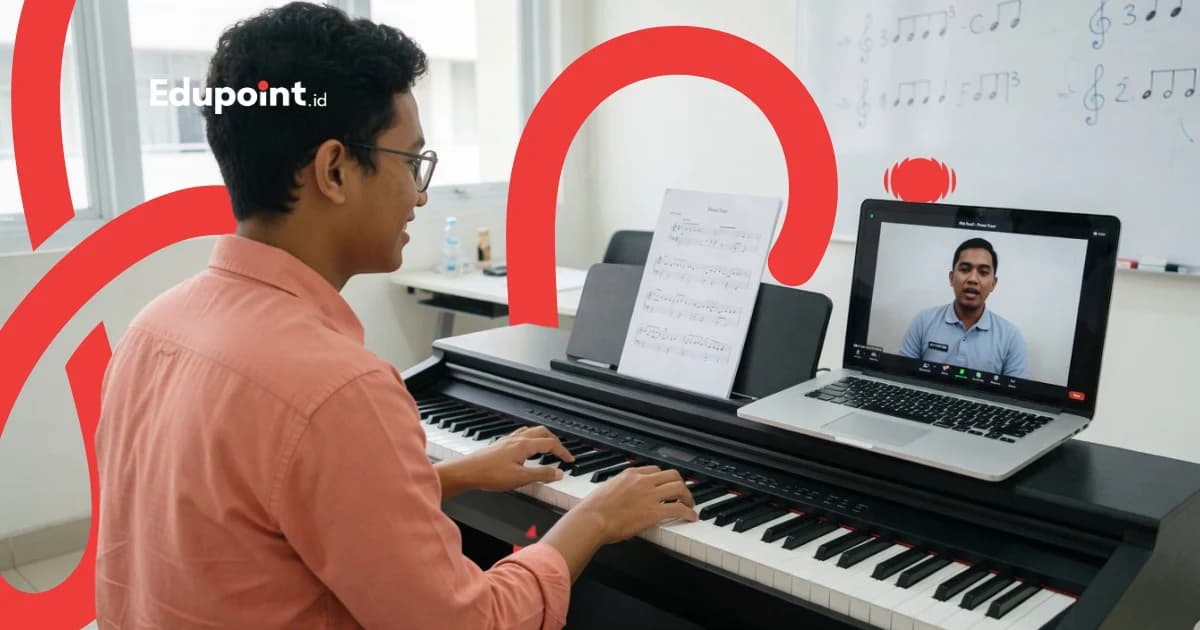
Online Piano Lessons: Camera on the Keys, a Teacher Guiding Every Finger
Your piano stays in your living room while your teacher can come from any city. One-on-one video call sessions with digital sheet music, curriculum tracks from classical to ABRSM exam prep, and monthly progress reports parents can actually read.
424+
tutors
3,400+
students
5
rating · 1,016 reviews
60+
cities
What is Online Piano Lessons?
Online piano lessons are one-on-one piano classes conducted by video link, keyboard in full view of the camera and scores shared on screen. EduPoint offers 5 curriculum tracks, from classical piano to ABRSM exam preparation, in 60, 90, or 120 minute sessions, with rates starting at Rp 61,000 per hour on 120-minute session packages.
- Fully one-on-one; the teacher watches your hands through a camera aimed at the keys and corrects fingering in real time
- 5 online piano curriculum tracks: classical, pop and contemporary, piano for kids, jazz, and graded exam preparation
- Curriculum follows the ABRSM framework (founded 1889), with Trinity as an alternative tracking path, from Initial through Grade 8
- Monthly reports cover technique, repertoire, and theory, so progress from complete beginner onward stays visible
- Online piano teachers across cities: a student in a small town can still study with a jazz or exam-prep specialist
Services
Session Lengths for Online Piano Lessons
Every session is one teacher, one student, over video call. You choose the length during consultation, matched to the student's age and attention span.
60-Minute Session
Right for children aged 4-8 and beginners building a practice habit. Enough for a warm-up, one technique focus, and one piece.
Rp 78.000/session
60 menit
- Good for steady warm-ups
- One focus per session
90-Minute Session
For teens and adults who want a balanced share of theory and playing. Leaves room for sight-reading work and deeper repertoire discussion.
Rp 97.000/session
90 menit
- The most balanced length
- Theory plus hands-on play
120-Minute Session
For ABRSM/Trinity exam preparation or serious students chasing a grade target. Fits scales and arpeggios drills, aural practice, and a three-piece exam run-through.
Rp 123.000/session
120 menit
- Cheapest effective hourly rate
- Room to explore repertoire
The Grade Ladder: From Initial to Grade 8
The ABRSM framework has 9 levels: Initial plus Grades 1 through 8. Your online piano teacher maps your starting point, then sets realistic targets.
Initial (Absolute Beginner)
For children aged 4-7 or adult beginners. Typically 6-8 months with 15-30 minutes of daily practice; the focus is posture, fingering, and short pieces.
Subjects:
Meet the keysFirst songs
Focus Areas:
- Meet the keyboard
- Sitting posture
- First songs
Grade 1
Roughly 12-15 months from zero with 30 minutes of daily practice. Material includes C, G, and F major scales over one octave plus three syllabus pieces.
Subjects:
Basic notationMajor scales
Focus Areas:
- Staff notation
- Basic scales
- Simple chords
Grades 2-5 (Intermediate)
Pieces get longer, the left hand works harder, and sight-reading and aural skills start to matter. This is where a structured practice habit pays off most.
Subjects:
Intermediate piecesPedal technique
Focus Areas:
- Graded repertoire
- Pedalling
- Sight-reading
Grades 6-8 (Advanced)
Concert-level repertoire with real interpretive demands, usually reached by classical or exam-track students after years of consistency.
Subjects:
Exam piecesInterpretation
Focus Areas:
- Exam pieces
- Interpretation
- Aural skills
5 Piano Curriculum Tracks to Choose From
Your track is decided together with the teacher in the early sessions, and switching later is fine as interests develop. Every track runs fully online.
Repertoire from the Baroque to the Modern era, music theory, sight-reading, and ear training. The strongest track for long-term technical foundations.
- Posture and hand position
- Basic fingering
- Reading staff notation
- Rhythm and pulse
Chord progressions, reading lead sheets, and basic improvisation. For students who want to play the songs they already love, fast.
- Major and minor scales
- Chords and progressions
- Pedal technique
- Dynamics
Suzuki and Bastien methods with children's songs and recital goals. Sessions are paced in short, varied segments so kids aged 4-6 stay engaged.
- Graded classical repertoire
- Interpretation
- Sight-reading
- ABRSM exam prep
Voicing, blues scales, jazz standards, comping, and walking bass. Built for players already comfortable with basic chords.
- Pop chords and accompaniment
- Playing while singing
- Simple improvisation
- Reading lead sheets
Regular mock exams, scales and arpeggios drills, and aural practice following the ABRSM or Trinity syllabus, from Initial through Grade 8.
- Progressive children songs
- Rhythm games
- Two-hand coordination
- Short focused drills
Who It Is For
Who These Online Piano Lessons Are For
The four student groups we teach most often, each with a different approach.
They start on the Piano for Kids track with Suzuki and Bastien methods. 60-minute sessions built around children's songs, with parents welcome beside the keyboard.
Recommended:
The Pop & Contemporary track: chord progressions and lead sheets so they can quickly accompany the songs they are listening to, with theory layered in gradually.
Recommended:
Online piano lessons for adult beginners remove the biggest obstacle: time. Learn piano from scratch online at home, with a curriculum that respects how adults learn.
Recommended:
The Exam Preparation track with mock exams, scales drills, and aural practice. ABRSM or Trinity grade targets are set realistically with the teacher.
Recommended:
Why Us
Why Take Online Piano Lessons with EduPoint
Our online format was designed around instruments, holding the same visual and curriculum standards as an in-person class.
Camera on the keys, precise correction
From the first session, the teacher sets up a camera angle facing the keys, so fingering, wrist posture, and pedaling are visible and corrected on the spot.
Specialist teachers across cities
424 online piano teachers from 60+ cities means a student anywhere can study jazz voicing or ABRSM exam prep with someone who genuinely specializes in it.
Sheet music shared digitally
Lead sheets, grade syllabi, and sight-reading exercises arrive before each session. Every online piano course material stays organized in one place.
Monthly three-part reports
Each month parents receive notes on technique, repertoire, and theory, plus a repertoire log and ABRSM/Trinity grade tracking for exam-track students.
Schedules that follow family rhythm
With no commute, sessions can sit after school or after work. The travel time you save goes straight into personal practice.
Teacher replacement guarantee
Should teacher and student fail to click, one message to us swaps in a better match, free.
Two-way demonstration on two instruments
The teacher demonstrates on their own piano with the camera close to their hands, and the student mirrors it on theirs. A viewing angle that close is hard to come by when two people share one piano bench.
Testimonials
What Piano Parents and Students Tell Us
Six voices spanning the kids track through graded exam preparation, from parents and adult learners alike.
I doubted a five-year-old could sit through a video call lesson. The teacher proved me wrong by rotating activities: a rhythm clap here, a short song there, a note-guessing game after. I sit in on sessions and get pointers on how to accompany practice on the off days.
Ratna W.
Parent of a 5-year-old student • Surabaya
Finding a suitable classical piano teacher in our town was a struggle. Online, my son studies with a teacher from another city who is endlessly patient about posture and fingering. The monthly report is detailed enough that I know exactly which technique work and pieces he is on.
Hendra S.
Parent of a 4th grader • Balikpapan
My daughter only wanted to play songs from her own playlist. Her teacher made that the entry point: favorite songs first, theory folded in gradually. These days she keeps track of her own lesson schedule without a single reminder from me.
Maya K.
Parent of a junior high student • Bekasi
I started from zero at 34 and never once felt talked down to. The Initial level material moves at a pace that respects a full-time job. The evening session after work has quietly become the hour I look forward to most.
Dimas P.
Adult beginner • Jakarta
I was comfortable with basic chords yet stuck on voicings for ages. My teacher genuinely lives in jazz; he demonstrates on his own piano with the camera right up close to his hands, and I mirror it on mine. The comping lessons build logically, from lead sheets to full accompaniment.
Sari L.
Jazz track student • Bandung
The regular mock exams are what keep me going. Every component gets weighed separately: syllabus pieces, scales, sight-reading, aural. So I always know which part deserves the bigger share of my practice before I register for the real exam.
Yusuf A.
Graded exam prep student • Makassar
Online Piano Lesson Fees
Rates are by the hour and follow the length: Rp 78,000 per hour for 60 minutes, Rp 97,000 for a 90-minute session, and Rp 61,000 per hour for the two-hour block. The longer the session, the lighter each hour.
Starting from
Rp 61.000 / hour
Final price is set at registration.
This is the lowest hourly rate, derived from the 28-session monthly plan at 120 minutes per session. Per-session prices (60, 90, or 120 minutes) appear in the format options above.
Flexible payment — QRIS, Virtual Account, Alfamart, Indomaret, transfer & e-wallets.
These are starting rates for one student. ABRSM/Trinity exam fees are paid separately and directly to the exam board; they are never part of the lesson fee.
An Honest Look: Online Piano Lessons, Studio Courses, and Tutorial Videos
Each of these three paths to the piano has real strengths. This table maps the differences plainly, so you can choose the format that fits your home setup and your family's schedule.
| Feature | EduPoint Private Tutoring | Studio Music Course | Learning from Tutorial Videos |
|---|---|---|---|
| A teacher watches your hand position and corrects it on the spot | |||
| Practice on an acoustic piano owned by the course venue | - | ||
| Practice materials and session recordings stay open anytime in the EduPoint learner app | |||
| Specialist teachers in jazz or exam prep from 60+ cities, zero commute |
FAQ
Online Piano Lessons FAQ
Answers to the questions parents and adult students ask most before enrolling.
Complete Guide
A Short Guide Before You Start
Guides & Tips
Supporting articles to help you decide and maximize learning outcomes.
How to Choose Piano Lessons for Young Children: A Parent's Guide
Choosing piano lessons for young children goes smoothly when parents gauge readiness first, then match the method, teacher, and session format to the child's own pace.
How to Learn Piano for Beginners: A Step by Step Guide
Piano practice flows best in a clear order: get to know the instrument, build correct hand position, then raise the difficulty little by little.
How to Read Piano Sheet Music from the Staff to the Keys
Reading piano sheet music goes most smoothly in a clear order: understand the two staves, learn note names on lines and spaces, read note values, then connect them to the keys.
How to Train Two-Hand Coordination on Piano From Scratch for Beginners
Seven sequential stages that carry a beginner from strengthening each hand separately to playing a full song where melody and accompaniment flow together smoothly.
Sit at the Keys, We Handle the Rest
Discuss the track you want, pick practice hours that fit, our team finds a piano teacher on that track, and the first session gets straight to hand position and reading.
A consultation on classical, pop, or ABRSM tracksPractice hours set by youA same-track teacher found by our teamA first session that starts right at the keys