Online Program for Ages 7-15
Online Coding Lessons for Kids: Scratch Blocks through Python Lines
Your child learns with a dedicated private tutor over video call and two-way screen sharing. The material grows with their age, and every stage wraps up with a game or animation that is genuinely their own creation.
340+
tutors
1,650+
students
4.9
rating · 1,112 reviews
60+
cities
What is Online Coding Lessons for Kids?
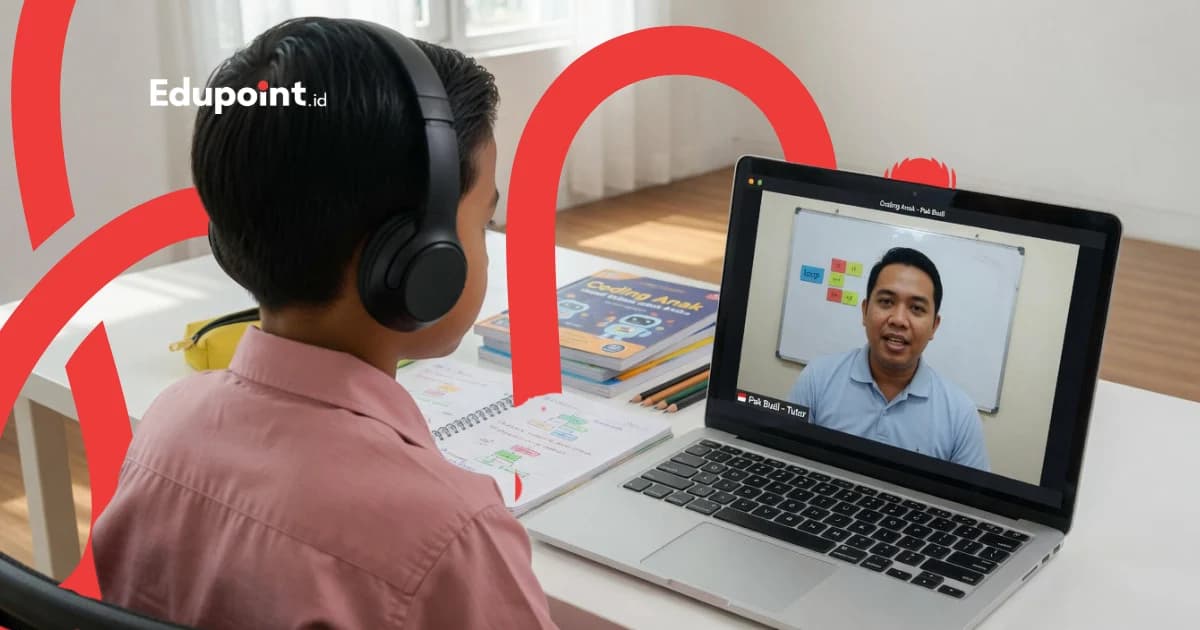
Think of this as a private coding class delivered entirely through video, complete with two-way screen sharing so tutor and child can work on the same project together in real time. It is built for the 7-15 age range, taking kids from Scratch's building blocks toward their first lines of Python, with a real game or animation to show at every stage. Parents choose a 60, 90, or 120-minute slot, with availability stretching from six in the morning to eleven at night WIB.
- Open to children aged 7-15, starting from zero with no prior experience required
- A staged curriculum: block-based Scratch, a logic bridge, then beginner Python
- One tutor, one student, with the pace always set by your child
- Two-way screen sharing: the tutor sees the child's screen, the child sees the tutor's examples
- Every stage closes with a game or animation project the child built independently
- Every recorded session and progress report stays archived inside the EduPoint learner app
Services
Session Length Options for Online Coding
Sessions happen live over video call, with a single tutor giving your child their undivided attention and two-way screen sharing built in throughout. Choose the length that fits your child's age and attention span.
60-Minute Online Session
A great fit for ages 7-9, whose focus span is still short. One concept, one exercise, one small result they can proudly show their parents.
Rp 111.000/ 60-minute session
Price on the 28-session monthly plan, 60-minute sessions. Fewer meetings, higher price per session.
- Fully one tutor, one student
- Suits the Scratch Starter level
- Session recordings available in the app
- Flexible scheduling, 6 AM-11 PM WIB
90-Minute Online Session
The most balanced length for ages 10-12: long enough to work on a game project, short enough to keep your child fresh until the end.
Rp 140.000/ 90-minute session
Price on the 28-session monthly plan, 90-minute sessions. Fewer meetings, higher price per session.
- More room for hands-on project work
- Suits the Game Creator level
- Quick homework review at the start of each session
- Progress reports in the learner app
120-Minute Online Session
An intensive project session for ages 13-15 who are deep into beginner Python or racing a school project deadline.
Rp 179.000/ 120-minute session
Price on the 28-session monthly plan, 120-minute sessions. Fewer meetings, higher price per session.
- Enough time for debugging together with the tutor
- Suits the Pre-Python level
- Self-study material between sessions in the app
- Works well for project mentoring
Online and in-person cost the same — the gap between these cards is session length, nothing else.
Coding Levels That Match Your Child's Age
During that first meeting, the tutor works out exactly where your child should begin, then dials up the difficulty the moment they are ready for more.
Scratch Starter
Ages 7-9Short, playful sessions. Children learn sequencing and cause-and-effect through Scratch blocks, with results they can see on screen at every single meeting.
Subjects:
Scratch basicsSequencing logicSimple animation
Focus Areas:
- Confidence at the computer
- Tidy click-and-drag skills
- The habit of finishing small projects
Game Creator
Ages 10-12The level where a love of games turns into the skill of making them. Children master variables, conditions, and level design until they can ship a complete Scratch game.
Subjects:
Advanced ScratchGame designVariables and conditions
Focus Areas:
- Computational thinking
- Breaking big problems into small steps
- Carrying a project from idea to finished
Pre-Python
Ages 13-15Children move into text code standing on solid ground. The target at this level is a simple Python program written entirely by the child, from interactive quizzes to calculators.
Subjects:
Beginner PythonProgramming logicText-based projects
Focus Areas:
- Reading error messages calmly
- Writing clean code
- Independence in finding solutions
Kids Coding Curriculum: Staged by Age
Four modules that carry a child from their very first block to writing a simple Python program. The tutor picks the right starting point based on your child's age and experience.
The module order is flexible. A 13-year-old who is already fluent in Scratch can move straight into the text-code bridge without repeating the basics.
Scratch Foundations
Children meet the world of programming through Scratch's colorful blocks. The goal here is confidence: a first command, a first movement, a first animated story.
- Sprites, the stage, and costumes
- Motion, looks, and sound blocks
- Events and simple loops
- Project: a short animated story made by the child
Scratch Games and Animation
From player to maker. Children design their own game rules: score, lives, moving enemies, all the way to win and lose screens.
- Variables for score and lives
- Win-lose conditions and branching
- Cloning objects and moving enemies
- Project: a complete game of the child's own design
Bridge to Text Code
The transition phase many courses skip entirely. The tutor helps your child read program flow, plan steps with pseudocode, and get comfortable inside a real code editor.
- Reading and explaining program flow
- Pseudocode: writing the steps before writing the code
- Conditions and loops across languages
- Getting to know a code editor and how it works
Beginner Python
Teens aged 13-15 start writing real text code. Concepts they already know from Scratch reappear as Python lines, so the jump feels logical instead of scary.
- Variables, data types, and basic operations
- Input, output, and if statements
- Loops and simple functions
- Mini projects: an interactive quiz and a calculator
Who It Is For
Who Are These Coding Lessons For?
Four kinds of kids and families who benefit most from one-tutor-one-student online coding.
Curious elementary schoolers
Ages 7-9 who love drawing, storytelling, or playing on a tablet. Scratch turns that curiosity into animations they made themselves.
Recommended:
Scratch Starter level60-minute sessions1-2 sessions per week
Game fans aged 10-12
Kids who can happily game for hours. That energy gets channeled into dissecting how games work and then building their own versions.
Recommended:
Game Creator level90-minute sessionsGame projects the child picks
Young teens ready to get serious
Ages 13-15 who are starting to think about majors or an informatics club. Beginner Python gives them a head start before the school material arrives.
Recommended:
Pre-Python level90 or 120-minute sessionsA project target every month
Homeschooling and relocating families
Families who move between cities or follow a home curriculum. The tutor and your child's progress travel with you; an internet connection is all it takes.
Recommended:
Morning slots available tooSame tutor even after a moveRegular reports for your learning records
Why Us
Why Parents Choose EduPoint for Kids Coding
Eight reasons families trust our online private tutors with their child's first steps in programming.
Vetted tutors who get kids
Our coding tutors pass a strict screening and are used to teaching children, so sessions feel like play that quietly builds logic.
One tutor, one student
Your child gets the tutor's full attention. Questions are answered on the spot, struggles are spotted immediately, and the pace follows the child.
Two-way screen sharing
The tutor watches your child's screen to correct their steps, and your child watches the tutor's screen to follow examples. Remote coding lessons end up feeling like sitting side by side.
Learning through game projects
Every concept is wrapped in a game or animation project chosen together with your child, so the motivation comes from their own creation.
Flexible hours, 6 AM-11 PM WIB
Morning slots before school, afternoon blocks, or evening sessions once other activities wrap up, whichever suits your family's routine, can all be arranged directly with the tutor.
Recordings and reports in the app
The EduPoint learner app stores session recordings, self-study material, and progress reports that parents can open anytime.
Tutors from 60+ cities
Because classes run online, your child can learn from the best coding tutors who have joined us from more than 60 cities across Indonesia.
Tutor replacement guarantee
If a teaching style doesn't click with your child, tell us and a new tutor steps in, at no additional charge.
Online Kids Coding Lesson Fees
Every figure on this page is pulled straight from the engine that also prices the registration form, so what you see here matches what shows up when you actually sign up. Rates scale with session length (60, 90, or 120 minutes), while the monthly package itself can be set anywhere between 4 and 28 sessions and adjusted again the following month.
Starting from
Rp 90.000 / hour
Final price is set at registration.
This is the lowest hourly rate, derived from the 28-session monthly plan at 120 minutes per session. Per-session prices (60, 90, or 120 minutes) appear in the format options above.
Register & Get a QuoteFlexible payment — QRIS, Virtual Account, Alfamart, Indomaret, transfer & e-wallets.
Settling the bill never comes down to one method: a bank transfer, a card swipe, a QRIS scan, or routing it through a Virtual Account or e-wallet all work the same way, and the total shown never grows behind the scenes. Prefer handling it in person? An Alfamart or Indomaret cashier takes the payment just as easily.
How We Teach Coding to Kids
Projects the child owns
Every concept is learned through a project whose theme the child picks. A game about their pet cat or an animation of their favorite football team, anything goes as long as the logic is sound.
Blocks first, text later
Children master logic through Scratch blocks before touching syntax. When they move to Python, the tutor shows how the concepts they already know return as lines of code.
Taking turns at the keyboard
Through two-way screen sharing, the tutor gives a short demonstration and then hands over control. Most of each session passes with the child's hands on the keyboard.
Breaking problems into small steps
The tutor trains the habit of splitting a big idea into small steps that can be done one at a time. That habit carries over into other school subjects too.
Celebrate the error, try again
Error messages are treated as valuable clues. Children learn to read them calmly, guess the cause, apply a fix, and run the program again until it works.
Where Online Kids Coding Lessons Are Available
Online Tutoring
Online WorldwideThe whole program runs online, which means a child anywhere can be matched with one of our coding tutors from a network spanning more than 60 cities, no matter their home city. Every meeting takes place through video call, with two-way screen sharing carrying the interaction throughout.
- Coding tutors from 60+ cities across Indonesia
- Video calls with two-way screen sharing
- Session recordings you can replay in the app
- Self-study material between sessions
- Progress reports for parents
FAQ
Online Kids Coding Lessons: Your Questions Answered
The questions we hear from parents again and again, answered before you decide to sign up.
Yes. The program accepts children aged 7-15 starting from zero. A 7-year-old begins at the Scratch Starter level with 60-minute sessions: learning sequencing logic through colorful blocks, with zero typing involved. The only practical requirements are reading short instructions and handling a mouse.
A standard laptop or desktop with a browser, a stable internet connection, plus a microphone and camera. Scratch and beginner Python run light, so an ordinary family laptop is plenty. A simple headset helps your child focus. We advise against tablets because the split screen makes hands-on practice awkward.
Sessions use video calls with two-way screen sharing. The tutor watches your child's screen live to correct their steps, and your child watches the tutor's screen during demonstrations. Control passes back and forth, with the largest share staying in your child's hands. Recordings are saved in the learner app for replay.
Usually at ages 13-15, after their core logic has matured through Scratch and the text-code bridge phase. A younger child who is clearly ready can be fast-tracked by their tutor, while a child who needs more time gets it without pressure. The switch point is decided by readiness, and that is the strength of the one-tutor-one-student format.
Use age and attention span as your guide. Ages 7-9 do best with 60 minutes, ages 10-12 with 90 minutes since game projects need practice time, and ages 13-15 working on Python can take 120 minutes. You can switch lengths the following month if needs change.
Complete Guide
The Complete Guide to Coding Lessons for Kids
The most common starting window is ages 7-15, which is exactly what this program covers. By age 7, most children can read short instructions, understand sequences, and control a mouse fairly well. Those three abilities are all Scratch requires.
Readiness signs matter more than the number on a birthday cake: your child happily finishes puzzles or simple lego builds, keeps asking "why" about things around them, and can stay focused for about 30-45 minutes with breaks. Once those signs appear, a 60-minute session with a private tutor will fly by for them.
For a 13-15-year-old who has never coded at all, starting still makes perfect sense. Tutors usually compress the block phase into a few sessions, then move the teen into beginner Python while their motivation is still fresh.
Scratch works as the gateway because it removes the beginner's biggest obstacle: typos. Children snap blocks together like lego, so all their energy goes into logic, flow, and creativity. This is the phase where they produce their first animations and games.
Once fluent, the child enters the bridge phase. They learn to read program flow, write pseudocode, and get comfortable in a code editor. This phase is what makes the move to Python feel gentle. Many children quit coding precisely because they jumped straight from blocks to text without this bridge.
In the beginner Python phase, the child rewrites ideas they once built in Scratch as lines of code: interactive quizzes, calculators, number-guessing games. The concepts are already theirs, so all that remains is learning the new language. The target for this phase is a simple text program that runs from start to finish, typed by the child alone.
- 1Let your child linger in Scratch while they still enjoy it; a solid logic foundation beats a fast language switch
- 2Ask your child to explain how their program works in their own words; it is the most honest measure of understanding
- 3Keep every old project; looking back at simple early work builds real pride in how far they have come
You do not need to know how to code to support your child. The most important role is simple: prepare a quiet study spot, have the device and connection ready five minutes before the session, and be the first audience for every new creation.
After each session, open the report and the recording in the EduPoint learner app. There you can see what was covered along with the tutor's notes, then chat casually with your child about the project. A question like "how did you make your character jump?" does far more good than assigning extra practice time.
- 1Provide a simple headset so your child can focus on the tutor's voice
- 2Schedule sessions for the hours when your child is freshest; the program runs 6 AM-11 PM WIB
- 3Have your child demo their project to the family; that little stage is the biggest fuel for motivation
- 4Tell the EduPoint team if the tutor's style feels off; the tutor replacement guarantee applies
Good intentions can quietly turn into obstacles. The four patterns below are the ones we see most often in families who come to us after their child lost interest elsewhere.
Forcing an adult programming language from day one
Start with a visual medium like Scratch. A child who masters logic through blocks will absorb Python far faster when the time comes.
Measuring progress by how much material has been covered
Measure by creations instead. One simple game that is finished and playable outweighs ten theory chapters rushed through.
Letting coding swallow all of a child's playtime
Keep the portion sensible; one or two sessions a week is enough for steady progress. At the right dose, coding stays a treat your child looks forward to.
Comparing your child's speed with other children
The one-tutor-one-student format exists precisely so the pace follows your child. Compare them with who they were last month; the reports in the app make that easy.
Guides & Tips
Supporting articles to help you decide and maximize learning outcomes.
How to Choose the Right Coding Course for Your Child
Six steps to filter an increasingly crowded market, from defining goals to observing the first class, complete with market price benchmarks.
How to Choose Your Child's First Programming Language
A practical guide to matching a coding language with your child's age, interests, and reading readiness.
How to Introduce Coding to Children Early
Growing a computational way of thinking in children aged 3 to 7 through daily moments and screen-free play, long before little fingers touch any app.
How to Teach Kids Coding from Scratch
Six steps parents can run at home, starting with simple games and ending with your child's first self-made video game.
How to Turn Your Child's Screen Time Productive
Five steps to shift screen hours from passive watching to making things, with coding as one of the paths kids love most.
The Right Age for Kids to Start Coding
Four age windows, one main compass: the child's readiness read from interest and ability, with the age number acting as a rough signpost.
Ready to See Your Child's First Game?
Tell us your child's age and interests, and we will find a coding tutor who fits. Sessions can start this very week at any hour you choose between 6 AM and 11 PM WIB.
Discuss your child's needs and scheduleWe match them with the right coding tutorStart the first session and follow along in the app