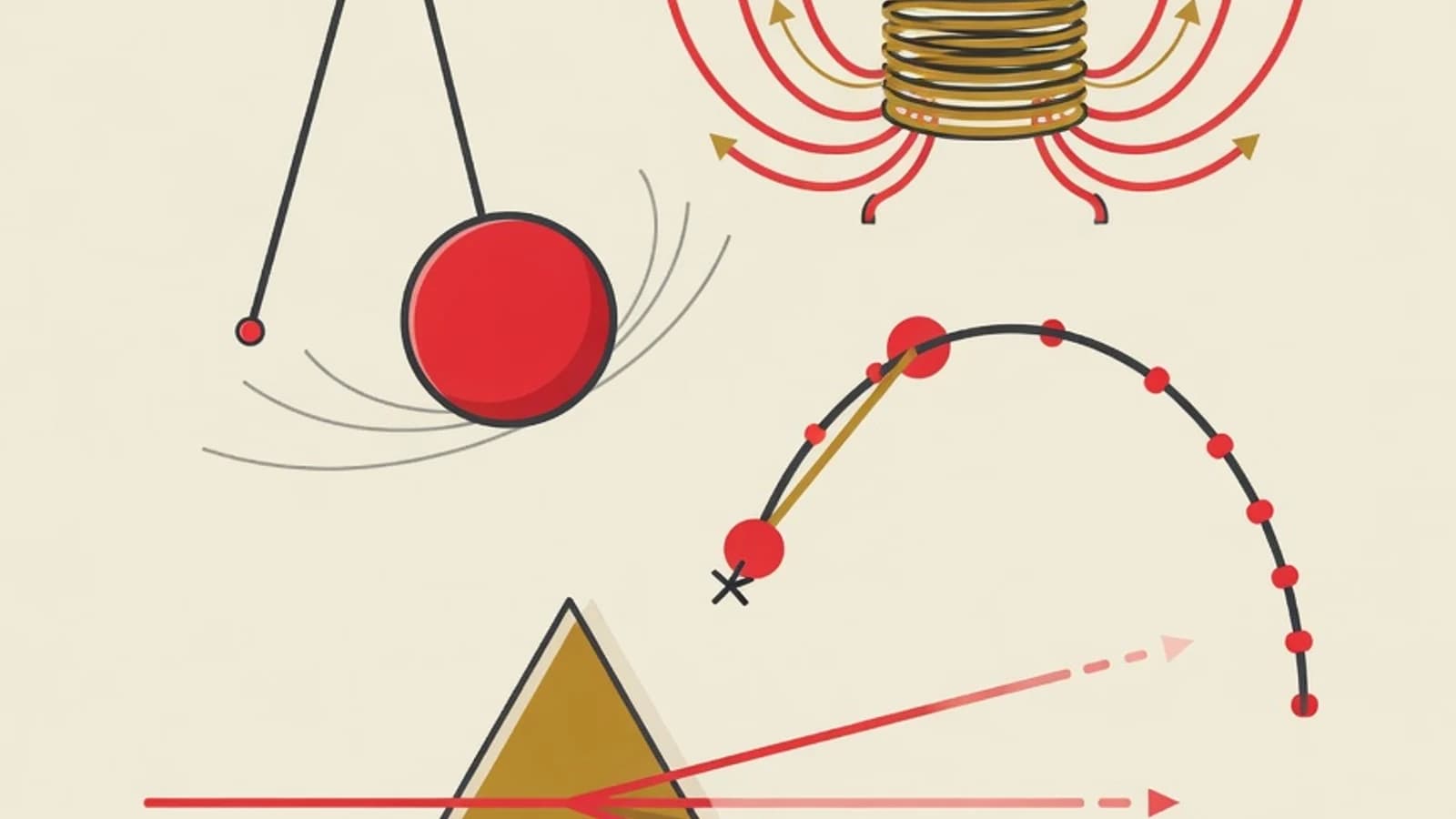
Studying for the physics olympiad effectively starts from a foundation of calculus and mechanics, then rises into five core fields: mechanics, electricity and magnetism, thermodynamics, waves and optics, and modern physics. Build theory, practice layered problem solving, sharpen experimental reasoning, then test yourself through the tiered OSN selection.
- Foundation first: calculus and Newtonian mechanics are the language for every advanced field
- The five core fields are trained in rotation so no physics olympiad material is left behind
- Experimental reasoning and error analysis matter as much as theoretical calculation
- Theory books at the level of Halliday, Irodov, or Kleppner
- Archive of past OSN and IPhO problems
- A notebook for error analysis
Numbers that shape a physics olympiad study map
Why studying for the physics olympiad must be layered
Physics olympiad problems rarely ask for a formula outright. A single question often fuses mechanics with energy conservation, then resolves through a clean integral. Studying by memorizing isolated formulas leaves a student stuck the moment a problem demands that concepts be combined. A durable way to study for the physics olympiad places understanding above memorization and arranges material from foundation to branch. The first layer is the thinking toolkit: differential and integral calculus, vector algebra, and Newton's laws used again and again across every field. Above it stand the five core fields that connect to one another. At the top sits the ability to read long problems, choose an approach, and write a coherent solution. Arranging practice by these layers gives every session a clear target and makes progress measurable.
Steps to study for the physics olympiad in stages
This order stacks skills from the bottom up. Work each stage until it feels solid before adding the load of the next, because every layer supports the one above it.
- 1
Strengthen calculus and mechanics before touching olympiad problems
Before opening an OSN problem, make sure the mathematical tools are ready. Master derivatives and integrals of basic functions, vector algebra, and motion under changing acceleration. Physics olympiad problems use calculus to derive equations of motion, compute centers of mass, and resolve position-dependent potential energy. Practice Newton's laws on multi-body systems, pulleys, and inclined planes with friction until fluent. A solid foundation makes advanced fields feel like a natural extension. Work through regency-level mechanics problems as a warm-up, and make sure every step has a physical reason you can explain in your own words.
Tips- Keep one dedicated notebook for deriving key equations from scratch
- Solve each mechanics problem two ways, through forces and through energy, to widen understanding
Skipping calculus and memorizing shortcut formulas leaves a student stuck the moment a problem demands a derivation of their own. - 2
Study the five core fields in rotation
Once the foundation is firm, enter the five core physics olympiad fields one at a time: advanced mechanics, electricity and magnetism, thermodynamics, waves and optics, then modern physics. For each field, begin by reading theory from a source at the level of Halliday, rise to Kleppner or Irodov for olympiad depth, then work graded problems. Schedule a weekly rotation so no field goes long untouched, because physics olympiad material demands all five fields mature together. Write a one-page summary of each field's key equations along with their origins. A summary you write yourself sticks far better than a ready-made one, and becomes a quick reference when you review before a selection.
Tips- Map how fields connect, for example oscillation appears in mechanics, in LC circuits, and in waves
- Identify your weakest field from practice results and give it a larger share of time
- 3
Practice problem solving with a three-layer approach
Physics olympiad problems are scored on process, so how you write a solution helps determine the mark. Build the habit of three layers: understand the physical situation and draw its diagram, set up equations from basic laws, then solve mathematically with consistent units. Work through archives of past OSN and IPhO problems under exam-like conditions, complete with a time limit. Afterward, compare against the official key and mark where your reasoning strayed. Honest error analysis speeds progress more than simply piling on problems. Keep a record of recurring mistakes, such as forgetting to check limiting cases or setting the wrong sign reference.
Tips- Write solutions as if a judge will read them: annotate every leap of logic briefly
- Attempt old problems without checking the key first, because that struggle is what builds reasoning
Reading the solution before genuinely trying makes the answer feel obvious while the skill itself never forms. - 4
Sharpen experimental reasoning and data processing
The experimental portion carries a large share of the score at higher levels, so this skill needs practice early. Learn to design simple experiments, read measuring instruments, and estimate the uncertainty of a result. Practice data processing by plotting graphs, drawing a best-fit line, and reading its slope as a physical quantity. Experiments such as measuring gravitational acceleration with a pendulum or finding resistance from a voltage-versus-current graph build an intuition that theory alone cannot give. Get used to naming sources of error and estimating their size, because examiners value awareness of an instrument's limits of precision. The ability to connect raw data with a physical model is what sets a mature contestant apart.
Tips- Practice reading a vernier scale and a micrometer until quick and accurate
- Always include units and reasonable significant figures on every measured result
- 5
Test readiness through OSN tier simulations
Skill only proves itself when tested under real selection conditions. OSN Physics runs in tiers from the regency or city level, up to the provincial level, then to the national level, with difficulty rising at each stage. Build periodic simulations using problem sets from each tier and work them for the full duration without pausing. Review the results with a mentor to see which field needs strengthening before the next selection. Regular simulation trains time management, hours-long focus endurance, and calm in the face of problems that look unfamiliar. Treat every simulation as feedback that reshapes your next practice mix.
Tips- Record how much time each item takes to find problems that drain time excessively
- After a simulation, rework any failed item to completion without help
The five core fields of physics olympiad material
Mechanics
Dynamics of bodies, conservation of energy and momentum, oscillation, rigid body rotation, and simple celestial mechanics.
Electricity and Magnetism
Electric fields, direct and alternating current circuits, electromagnetic induction, and Maxwell's laws at a basic level.
Thermodynamics
Laws of thermodynamics, kinetic theory of gases, processes and cycles, plus heat transfer that demands integration.
Waves and Optics
Mechanical waves, sound, geometric optics, interference, and diffraction of light that demand strong visualization.
Modern Physics
Special relativity, wave-particle duality, atomic models, and an introduction to quantum physics for advanced tiers.
Experimental Skills
Experiment design, measurement, uncertainty analysis, and data processing, tested separately at the IPhO.
OSN Physics tiers and their preparation focus
| Tier | Material scope | Practice focus |
|---|---|---|
| Regency or city level | Basic concepts of all five fields | Speed and accuracy on core problems |
| Provincial level | Combining concepts across fields | Depth of analysis and equation derivation |
| National level | Deep theory and experiment | Creativity, time management, experimental reasoning |
Difficulty rises at each tier. Readiness grows continuously, so a field that looks weak at one stage is strengthened before the next.
“The contestants who grow fastest are the ones who dare to wrestle with a hard problem before looking at the solution. That honest struggle is what shapes physical reasoning, and this habit of orderly thinking carries far beyond the olympiad itself.”
Signs of readiness to move to the next practice stage
- Can derive equations of motion from Newton's laws without a worked example
- Solves a mechanics problem through both forces and energy with the same result
- Recognizes all five core fields and knows which is weakest
- Writes coherent solutions complete with diagrams and consistent units
- Habitually estimates the uncertainty of every experimental result
The physics olympiad in Indonesia and the role of coaching
The physics olympiad in Indonesia runs through a tiered path managed by the National Achievement Center. Selection begins at the regency or city level, continues to the provincial level, then peaks at the national level, before the best contestants enter training toward international events such as the International Physics Olympiad. This path is open to anyone who builds a foundation patiently and practices with direction. The right coaching keeps the order of learning healthy. A mentor helps flag weak fields early, points out alternative approaches missed during problem analysis, and keeps the balance of theory and experiment practice steady. The road to the OSN does take months, and a mentor who understands the material map makes every hour of practice more purposeful toward the goal.
- Studying for the physics olympiad is best arranged in layers, from a calculus and mechanics foundation to the five core fields
- The five core fields are trained in rotation so mechanics, electricity and magnetism, thermodynamics, waves and optics, and modern physics mature together
- Three-layer problem solving scores on process: understand the physical situation, set up equations, solve mathematically
- Experimental reasoning and data processing carry a large share of the score at higher tiers
- OSN Physics runs in tiers from regency or city, to provincial, to national, with difficulty rising step by step