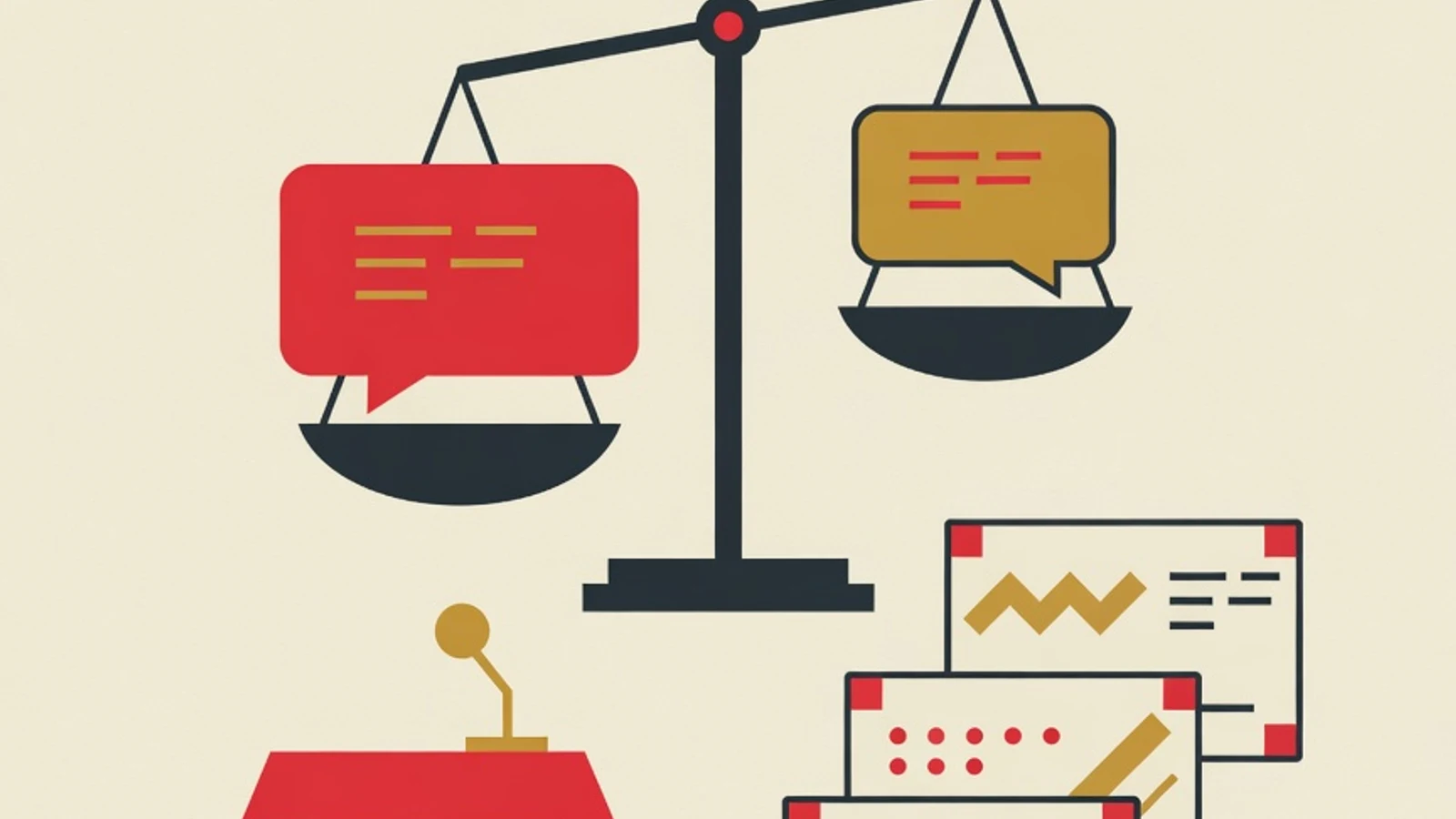
Building a strong debate argument rests on four layers: state a sharp claim, explain the cause and effect reasoning, back it with credible evidence, then link it back to the motion while showing its impact. The AREL framework and the Toulmin model keep every argument whole and hard for opponents to knock down.
- A strong argument always carries a claim, reasoning, evidence, and a link to the motion
- AREL helps a speaker map the content before stepping up to the podium
- An argument that pre-empts rebuttals is far harder to topple in the clash
- A practice motion together with its context
- A notebook or argument cards to map each claim
- A timer to get used to the speaking limit
A debate argument has an anatomy you can drill
Why structure decides the strength of a debate argument
Many beginner debaters assume a strong argument means speaking at length and loudly. What actually decides it is the framework. One simple point with every part complete often beats three long points that float without evidence. Judges assess whether a listener can follow the flow from the opening statement to the conclusion, and that flow comes from a tidy structure. This is where building a debate argument becomes a trainable skill that grows with practice, well within reach for anyone willing to drill it. The Toulmin model splits an argument into a claim, evidence, and the reasoning that links the two, then adds rebuttal as a defensive layer. The AREL framework popular on the school debate circuit compresses that model into four letters that are easy to recall when preparation time is short. Research on teaching through debate shows that practising structured argument also sharpens critical thinking, such as weighing the credibility of sources and spotting hidden assumptions. Those skills stay long after the tournament ends.
6 steps to build a strong debate argument
The sequence below carries you from reading the motion to an argument ready for the clash. Work through it in order while preparing your case, and repeat any step whose argument still feels fragile before you take the podium.
- 1
Unpack the motion and set the burden
Before writing a single line of argument, understand what is actually being debated. Read the motion word by word, mark the key terms that need defining, then decide whether your team is proposing or opposing. Set the burden, meaning the thing you must prove in order to win. On a motion such as this house would ban fast food advertising during school hours, the proposing side is obliged to show a real problem exists and the ban solves it. Misreading the burden makes a good argument feel like it fails to answer the debate. Write the definition and the burden on the very top line of your prep sheet so every argument stays anchored to it.
Tips- Underline loaded words such as should, must, or ban because they set the burden
- Agree on one definition with your teammate so arguments do not collide
- 2
State a sharp claim aligned with the motion
The claim is the core sentence you want the judge to accept, the A for Assertion in the AREL framework. Write it as a single firm statement that can be disputed, for example this ban shields children from an eating pattern that endangers their health. Avoid a claim so broad it cannot be proven in a short speech, and avoid one so narrow it has no bearing on the motion. Each argument should carry one main claim so its reasoning and evidence can stay focused. Give every claim a short name, such as the health argument or the economics argument, so teammates and judges can refer to it easily during the clash.
Tips- Test a claim by asking whether an opponent could reasonably reject it
- One speaker only needs two or three claims that are fully developed
Do not merge two claims into one argument. A branching argument spreads its reasoning thin and is easily broken at a single weak point. - 3
Build logical cause and effect reasoning
Reasoning is the R, the bridge that explains why your claim makes sense. Toulmin calls this the warrant, and it is the part beginners skip most often. Lay out the cause and effect chain step by step, and resist the urge to jump straight to the conclusion. For the health claim above, explain that children are less able to filter advertising, that heavy advertising normalises eating food high in sugar and salt, that excess consumption raises the risk of nutritional problems, so limiting exposure to the advertising breaks that chain early. Every time you write words like so or therefore, check whether the logical leap truly connects. Detailed reasoning makes an argument feel alive and hard to knock down with a single rebuttal.
Tips- Imagine the judge asking why after each sentence, then answer it in the next
- A chain of three or four links is enough, too long and it blurs
- 4
Add credible and relevant evidence
Evidence is the E, the material that grounds your reasoning in the real world. It can be statistics, research findings, a case example, a fitting analogy, or commonly accepted logic. Choose evidence that genuinely supports the claim, and let real relevance outweigh anything that merely sounds impressive. Name the source briefly for credibility, for example according to health ministry data, without reading a long quotation that eats into your time. One strong piece of evidence whose link is explained convinces more than five numbers fired off without context. In impromptu motions that allow no research during the round, train yourself to gather a stock of examples and data by reading news and current issues long before match day.
Tips- Tie each piece of evidence explicitly to the claim, do not leave the judge to guess
- Keep a bank of examples across issues, from health to education to economics, for impromptu motions
Never invent numbers or sources. Fabricated evidence caught by an opponent or judge instantly collapses the credibility of your whole argument. - 5
Show the impact and link back to the motion
This step is the L for Link back, the closer that returns your argument to the larger debate. Once the claim, reasoning, and evidence are in place, explain why they matter for the motion and who benefits. Show the concrete impact, for example children grow up with healthier eating habits so the family health burden falls. Compare the world with and without your proposal so the judge sees the difference you are fighting for. This link to the motion is what separates an argument that answers the debate from a good lecture that misses it. Close by restating the name of your claim so the judge can note it easily on the score sheet.
Tips- Use a comparative line, without this ban the situation stays exactly as it is now
- Always end on a sentence that names the motion, do not leave it hanging on evidence
- 6
Pre-empt rebuttals and prepare responses
A strong debate argument already imagines the attack before it arrives. The Toulmin model calls this rebuttal, the layer that considers exceptions and counter-arguments. After building each argument, move briefly to the opponent's chair and ask where its weakest point sits. The opposition might say the advertising ban infringes on business freedom, or that children are still exposed to the food from other sources. Prepare a concise response to each objection, whether by showing that protecting children takes priority, or that cutting one exposure route still matters. Preparing rebuttals in advance keeps you calm during the questioning and clash. Also practise dismantling the opponent's argument by pinpointing the flimsiest link in its reasoning and pressing on it, going past a plain denial of the claim.
Tips- Attack the opponent's reasoning or evidence, since that is where an argument cracks most easily
- Have one ready made rebuttal sentence for the objection most likely to appear
Do not rebut by simply repeating your own claim more loudly. A convincing rebuttal shows where the opponent's logic goes wrong, then offers a counter reasoning.
Argument frameworks debaters actually use
AREL
Assertion, Reasoning, Evidence, Link back. The most practical four letters for building a debate argument when prep time is short.
Toulmin model
Claim, evidence, reasoning, backing, qualifier, and rebuttal. A complete map for both dissecting and building a deep argument.
SEXI
Statement, Explanation, eXample, Importance. A light variation that stresses the example and the point's importance to the motion.
Telling a strong debate argument from a fragile one
| Aspect | Fragile argument | Strong argument |
|---|---|---|
| Claim | Vague and floating | Sharp, narrow, aligned with the motion |
| Reasoning | Jumps to the conclusion | A tidy cause and effect chain |
| Evidence | Numbers without context | Relevant evidence tied to the claim |
| Link to motion | Impact left unclear | Shows who benefits and why it matters |
Most points that lose a debate fail because one of these four layers is empty, giving the opponent a gap to exploit. The idea is often fine; the structure is what has a hole.
“Beginner debaters chase the cleverest argument. Mature debaters make sure their simple argument is complete from claim to link back, because judges reward wholeness, not complexity.”
A checklist to test your argument before you speak
- Is my claim a single firm sentence that can be disputed
- Does the reasoning explain why the claim is true without a logical leap
- Is the evidence relevant, credible, and already tied to the claim
- Do I show the impact and link it back to the motion
- Have I prepared a rebuttal for the objection most likely to appear
- Building a strong debate argument requires four complete layers: claim, reasoning, evidence, and link to the motion
- The AREL framework compresses the Toulmin model into four steps that are easy to use when prep time is short
- Detailed cause and effect reasoning is the part most often skipped and the most decisive for an argument's strength
- An argument that pre-empts rebuttals from the start faces the clash more calmly and is harder to knock down