The way of studying primary science in grades 4-6 that lasts longest is to observe first and memorise afterwards. Take one IPAS topic the class is covering, turn it into a question, and investigate it with safe household materials. This guide sets out 7 investigations, one per week, using ice, toys, glasses, and the child's own pulse.
- At school, primary science now sits inside the IPAS subject, which lists six process skills
- Grade 4 usually falls at the end of Phase B, grades 5 and 6 in Phase C
- Each investigation is tied to one official science topic, from states of matter to ecosystems
- A four-column observation journal is used for every step
- Five safety rules: no flames, no cleaning products, no tasting materials
- An exercise book for the observation journal, ruled into four columns per page
- Ice cubes, small plates, and a dry tea towel
- A toy car plus a board or a stack of thick books for a ramp
- Four identical glasses, a spoon, and a torch
- Mung beans, cotton wool, and two clear plastic cups
- Coloured pencils for tables and charts
Why grade 4-6 science notes fade after the test
Plenty of children in grades 4 to 6 study science the same way: they reread their notes the night before a test, memorise the definitions, and write them back onto the answer sheet. The mark can be good, yet two weeks later words like melting, evaporation, or friction have gone blurry again. That is normal, because what was stored is a set of words with no experience attached to them. In Indonesian primary schools the subject is now called Ilmu Pengetahuan Alam dan Sosial (IPAS), natural and social science combined. The 2025 IPAS subject guide published by BSKAP at Kemendikdasmen splits it into two elements taught as one whole: IPAS understanding and process skills. Process skills are how a child arrives at that understanding, and the guide names six of them: observing, questioning and predicting, planning and carrying out investigations, processing data, evaluating and reflecting, and communicating results. The same guide records two problems most parents of primary pupils will recognise. Assessment still leans heavily on memorisation, and lessons often stop at surface understanding with little link to daily life. The IPAS learning outcomes are written with the levels of the SOLO taxonomy, and memorising sits at the lowest level (unistructural). The level above it asks a child to connect several facts and explain the pattern that ties them together. So a sturdier way to study science in grades 4-6 can begin at the dining table or on the porch: the child watches ice melt, counts their own pulse, and measures how far a toy rolls across the floor. After that, the terms in the textbook have something to hold on to. This guide covers the science half of IPAS. The social half (maps, history, culture, economics) calls for its own study approach.
7 steps to learning grade 4-6 science through home investigations
Each step pairs one investigation with one science topic from IPAS. Grade 4 usually sits at the end of Phase B, while grades 5 and 6 are in Phase C, so the way data is recorded and processed steps up in the later stages. One step a week is plenty, and the order can follow whichever chapter the teacher is covering at school.
- 1
Turn one chapter into a question that can be investigated
Start from the notebook or worksheet the class has just covered. Ask the child to pick the one sentence they have memorised most often, such as "ice melts because it takes in heat". That sentence is then rewritten as a question whose answer they can see for themselves: which ice cube disappears first, the one by the window or the one on the table indoors? A question worth investigating has two features. Its answer can be seen with the eyes or measured with a simple tool, and the experiment can be done at home without hazardous materials. Before trying anything, the child writes a prediction on the first page of the observation journal, with a reason. "The one by the window goes faster, because the sun hits it" is already a sound prediction. The IPAS guide names this ability in both phases: in Phase B children ask their own questions while observing and predict from what they already know, and in Phase C, with a teacher's help, they start sorting out which questions can actually be investigated scientifically. An ordinary exercise book works as the observation journal. Each page is split into four columns: question, prediction, what I saw, and conclusion. The same layout carries through every later step, so the child never has to relearn how to take notes each week and can give full attention to observing.
Tips- Write predictions in pencil and leave them in place even when they turn out wrong. A missed prediction makes the best discussion material in step 7.
- Give each question its own page so the journal is easy to flip through before a test.
- 2
States of matter: three ice cubes in three spots (Phase B, grade 4)
Changes in the state of matter are part of the Phase B science content, and the IPAS guide itself suggests watching ice melt while recording temperature and time. Prepare three ice cubes of similar size, each on a small plate. Put one by a sunny window, one on a table indoors, and wrap the third in a dry tea towel. The child sets a timer on a phone, checks every five minutes, and notes the time and the state of each cube in a few words: still whole, corners rounded, half left, gone. If there is a room thermometer at home, record the temperature by the window and inside the room too. These temperature and time readings double as maths practice, which matches the cross-subject link the IPAS guide draws for this topic. Once all the ice has melted, the child compares the real order with the prediction written in step 1. A good follow-up question: where does the water on the plate go if it is left until the afternoon? That is how the child meets evaporation through their own experience. The wrapped cube also sparks discussion, because many children guess the cloth will make it melt faster, while a dry cloth usually slows the heat reaching it from the surrounding air. The textbook example of a candle melting is best discussed through pictures, since experiments with an open flame are discouraged for home activities.
Tips- Use ice from the same tray so the starting sizes match.
This experiment needs no stove or candle. Sunlight and room temperature provide all the heat required. - 3
Friction: a toy car on three surfaces (Phase B)
The Phase B topic on forces covers the types of force and how they affect the direction, motion, and shape of objects. The IPAS guide suggests observing pushes and pulls and measuring friction on different surfaces. At home, build a ramp from a board or a stack of thick books about two hand-spans high. Release a toy car from the top without pushing it, then measure how far it rolls with a sewing tape measure, from the end of the board to where the wheels stop. Repeat on three surfaces: a tiled floor, a rug or doormat, and a towel spread flat. Try each surface three times, because a single run can be a fluke. For a grade 4 child, recording results with tally marks or a picture chart is enough, which matches how Phase B handles data. Children in grades 5 and 6 can go straight to a table and work out the average distance across three runs. What the child should find on their own is the pattern: the rougher the surface, the shorter the roll. At that point friction stops being a memorised word and becomes something they have measured with their own hands. For a curious child, follow-up questions include why rubber-soled trainers grip well and why a wet floor calls for extra care. An answer built from their own toy car data is far easier to recall when a similar question appears in a test.
Tips- Use the same toy car in every run so the only thing that changes is the surface.
- Mark the release point with tape so the starting position stays identical.
- 4
Organ systems: pulse and breathing before and after exercise (Phase C)
Human organ systems and how to keep them healthy belong to the Phase C science content, usually studied in grades 5 and 6. The IPAS guide gives the example of observing breathing during activity and measuring heart rate after running. Show the child how to find the pulse on the inside of the wrist with two fingers, then count the beats for 15 seconds while watching a timer. Multiplying by four gives beats per minute. Measure three times: sitting quietly, straight after a minute of jumping on the spot, and after five minutes of rest. Do the same for breathing by counting how many times the chest rises in 30 seconds. All the numbers go into one table with three rows (the three conditions) and two columns (pulse and breaths). In Phase C children are expected to turn data into tables and charts and look for relationships within them. A simple bar chart of the three conditions shows straight away that pulse and breathing rise together when the body moves, then fall again during rest. The textbook explanation of a heart pumping blood and lungs taking in oxygen now has evidence from the child's own body. If another family member joins in, the child can compare the figures and ask why each person's results differ.
Tips- Take the pulse in the same seated position each time so the readings can be compared.
Keep the movement light, such as jumping on the spot. A child with a health condition should follow their doctor's advice before joining this part. - 5
Sound and light: glasses of water and a torch (Phase C)
Sound waves and light in everyday life appear on the Phase C content list. The IPAS guide mentions listening to musical instruments, comparing lighting indoors and outdoors, and observing sound travelling through different materials. All three can be tried at home in a single afternoon. For sound, line up four identical glasses filled to different heights with water and tap them gently with a spoon. The child guesses which glass will give the highest note before trying. Next, the child presses an ear to the tabletop while someone taps the far end, then compares that with hearing the same tap through the air. Sound travelling through wood usually comes across more clearly, and the child can write down a guess about why. For light, switch off the bedroom lamp and shine a torch at a wall. The child moves a hand closer to and further from the torch and notes how the size of the shadow changes. Later in the day, the child reads the same page of a book near a window and in a dim corner, then writes down the difference. Every observation goes into the journal as a simple drawing showing the source of the sound or light, the path it takes, and what was heard or seen.
Tips- Choose sturdy glasses and tap softly, since thin glass cracks easily.
Keep the torch aimed at the wall or at objects and away from everyone's eyes. - 6
Living and non-living components: mung bean sprouts over seven days (Phase C)
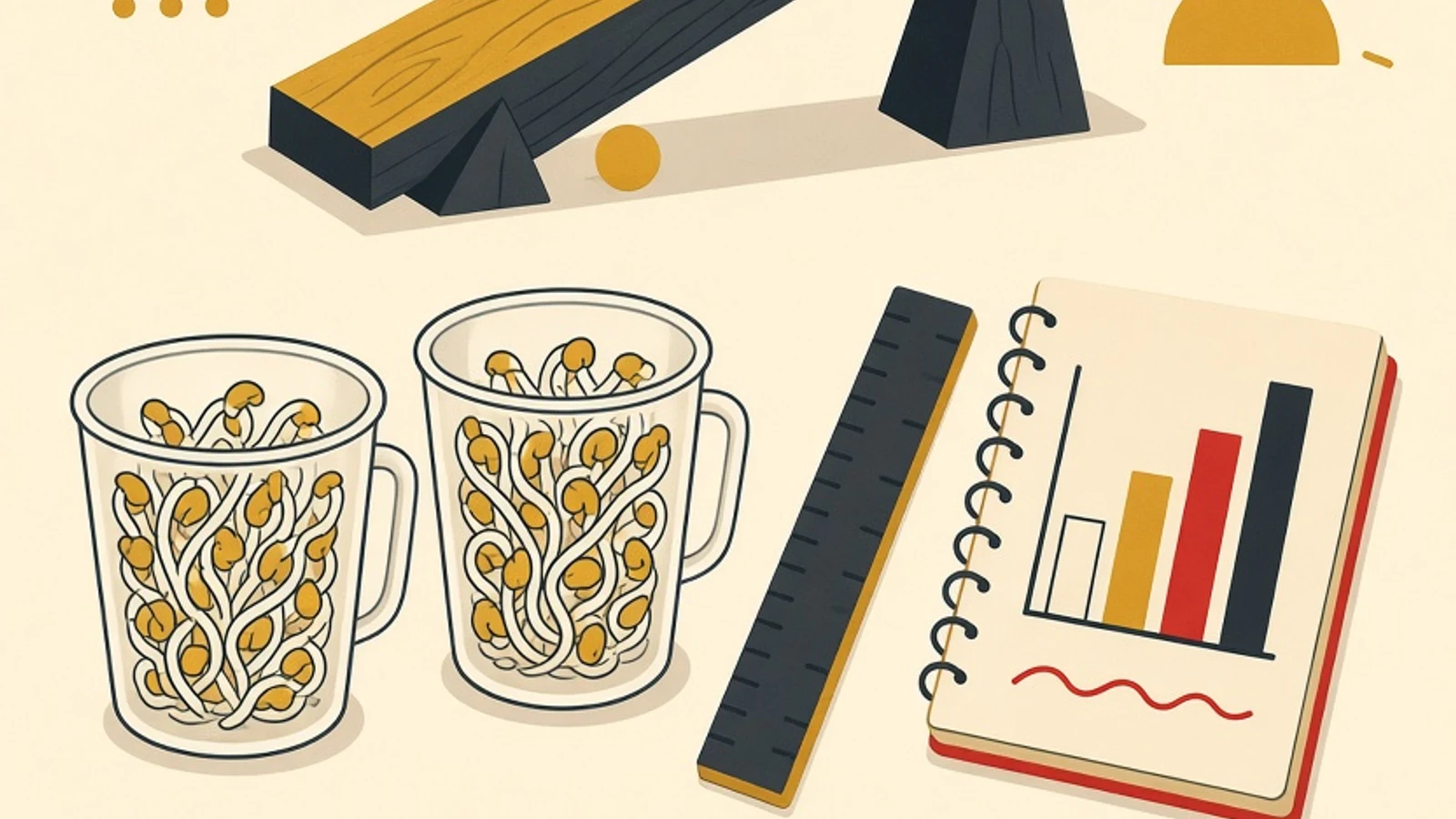
The relationship between biotic and abiotic components and their effect on ecosystems is another Phase C topic. The IPAS guide asks children to observe how plants, animals, soil, and air interact around them. The easiest investigation to control is growing mung beans in two containers: damp cotton wool in clear plastic cups, one placed somewhere bright and one inside a dark cupboard. The amount of water, the type of bean, and the number of seeds are kept the same, so light is the only difference. Every afternoon for seven days, the child measures the tallest sprout in each cup with a ruler, notes its colour, and sketches its shape. Around day three or four the difference usually becomes visible: sprouts in the dark grow tall, thin, and pale, while those in the light stay shorter and green. Seven days of data make a natural line graph with two lines in different colours. From here the conversation can widen to other non-living factors. What happens if one cup is not watered? What if the cotton wool is swapped for soil from the garden? A child who designs follow-up investigations like these has moved into a Phase C ability the IPAS guide describes: planning and carrying out investigation steps independently with simple measuring tools.
Tips- These mung beans are experiment material. When finished, bury them in soil or compost and keep them out of the kitchen.
- 7
Process the data, share the results, then test recall a few days later
The final step ties the earlier investigations together. Open the observation journal again and ask the child to compare the prediction with the result on every page. The IPAS guide places this ability in Phase C: comparing data with predictions, giving reasons based on evidence, and suggesting improvements for the next investigation. Three guiding questions are enough: what did you guess, what happened, and if you did it again, what would you change? Next, the child tells a family member about one investigation, with its table or chart. Explaining like this is a form of communicating results, the sixth process skill, and also practice in writing a simple report, which the IPAS guide links to Bahasa Indonesia lessons. Finally, wait two or three days and ask a few questions with the book closed. Why did the ice by the window vanish first? Why did your pulse rise after jumping? A study by Roediger and Karpicke (2006) found that participants who practised answering questions remembered more on tests taken two days and one week later than participants who only reread the material. The study involved university students, so the finding serves as general guidance for primary pupils. Before a test, this habit helps the child answer with examples they have seen with their own eyes.
Tips- Three to five closed-book questions are plenty. Any wrong answers send the child back to the matching journal page.
Six more IPAS topics and an investigation to match each
The senses and how they work
Blindfold the child with a cloth and ask them to identify objects by texture: a sponge, a comb, orange peel, a towel. Move on to recognising kitchen spices by smell, such as ginger or cinnamon. Record how many items each sense identified correctly. Taste is left out, since experiment materials are never tasted.
Life cycles of living things
Sow a few chilli or tomato seeds from the kitchen in a small pot and draw their progress every three days. Over several weeks the child sees seeds sprout, grow leaves, and, with continued care, flower. Stages the child has drawn personally give real meaning to the life-cycle diagram in the textbook.
Energy sources and how energy changes
Have the child list energy sources at home: electricity, sunlight, heat, batteries. A battery toy that moves shows electrical energy turning into motion. Two glasses of water, one in the sun and one in the shade for an hour, show light turning into heat. Batteries stay sealed.
Conserving natural resources
Catch the water used while brushing teeth with the tap running, then measure it with a 1.5 litre bottle. Repeat using a rinsing cup. The difference gives a real number for the topic on conserving natural resources to help limit climate change.
Saving energy
For one day, the child logs lights and appliances left on with nobody using them, along with the time each was spotted. Talk the list through together: which could be switched off, and for how long. The log connects energy saving with climate change mitigation, as the Phase C content describes.
The solar system, rotation, and revolution
Push a straight stick into a pot or garden soil and mark the tip of its shadow at 08.00, 12.00, and 15.00. A shadow that shifts direction and changes length is evidence of the sun's apparent movement caused by Earth's rotation. Only the shadow is observed; nobody looks at the sun.
Two numbers from the official IPAS guide
Signs a child's science study is shifting towards observation
- The child answers questions with examples from home, such as mentioning the ice by the window when asked about melting.
- The child writes a prediction before trying something, along with a reason.
- The child can read a table or chart they made and name the pattern in it.
- The child suggests improvements when an investigation does not turn out as expected.
- The child asks "what if..." about other things around them without being prompted.
What private science lessons for grades 4-6 look like, and when a child needs them
Say the class is studying sound. In a private science lesson, the tutor might open with one question: is a finger tap heard more clearly through the air or through a wooden table? The child writes a guess first, presses an ear to the table to try it, notes what they hear, then explains it with the IPAS terms their teacher uses in class. Household furniture and kitchen items are all the equipment it takes. The IPAS guide itself notes that school facilities for the subject are often limited, so home is a natural place for small investigations like this one. The need for a companion usually shows most when a child moves up to grade 5. Grade 4 still sits at the end of Phase B, where children observe and record with a teacher's direction. Once they enter Phase C, they are expected to recognise questions that can be investigated scientifically, plan their own investigation steps, present data in tables and charts, and suggest improvements when a result misses. The checklist above works as a yardstick. If most of its boxes are still unticked after four or five weeks, for instance the child still tries things without writing a guess, or cannot yet read the table they made, a tutor who comes regularly tends to help. Private science lessons start from IDR 61,000 / hour. The length can follow the plan for the lesson: 60 minutes to revisit one chapter, 90 minutes for one full investigation with its notes, 120 minutes for test preparation that pulls several topics together. A month holds between 4 and 28 lessons, booked any time from 06.00 to 23.00, face to face at home or online. The full cost appears on the registration form, and any payment method works, starting with bank transfer, Virtual Account, QRIS, e-wallets, and cards to Alfamart or Indomaret counters. In EduPoint's science programme, the IPA SD Grades 4-6 level sits between IPA SD Grades 1-3 and junior secondary science for grades 7-9, with senior secondary and KSN science preparation at the far end. The first step is the form, followed by a free consultation on the child's needs and schedule, after which EduPoint finds a tutor before the first session begins. Swapping a tutor who feels like the wrong fit is also free. Progress reports, session recordings, and self-study materials are kept in the EduPoint learner app. Test scores depend on many things outside lessons, while the habit of guessing, testing, and then explaining carries on into junior secondary science.
- A lasting way to study science in grades 4-6 starts with observing one IPAS topic at home, then learning the terms once the child has experienced them.
- Grade 4 usually sits at the end of Phase B with tallies and picture charts; grades 5 and 6 are in Phase C with tables, graphs, and suggested improvements.
- All seven investigations use safe household materials, with no open flames, no cleaning products, and no tasting.
- Answering closed-book questions two or three days after an investigation helps the child recall with examples they saw first-hand.
Questions about studying science in grades 4-6
Why does the school report say IPAS when parents call it science (IPA)?
The official primary subject name is Ilmu Pengetahuan Alam dan Sosial (IPAS), following the 2025 subject guide from BSKAP at Kemendikdasmen. It combines natural science and social studies. The science half, covering states of matter, forces, energy, organ systems, sound and light, and the solar system, is what people still call IPA day to day. This guide focuses on that science half.
How often should a child do a home investigation?
One investigation a week is enough, at roughly 30 to 45 minutes including writing in the observation journal. That figure is a rough guide and shifts with the topic. The sprout investigation, for example, needs a short check every afternoon for seven days. Choose the same topic as the chapter being taught at school, so the home experience links straight back to class.
Does the child still need to memorise science terms?
Yes, because tests use terms such as evaporation, friction, or abiotic components. What changes is the order. The child experiences the event first through an investigation, then learns the word for it. That way every term has a real example the child can call back. Answering questions with the book closed a few days later helps those terms stay put for longer.
Which materials should stay out of home science experiments?
Avoid open flames (candles, stoves, matches), household cleaners, bleach, insecticides, and medicines. Bleach mixed with ammonia or vinegar produces toxic gas. Safe kitchen items such as water, ice, salt, sugar, and mung beans cover all seven investigations in this guide. Experiment materials are never tasted, even when they come from the kitchen.
What if the child's results differ from the textbook?
A different result is excellent learning material. Help the child check the method: were the ice cubes the same size, was the car released from the same point, was each trial repeated three times? The IPAS guide places suggesting improvements to an investigation in Phase C. Note the suspected cause in the conclusion column, then repeat with one change.
How much do grade 4-6 private science lessons at EduPoint cost, and how do I register?
Private science lessons for grades 4-6 at EduPoint start from IDR 61,000 / hour. The length of each lesson can match what it holds: 60 minutes is enough to revisit one chapter and practise answering without the book, 90 minutes leaves room for one complete investigation from first guess to finished table, and 120 minutes suits the days before a test. A month holds 4 to 28 lessons. Fill in the registration form, talk through the child's needs in a free consultation, and a tutor is then found. The full cost is shown on the form.