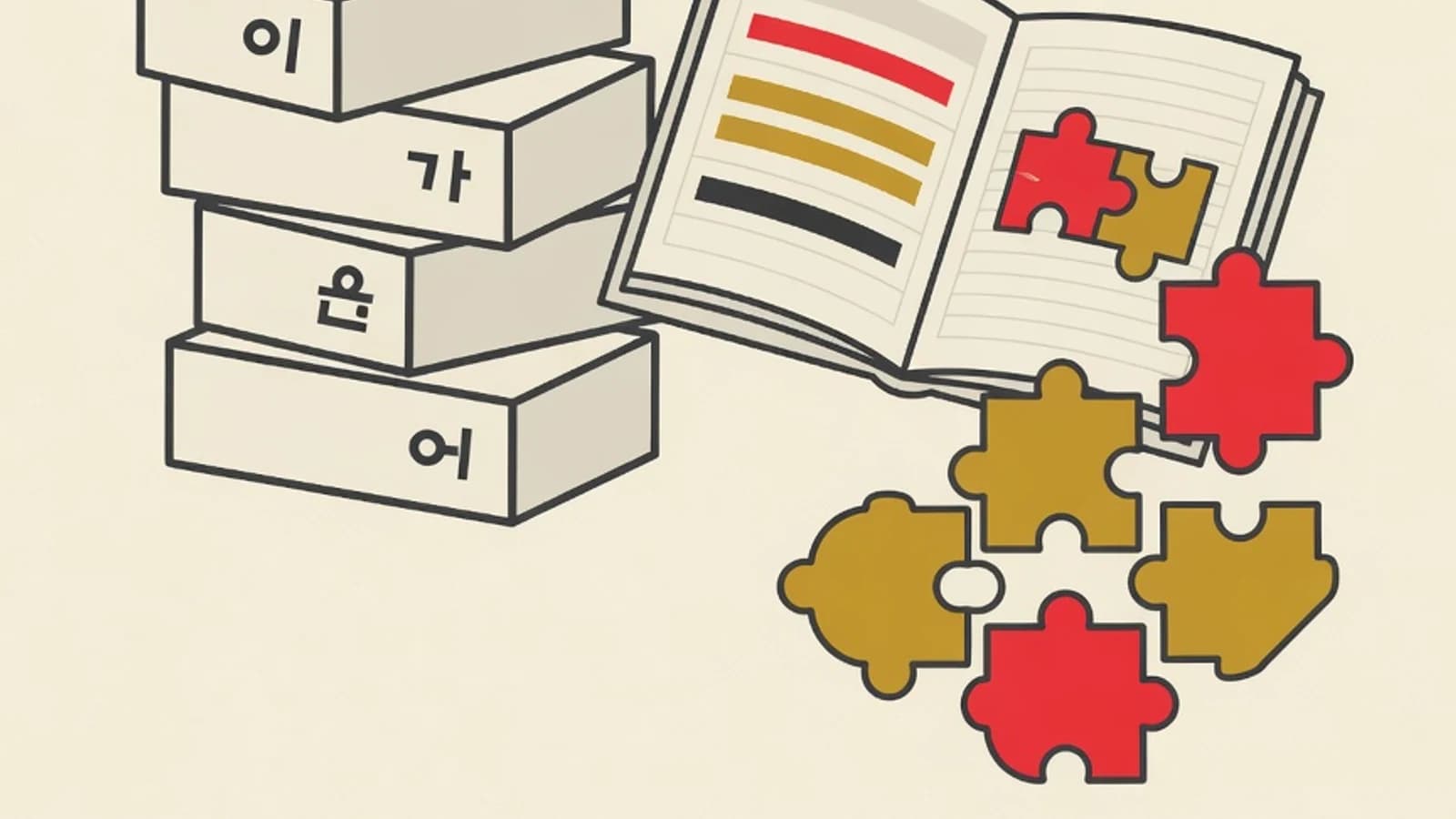
Basic Korean grammar rests on three foundations: subject-object-verb word order, particles that mark the role of each word, and verb conjugation that shifts with the level of politeness. Beginners who master these three can already build correct everyday sentences.
- The predicate always sits at the end of a Korean sentence
- Particles attach behind a noun to mark its function
- One verb can change shape depending on the listener
- Basic ability to read Hangeul
- A notebook for sentence patterns
- A list of your first 100 vocabulary words
Numbers that frame Korean grammar
What basic Korean grammar means
Basic Korean grammar is the set of rules that governs how words combine into sentences a native speaker can understand. For beginners, the three earliest things to master are word order, particles, and verb conjugation. Korean places the predicate at the end of the sentence. The idea “I eat rice” is arranged as “I rice eat” (저는 밥을 먹어요). This arrangement feels unfamiliar at first, then becomes automatic with regular practice. Particles such as 은/는 and 을/를 attach behind a noun to mark which word is the subject and which is the object, so the meaning stays clear even when word order shifts slightly. Korean verbs end in 다 in their dictionary form, and the stem then takes an ending that matches the tense and level of politeness.
Korean grammar compared with English
| Aspect | English | Korean |
|---|---|---|
| Word order | Subject-Verb-Object | Subject-Object-Verb |
| Role marking | Through position and prepositions | Through attached particles |
| Verbs | Change mainly for tense | Change for tense and politeness |
| Politeness | Word choice and phrasing | A grammatical ending system |
These differences can be learned in stages. Focus first on word order and particles before moving to conjugation.
Six steps to master basic Korean grammar
This sequence is designed so each new pattern stands on the previous one, so beginners do not stack every rule at once.
- 1
Lock in subject-object-verb order
Begin by building the habit of placing the predicate at the end of the sentence. Take a simple English sentence, then rearrange it into the Korean pattern. “I drink water” becomes “I water drink” (저는 물을 마셔요). Practice ten short sentences each day with this fixed pattern. The habit of putting the verb at the very end is the foundation that makes every later pattern feel logical.
Tips- Write the English sentence first, then move the verb to the end
- Use sentences about daily activities so they are easy to recall
- 2
Attach subject and object particles
Once word order feels natural, add the marking particles. The particle 은/는 marks the topic, 이/가 marks the subject, and 을/를 marks the object. The chosen form depends on the ending of the noun: use 은, 이, 을 after a consonant, and 는, 가, 를 after a vowel. For example, 저는 (I, as topic) and 밥을 (rice, as object). Make small cards for each particle and practice pairing them with different nouns.
Tips- Remember the consonant-vowel rule to pick the right particle form
- Practice with nouns you already know from your vocabulary list
Swapping 은/는 for 이/가 changes the nuance of a sentence. Understand the difference between topic and subject before combining them in conversation. - 3
Conjugate verbs in the polite form (해요체)
The 해요체 form is the casual-polite style used most often in daily life. Take the verb stem by removing 다 from the dictionary form, then add 아요 when the stem's last vowel is ㅏ or ㅗ, and 어요 for other vowels. Verbs ending in 하다 change to 해요. For example, 먹다 (to eat) becomes 먹어요, and 공부하다 (to study) becomes 공부해요. Memorize these three patterns with the ten most common verbs.
Tips- Group verbs by ending type so the pattern sticks
- Say each conjugation aloud so it becomes comfortable to pronounce
- 4
Distinguish the levels of politeness
Korean uses an ending system to mark politeness. 존댓말 is the respectful register, while 반말 is the casual register for close friends and younger people. Within the respectful register there is a very formal style (합니다체) used in news broadcasts and official settings, and a casual-polite style (해요체) for general conversation. Beginners are wise to start with 해요체 because it is safe to use with almost anyone. Save 반말 until you understand the context for it.
Tips- Use 해요체 as your main style while still learning
- Notice the age and status of the listener before choosing a register
Using 반말 with someone older or newly met comes across as impolite in Korean culture. Be careful when choosing a register. - 5
Form past and planned sentences
Tense in Korean is also handled through endings. For the past tense, insert 았 or 었 before the ending, following the same vowel rule as the polite form. 먹어요 (eat) becomes 먹었어요 (ate), and 공부해요 becomes 공부했어요. For plans or predictions, use the pattern –(으)ㄹ 거예요, for example 먹을 거예요 (will eat). With these three tenses, you can already talk about yesterday, today, and tomorrow.
Tips- Practice one verb across all three tenses so the pattern stays whole
- Keep a daily journal of three sentences: yesterday, today, and a plan for tomorrow
- 6
Combine into daily sentences and honorifics
The final step joins every pattern into a full sentence and introduces honorifics. Insert –시– into a verb to honor the subject you are speaking about, for example 읽으세요 (please read, with respect). The particle 께서 replaces 이/가 for an honored subject. Write a short paragraph of five sentences using the word order, particles, conjugation, and tenses you have learned. Read it to a teacher or friend for correction.
Tips- Build sentences yourself and ask for feedback on them, alongside memorized examples
- Add honorifics gradually once the basic patterns are fluent
The six most frequently used particles
은 / 는
Marks the topic, the thing being talked about. Example: 저는 (as for me).
이 / 가
Marks the subject that does or experiences something. Example: 날씨가 (the weather).
을 / 를
Marks the object that receives the action. Example: 책을 (a book, as object).
에
Marks time, destination, or a place of existence. Example: 집에 (at home).
에서
Marks where an activity happens or a point of origin. Example: 학교에서 (at school).
에게 / 한테
Marks the recipient, the person addressed. Example: 친구한테 (to a friend).
“The beginners who progress fastest are the ones brave enough to build their own sentences from the first week, then ask for correction. Korean grammar sticks through repeated use, and ten small sentences a day are worth more than a hundred rules that are only read.”
Daily practice checklist
- Build ten sentences in subject-object-verb order
- Attach the correct particle to five new nouns
- Conjugate three verbs into the 해요체 form
- Write one past-tense sentence and one planned sentence
- Read the results aloud and flag the parts you are unsure about
Self-study and learning with a mentor
- Freedom to set your own schedule and pace
- Plenty of free resources to meet the basic patterns
- Good for reviewing material you already understand
- Direct correction of the sentences you create
- Material ordered to match your readiness
- Specific questions answered right in the session
- A verb at the end of the sentence is the main frame of Korean grammar and should become a habit from the start
- Particles that mark topic, subject, object, and location keep sentence meaning clear
- Verb conjugation changes with tense and politeness, beginning with the 해요체 form
- Building your own sentences every day speeds up understanding more than simply reading rules