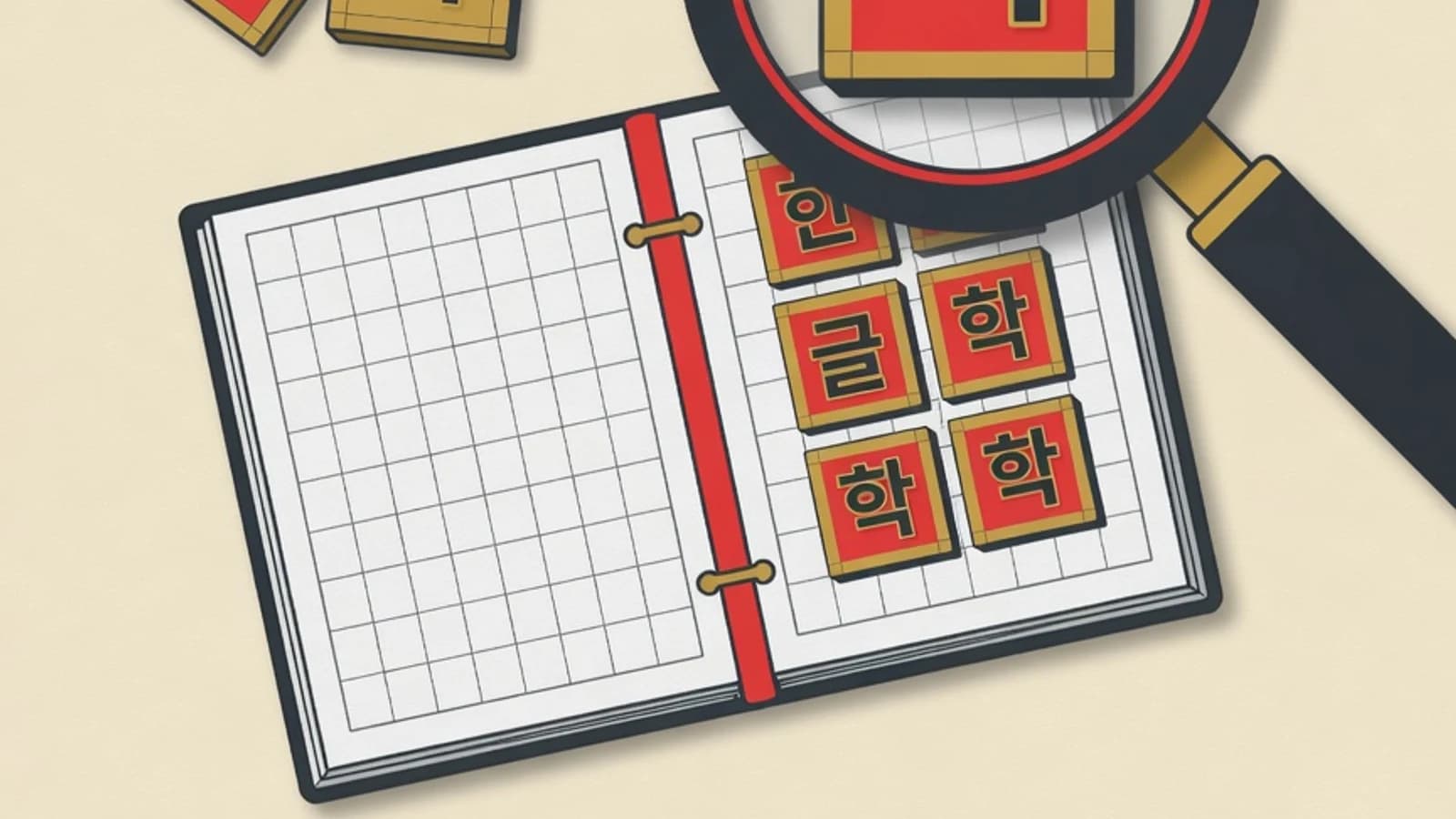
How to read Hangul for total beginners starts with recognizing the ten vowels through their arrangement of dots and lines, memorizing the fourteen consonants by mouth-shape groups, then combining both into syllable blocks and applying batchim rules at the final position. Reading aloud for two to four weeks trains your eyes to recognize each block automatically.
- Hangul letter shapes carry clues to their sound, so reading feels logical
- Every syllable block follows one of four easily recognized layout patterns
- Batchim rules reduce all final consonants down to seven representative sounds
- A Hangul chart that separates the 14 consonants, 10 vowels, and their derived letters
- Syllable-block flashcards for fast block recognition drills
- A set of short Korean words to use as reading practice material
Three numbers that explain how to read Hangul
The logic behind letter shapes that makes reading Hangul easier
Hangul is a writing system whose shapes were deliberately designed with a clear rationale, and grasping that rationale immediately speeds up how you read. Its basic consonants depict the position of the speech organs when the letter is pronounced. The letter ㄱ (g) traces the tongue curling at the back of the throat, ㄴ (n) mirrors the tongue tip touching the front of the palate, and ㅁ (m) resembles a closed mouth. When a shape holds a clue to its sound, you read by pattern, so each letter stops feeling like a foreign symbol. The vowels are built from three simple elements: a dot for the sky, a horizontal line for the earth, and a vertical line for the human being. From these three elements come ten interrelated basic vowels, so the direction of a line becomes a marker of sound. This orderly structure lets you read Hangul from zero after brief practice, because you recognize the system, and every time you meet a new block your eyes already know how to unpack it.
Five steps to read Hangul from zero to fluent
Work through these steps in order over two to four weeks. The first three introduce the letters and how to combine them, while the last two lock in the final-sound rules and build your reading speed.
- 1
Recognize the ten basic vowels through line direction and dots
Vowels are the heart of every syllable, so start here to give your Hangul reading a foothold. First understand the three building elements: a short dot, a vertical line, and a horizontal line. Vertical-line vowels such as ㅏ (a) and ㅓ (eo) differ by whether the dot attaches to the right or the left. Horizontal-line vowels such as ㅗ (o) and ㅜ (u) differ by the dot sitting above or below. One extra short stroke turns them into a y-sound, so ㅏ becomes ㅑ (ya) and ㅜ becomes ㅠ (yu). Say each vowel aloud while pointing at its shape, and master five letters per session so line direction sticks as a sound marker.
Tips- Sort vertical-line and horizontal-line vowels into two separate columns so the pattern shows
- Say near-identical pairs like ㅓ and ㅗ side by side so your ear learns to tell them apart
- 2
Master the fourteen consonants by mouth-shape groups
The fourteen basic consonants are easier to remember when grouped by how the mouth forms each sound. The throat-back group holds ㄱ (g); the tongue-tip group holds ㄴ (n), ㄷ (d), ㄹ (r or l); the lip group holds ㅁ (m), ㅂ (b); the teeth group holds ㅅ (s), ㅈ (j); and the throat group holds ㅇ and ㅎ (h). The letter ㅇ plays a special role: at the start of a syllable it stays silent as a seat for the vowel, while at the end it sounds as ng. Practice by voicing each consonant paired with the vowel ㅏ, forming 가 (ga), 나 (na), 다 (da), and so on. This trains you to read combinations, the raw material of every Korean word.
Tips- Read a full row of consonants with the vowel ㅏ at the start of each session as a warm-up
- Flag ㅇ specially because its role changes depending on its position in the block
Avoid leaning on romanization beyond the first few days. That habit leaves your eyes unwilling to spot the genuine Korean letters, and sounds slip off target. - 3
Build letters into syllable blocks using the four layout patterns
Hangul is written in square blocks, and each block represents one syllable. Reading a block follows four consistent layout patterns. A block with a vertical vowel places the consonant on the left and the vowel on the right, as in 가 (ga). A block with a horizontal vowel places the consonant on top and the vowel below, as in 소 (so). When a closing consonant appears, it drops to the base of the block, forming 각 (gak) and 목 (mok). Read a block left to right and then down, one syllable in one breath. Reinforce it by copying compact words already familiar to your ear, for instance 나비 (nabi, butterfly) and 우유 (uyu, milk), so the flow of reading a Hangul block blends with the motion of writing.
Tips- Use a grid notebook so each block sits neatly and its position stays consistent
- Compare 가 and 소 side by side so the vertical and horizontal layouts are clear
- 4
Apply batchim rules to read final sounds accurately
The closing consonant at the base of a block is called batchim, and this is the part that most determines accurate Hangul reading. Although many consonants can sit in the final position, their sounds reduce to just seven representative sounds. For example, ㄱ, ㅋ, and ㄲ at the end all sound like a held k, while ㅅ, ㅈ, ㅊ, ㅌ at the end sound like a held t. There is also a linking rule: if a block with a batchim is followed by a block starting with ㅇ, the closing consonant moves into the next syllable, so 한국어 reads as han-gu-geo. Understanding the seven representative sounds and this linking rule clears up almost every doubt when reading consonant-heavy words.
Tips- Memorize the three most common representative sounds first: held k, t, and p
- Read batchim words such as 밥 (bap) and 책 (chaek) aloud so the held final sound feels natural
Some blocks carry a double batchim such as ㄼ or ㄺ. Usually only one consonant is voiced, so study this group after you have mastered the seven basic representative sounds. - 5
Practice reading short Korean texts in stages every day
Hangul reading ability settles only through repeated use. Build a tiered drill: start by reading single blocks at random, move up to words of two or three syllables, then to short phrases on everyday material such as the dish list at a Korean restaurant, the title of a favorite song, or a shop sign that appears in a drama series. Read slowly and aloud without rushing to grasp the meaning, because the goal at this stage is the speed of decoding letters. Time yourself reading ten blocks, then repeat the next day to see your progress. Once your eyes begin to recognize a block without spelling it out letter by letter, reading Hangul has shifted into an automatic skill ready to support vocabulary and grammar next.
Tips- Follow the printed lyrics of a Korean song while playing its audio so letter recognition moves in step with the sound
- Set aside five minutes at the end of each session to read one short paragraph without romanization
The seven representative batchim sounds to know when reading
| Representative final sound | Batchim letters it covers | Example word |
|---|---|---|
| Held k | ㄱ, ㅋ, ㄲ | 책 (chaek, book) |
| n | ㄴ | 돈 (don, money) |
| Held t | ㄷ, ㅅ, ㅈ, ㅊ, ㅌ, ㅎ | 옷 (ot, clothes) |
| l | ㄹ | 물 (mul, water) |
| m | ㅁ | 밤 (bam, night) |
| Held p | ㅂ, ㅍ | 밥 (bap, rice) |
| ng | ㅇ | 강 (gang, river) |
These seven representative sounds simplify reading closing consonants, so many different letters end up read with the same single final sound.
The four layout patterns of a Hangul syllable block
Consonant left, vowel right
Used when the vowel is vertical. Examples 가 (ga) and 나 (na). Read the consonant first, then the vowel to its right.
Consonant top, vowel bottom
Used when the vowel is horizontal. Examples 소 (so) and 무 (mu). Read the consonant on top, then the vowel below it.
Consonant left, vowel right, batchim below
Adds a closing consonant at the base of the block. Examples 각 (gak) and 반 (ban). Read left to right, then down to the batchim.
Consonant top, vowel bottom, batchim at base
A horizontal-vowel pattern given a closing consonant. Examples 목 (mok) and 문 (mun). The batchim is always read last in the block.
“Beginners who read Hangul aloud block by block from the very start usually recognize words faster, because they train the eye and ear together. Reading only in silence often lets the batchim slip past, leaving the final sound of a word blurry.”
A daily practice list to read Hangul fluently sooner
- Warm up by reading one row of consonants paired with the vowel ㅏ
- Read ten random syllable blocks and time yourself to track progress
- Write three batchim words and pronounce their final sounds accurately
- Read one short phrase from real material such as a song title or menu name
- Close the session by re-reading yesterday's material without romanization
After reading Hangul fluently, where the next learning step leads
Once every block reads automatically and the batchim no longer causes hesitation, your Hangul reading foundation is solid enough to support the next stage. The natural direction from here is expanding themed vocabulary and learning everyday conversational phrases, since all of them are written with the letters you already recognize. From there you can begin building simple sentences, grasping Korean word-order patterns, and recognizing the politeness levels that govern verb endings. At this transition stage, guided support helps a great deal. A tutor makes sure your pronunciation and batchim reading stay consistent before any mistaken habit hardens, then shapes a learning path to fit your goal, be it enjoying Korean entertainment, completing study prerequisites, or getting ready for the official TOPIK exam. A private one-teacher-one-student format gives you the freedom to read aloud as often as you wish, at a rhythm that adjusts to your own learning speed.
- Hangul consonant shapes mimic the speech organs and its vowels are built from dots and lines, so reading feels patterned
- Every syllable block follows one of four consistent, easily recognized layout patterns
- Closing consonants, or batchim, reduce to seven representative sounds when read
- The letter ㅇ is silent at the start of a syllable and sounds as ng at the end
- Daily reading-aloud practice turns letter recognition into an automatic skill