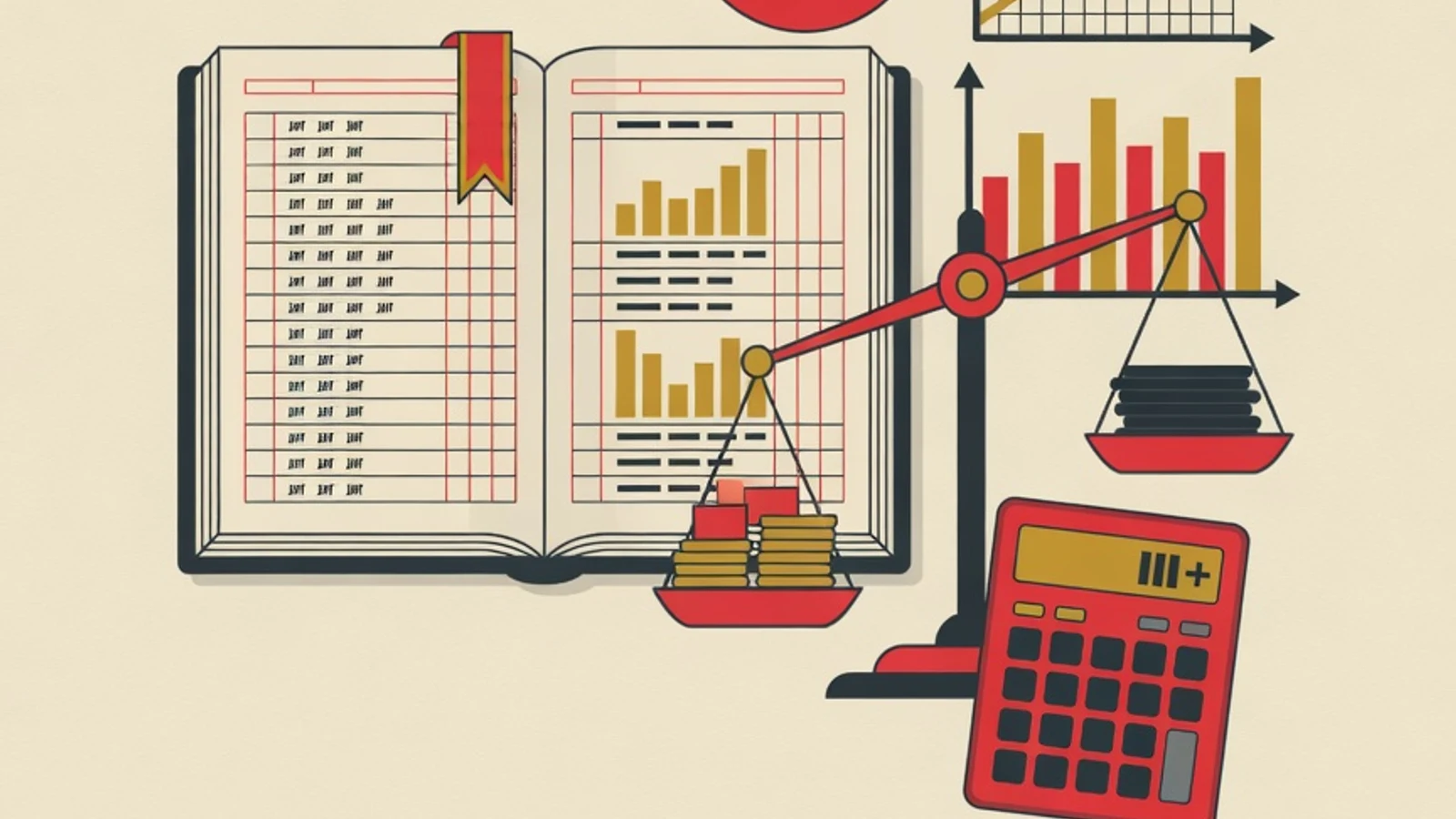
How to understand debits and credits for beginners starts from the accounting equation Assets equals Liabilities plus Equity, then recognizing the five account groups along with their normal balances. From there, the debit and credit rules make sense: every transaction touches at least two accounts, and the total debit side always equals the total credit side. This skill can be mastered in two to four weeks with gradual practice.
- Debit means the left side and credit means the right side, with no automatic meaning of increase or decrease
- Every transaction is recorded in pairs so the accounting equation always stays balanced
- The key to fluency lies in understanding each account group's normal balance, followed by plenty of practice
- A notebook or paper to draw simple debit and credit columns
- A list of real daily transactions, for example a small shop's records or allowance spending
- A calculator to total the debit side and the credit side
- A regular practice schedule, around 3 to 5 hours spread across the week
Why Debits and Credits Are the Foundation of Accounting
Set the Meaning of Debit and Credit Straight First
Many beginners get stuck equating debit with decrease and credit with increase. That impression comes from bank statements, where a credit raises the balance and a debit lowers it. In company accounting, the meaning of both is simpler and purer: a debit is merely the left side of an account, and a credit is its right side. Whether it adds or reduces depends on the type of account being recorded. For example, the cash account is an asset whose normal balance sits on the debit side. When cash comes in, cash is recorded on the debit side because it grows. When cash goes out, cash is recorded on the credit side because it shrinks. A liability account works the reverse way. Grasping this logic frees you from blind memorization that easily gets muddled the moment a new transaction appears.
Seven Steps to Understand Debits and Credits From Scratch
Take them in order. Each step rests on the one before it, and each step leaves one skill that applies directly when you journal.
- 1
Step 1: Grasp the Accounting Equation as the Foundation
Every debit and credit rule is rooted in one equation: Assets equals Liabilities plus Equity. Assets are the property owned, such as cash, receivables, and equipment. Liabilities are obligations to other parties, such as accounts payable. Equity is the owner's claim on the property after subtracting obligations, often called capital. This equation stays balanced on both sides. When a transaction changes one side, the other side adjusts along with it, or another account on the same side shifts. Master this sentence first until it sticks, because this is where the reason debits and credits always balance comes from. Practice by writing three simple examples, for example the owner deposits capital of Rp 10,000,000 as cash, then watch cash rise on the asset side and capital rise on the equity side by the same figure.
Tips- Write the equation on paper and change the numbers for a few transactions so it feels real
- Remember that equity also grows from revenue and shrinks from expenses, both branches of capital
- 2
Step 2: Recognize the Five Account Groups and Their Normal Balances
Every account falls into one of five groups: assets, liabilities, equity, revenue, and expenses. The first three appear on the balance sheet, the last two appear on the income statement. Each group has a normal balance, meaning the side where that account increases. Assets and expenses carry a normal balance on the debit side. Liabilities, equity, and revenue carry a normal balance on the credit side. The normal-balance side is your compass: an account that increases is recorded on its normal-balance side, and one that decreases is recorded on the opposite side. Commit this split to memory through understanding, for example an expense erodes capital, so it is recorded opposite to equity, which builds capital.
Tips- Make a small memory card: assets and expenses on the left, liabilities, equity, and revenue on the right
- Tie each group to its report, assets to the balance sheet and revenue to the income statement, so they stay clear
Memorizing rules without understanding the normal balance makes it easy to slip the moment you meet an account type you have never practiced. - 3
Step 3: Master the Debit and Credit Rules Through Logic
Once normal balances are clear, the rule becomes compact. Asset and expense accounts increase on the debit side and decrease on the credit side. Liability, equity, and revenue accounts increase on the credit side and decrease on the debit side. Each time you face a transaction, ask two questions in order: which accounts are affected, and whether each one increases or decreases. From those two answers, the debit or credit side becomes clear at once. Practice with five daily transactions: buying equipment in cash, receiving payment for a service, paying salaries, buying supplies on credit, and withdrawing money for personal use. Write out the reasoning for each step in sentences, alongside the figures.
Tips- Always start from the question of which account is affected, avoid guessing the debit or credit side first
- Say the reasoning aloud, this way it lodges in memory faster
- 4
Step 4: Apply the Balanced-Entry Rule
The double-entry principle demands one firm thing: within a single transaction, the rupiah amount on the debit side exactly matches the amount on the credit side. This rule keeps the accounting equation balanced. A transaction may touch two accounts or more, as long as the totals of both sides stay equal. For example, buying equipment for Rp 3,000,000 by paying Rp 1,000,000 in cash with the rest on credit: equipment on the debit side Rp 3,000,000, cash on the credit side Rp 1,000,000, and accounts payable on the credit side Rp 2,000,000. The debit total is three million, the credit total is three million, balanced. Get into the habit of closing each entry by checking that both sides agree before moving on.
Tips- Total the debit and credit sides each time you finish recording one transaction
- If the two sides differ, trace back which account was missed or has the wrong amount
Debit and credit sides that do not match signal a wrong or missing account, so do not continue before you find it. - 5
Step 5: Practice Recording Into the General Journal
The general journal is the first record where transactions are written in chronological order. The format is simple: the date, the debited account name written first and aligned left, then the credited account name written slightly indented on the next line, along with the amount in the matching debit or credit column. Add a brief description below it. Take the transaction list from Step 3, then record them one by one into the journal format. Consistent writing makes moving them to the ledger far tidier. Work through ten transactions until your hand grows used to the journal layout.
Tips- Write the debit account first, then the credit account, this order is standard and eases reading
- Include a brief description for each entry so it is easy to trace when correcting
- 6
Step 6: Post to the General Ledger
After being recorded in the journal, each figure is moved to the general ledger, a collection of accounts that groups every movement by type. This process is called posting. The T-shaped ledger helps beginners: a vertical line divides the debit side on the left from the credit side on the right, with the account name on top. Debit figures in the journal enter the debit side of the related account, credit figures enter the credit side. After all journal entries are posted, calculate each account's balance by subtracting the smaller side from the larger side. This ledger reveals the final position of cash, payables, capital, and other accounts. Practice by posting ten journal entries from the previous step into their respective T-accounts.
Tips- Group every cash movement into one cash T-account, avoid scattering them in many places
- Date each posting so the order of movements stays readable
- 7
Step 7: Test the Balance With a Trial Balance
The final step is preparing a trial balance, a list of the closing balances of every account from the ledger, in two columns of debit and credit. The trial balance becomes a checking tool: when the debit column total equals the credit column total, your records are mathematically balanced. Any difference that appears signals a posting or calculation error worth tracing. Compile the trial balance from the T-accounts you worked on earlier, then total both columns. When the two meet at the same figure, you have traveled the cycle from transaction, journal, ledger, to checking. Repeat this cycle with new cases until deciding debits and credits feels natural.
Tips- A balanced trial balance still needs its contents checked, since account errors can cancel each other out
- Save each trial-balance exercise as a benchmark of progress from week to week
Normal Balance of the Five Account Groups
Assets
Property owned such as cash, receivables, and equipment. Increases on the debit side, decreases on the credit side.
Expenses
Costs of running the business such as salaries, rent, and electricity. Increases on the debit side.
Liabilities
Obligations to other parties such as accounts payable and bank loans. Increases on the credit side.
Equity
The owner's claim on property after subtracting obligations, often called capital. Increases on the credit side.
Revenue
Income from business activity such as sales and services. Increases on the credit side.
How to use it
An account that increases is recorded on its normal-balance side. One that decreases is recorded on the opposite side.
Sample Debit and Credit Decisions on Common Transactions
| Transaction | Recorded as Debit | Recorded as Credit |
|---|---|---|
| Owner deposits capital in cash | Cash increases | Capital increases |
| Buying equipment in cash | Equipment increases | Cash decreases |
| Receiving payment for a service | Cash increases | Service revenue increases |
| Paying employee salaries | Salary expense increases | Cash decreases |
| Buying supplies on credit | Supplies increase | Accounts payable increases |
Notice the pattern: once the account type and the direction of change are known, the debit or credit side follows straight from the normal-balance rule.
“Beginners who reach debit-credit fluency fast are the ones who stop memorizing and start asking of each transaction: which account moves, and in which direction. Those two questions answer almost every early confusion.”
Checklist Before Calling Yourself Fluent at Journaling
- Can name the normal balance of all five account groups without looking at notes
- Able to decide the debit and credit side for cash as well as credit transactions
- Keeps the debit-side total equal to the credit-side total in every entry
- Fluent at posting journal entries to a T-account ledger and calculating its balance
- Can prepare a balanced trial balance from a set of practice transactions
How Much Does Learning Accounting at EduPoint Cost
The guided learning path stays affordable. Accounting lessons at EduPoint start from Rp 110,000 per session for online lessons, and from Rp 140,000 per session for in-person. A small group of two to three students is also available from Rp 95,000 per student. The final price adjusts to your learning goal, the level of the material, location, and lesson format. For beginners who want to finish the debit-credit steps with guidance, the mentor adjusts the emphasis to your starting point. Some students need to strengthen the accounting equation, while others want quick fluency at journaling complex transactions. Your study time is steered toward the part you need most, until deciding debits and credits feels natural across a range of cases.
- A debit is the left side of an account and a credit is the right side, whether it adds or reduces depends on the account type
- Every rule is rooted in the equation Assets equals Liabilities plus Equity, which always stays balanced
- Assets and expenses carry a normal balance on the debit side, while liabilities, equity, and revenue carry a normal balance on the credit side
- Every transaction touches at least two accounts, and the total debit side always equals the total credit side
- The learning path moves from the accounting equation, normal balances, debit-credit rules, journal, ledger, to the trial balance