Private Online Chess Lessons
Online Chess Lessons: One Coach, One Student, One Shared Board
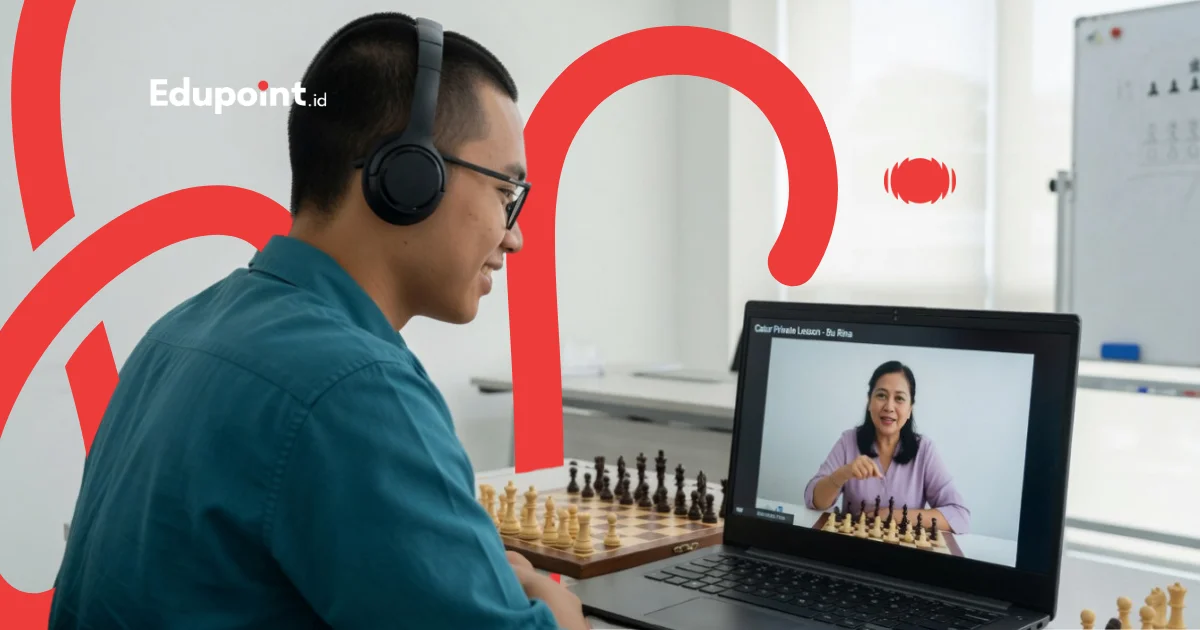
An experienced chess coach guides every session on a live digital board you both control, so each move gets corrected the moment it happens. Lessons adapt to age and level, from a child meeting the pieces for the first time to an adult chasing a tournament rating.
85+
tutors
940+
students
4.9
rating · 824 reviews
60+
cities
What is Online Chess Lessons?
Online chess lessons are private one-coach-one-student sessions held over a shared digital board and a video call. Coaches drawn from a 60+ city network teach the rules, tactics, strategy, and analysis of the student's own games. Sessions run 60, 90, or 120 minutes, available daily from 6 AM to 11 PM (WIB), for kids through adults.
- One coach, one student for the entire session, at the student's own pace
- A shared digital board: coach and student move pieces on the same board in real time
- The student's own games become the core training material for review and correction
- Rating serves as a progress benchmark; targets are agreed together and the process is what gets coached
Services
Online Chess Session Options
Every session keeps it private: one coach, one student, working from a shared digital board. Choose whichever duration fits the student's age and how long their focus typically holds.
60-Minute Session
The best fit for young children and absolute beginners: enough for one lesson plus practice before focus runs out.
Rp 87.000/session
60 minutes
- One core lesson plus mini games on the digital board
- Well suited for ages 5-9
- Progress notes after every session
- Flexible scheduling, 6 AM to 11 PM
90-Minute Session
The favorite length for students and adults: a lesson, tactics puzzles, and one practice game reviewed on the spot.
Rp 109.000/session
90 minutes
- Lesson, tactics training, and a practice game in one sitting
- Review happens while the position is still fresh
- Targeted puzzle homework
- Progress reports in the learner app
120-Minute Session
Built for club and tournament players: long enough for deep game review plus critical-position drills without rushing.
Rp 139.000/session
120 minutes
- Move-by-move review of tournament games
- Opening repertoire training for both colors
- Critical-position drills under the clock
- Scheduled rating-target reviews
Chess Learning Levels
The coach places each student at the right level during the first session, so the material feels challenging without becoming discouraging.
Absolute Beginner
New to the boardFor students who have never played at all. The focus is building the habit of thinking before moving and finishing a full game from start to end.
Subjects:
The rules of play and algebraic notationPiece values and simple tradesBasic checkmates and short practice games
Focus Areas:
- Think first, touch the piece second
- Comfortable playing one complete game
Foundation
Can play, still blundersFor students who know the rules yet keep losing pieces for nothing. Core tactics and the discipline of checking the opponent's threats become the main menu.
Subjects:
Fork, pin, and double-attack tacticsOpening principles: center, development, castlingReading the opponent's threat every single turn
Focus Areas:
- Cutting down one-move blunders
- Calculating short variations cleanly
Club and School
Playing actively, ready to level upFor students who play regularly at school, in a club, or online and want their chess to have direction. Strategy and endgames start getting serious training time.
Subjects:
A simple opening repertoireMiddlegame plans based on pawn structurePractical rook and pawn endgames
Focus Areas:
- Every move backed by a reason
- Ready for inter-school competition
Competitive
Chasing rating and titlesFor tournament players who want a structured training program. The coach sets rating targets together with the student and guards the process through deep analysis.
Subjects:
Deep analysis of the student's tournament gamesRepertoire expansion and opponent preparationCritical-position training and clock management
Focus Areas:
- Rating targets agreed and reviewed on schedule
- Mental stamina for long games
Online Chess Curriculum
Five modules that take a student from meeting the board to competing with confidence, reordered to fit each starting level.
Beginners start with the foundation module, while players already active in clubs or tournaments can go straight into game analysis and opening repertoire work.
Foundations and Notation
The groundwork self-taught players often skip: the complete rules, how to record a game, and what the pieces are really worth.
- Full rules including castling, en passant, and promotion
- Algebraic notation for reading and recording games
- Piece values and the principles of a good trade
- Basic checkmate patterns with one and two major pieces
Tactics and Combinations
The tools that win material: short attacking patterns that repeat in nearly every game ever played.
- Forks, pins, and skewers across different positions
- Double attacks and discovered attacks
- Combinations that lead to mate on the castled king
- Calculation drills two to four moves deep
Middlegame Strategy
Learning to build a plan when no tactic is on the board: square control, pawn structure, and piece placement.
- Pawn structures and weak squares
- Active pieces versus passive pieces
- When to trade and when to keep a piece
- Building a plan from what the position demands
The Endgame
The phase that decides the score: technique for converting winning positions and holding difficult ones.
- King and pawn endings: opposition and key squares
- The practical rook endgames that appear most often
- Technique for converting a material advantage
- Drawing resources: stalemate, the desperado rook, and the wrong-colored bishop
Game Analysis and Competition Prep
The student's own games are dissected with the coach to surface recurring mistakes, then repertoire and competitive nerves get their turn.
- Move-by-move review of the student's games
- Building a simple opening repertoire for White and Black
- Clock management in classical and rapid games
- Preparation for school, club, and online tournaments
Who It Is For
Who These Online Chess Lessons Are For
One curriculum, many doors in. The coach adjusts the teaching approach to the student's age and goals.
Kids Ages 5-12
Learning happens through piece stories, mini games, and well-aimed praise. Chess trains a child to sit with focus, weigh choices, and take a loss gracefully.
Recommended:
60-minute sessionsAbsolute beginner or foundation levelParents welcome to sit in during early sessions
Middle and High School Students
Many are aiming for the school chess team or student competitions. The coach prepares a simple repertoire and builds playing hours through practice games reviewed in full.
Recommended:
90-minute sessionsFoundation through club-and-school levelStudent competition preparation
Adult Beginners
Starting chess from zero as an adult is completely normal, and genuinely fun. Lessons move faster through concepts and more patiently through habits that have already set in.
Recommended:
90-minute sessionsAbsolute beginner level at an adult paceEvening slots after work hours
Tournament Players
Rated players who want training with direction. Game analysis, repertoire repair, and critical-position drills are guided by one consistent coach.
Recommended:
120-minute sessionsCompetitive levelScheduled rating-target reviews
Why Us
Why Take Online Chess Lessons at EduPoint
Learning chess well takes a partner who understands the position on your board. These six things keep our students coming back.
One Coach, One Student
The whole session belongs to a single student. The coach can pause on any position, ask a question back, and wait for the student to find the answer alone.
A Shared Digital Board
Coach and student use the same online board while connected by video. A piece the student moves appears instantly and gets corrected right there.
Your Own Games Are the Material
Games the student plays at school, in a club, or online get dissected with the coach. Personal mistake patterns surface far faster than in generic puzzle sets.
Coaches from a 60+ City Network
Because lessons are online, a student in a small town can learn from a tournament-tested chess coach who would normally only be found in a big city.
A Schedule That Follows Your Family
Sessions run daily from 6 AM to 11 PM (WIB). Lessons fit after school, after religious classes, or in the evening once the workday is done.
Coach Replacement Guarantee
Not every teaching style suits every student right away. Should the connection not work out, a replacement coach steps in at no added cost, and the search continues until the pairing feels right.
Testimonials
What They Say About Our Online Chess Lessons
Stories from families and adult learners studying chess with EduPoint private coaches.
My son is 8 and gets bored easily, yet he stays engaged the full 60 minutes because his coach turns positions into guessing games. These days he's the one reminding me about lesson time.
Ratna
Mother of a 2nd grader • Bekasi
My son used to only play against the computer. A few months into lessons he signed up for an inter-school tournament and came home with a long story about his games. The post-game review with his coach is the part he looks forward to most.
Hendra
Father of a 6th grader • Makassar
I started from absolute zero, notation alone confused me when I opened the board. My coach was patient and systematic. Now every move I make has a reason behind it, and playing against my office friends feels so much more confident.
Dimas
University student • Bandung
I'd been playing since high school and stayed stuck at the same strength. My coach went through my online games one by one and my endgame mistake pattern showed up clearly. The phase I used to avoid has turned into my weapon.
Yosua
Office worker • South Jakarta
My daughter is in 4th grade with a packed schedule. The nice thing about online lessons is how easily the time shifts around school activities, and her coach always sends a progress note after each session.
Maya
Mother of a 4th grader • Surabaya
I'm 47 and only recently got serious about chess. I wondered if I'd left it too late. My coach adjusts the pace and has never once made me feel behind. Chess has become the weekend hobby that keeps my mind sharp.
Bambang
Business owner • Semarang
Online Chess Lesson Fees
Rates are calculated per session by length (60, 90, or 120 minutes), then bundled into monthly packages of 4 to 28 sessions. The numbers shown come straight from the registration pricing engine, so what you see here matches what appears when you sign up.
Starting from
Rp 69.000 / hour
Final price is set at registration.
This is the lowest hourly rate, derived from the 28-session monthly plan at 120 minutes per session. Per-session prices (60, 90, or 120 minutes) appear in the format options above.
Flexible payment — QRIS, Virtual Account, Alfamart, Indomaret, transfer & e-wallets.
Paying works however is easiest: straight to a bank account, through Virtual Account or QRIS, from an e-wallet, by card, or in person at an Alfamart or Indomaret counter. A coach replacement guarantee applies whenever the fit feels wrong.
Private Chess Lessons Compared to Other Options
Every way of learning chess has its strengths. This table helps you pick what fits the student best.
| Feature | EduPoint Private Tutoring | Online group chess class | Chess training app |
|---|---|---|---|
| One coach, one student for the whole session | |||
| The student's own games analyzed live by a coach | |||
| Study materials open anytime through the app | |||
| Unlimited automated puzzle drills every day | - | ||
| A lively room full of same-age sparring partners | - |
Where Online Chess Lessons Reach
Online Tutoring
Online WorldwideSince everything happens on a digital board, EduPoint online chess lessons work from any city. Students in areas without a chess club still get an experienced coach.
- Chess coaches from a 60+ city network
- Shared digital board plus video call
- Sessions daily from 6 AM to 11 PM (WIB)
- Self-study materials and progress reports in the learner app
FAQ
Online Chess Lessons FAQ
The questions parents and adult learners ask most before starting chess lessons.
Ready to Make Your Move?
Tell us the student's age, level, and goals in a short consultation. We'll find an online chess coach who fits, and the first session can go straight onto the calendar.
One coach, one student on a shared digital boardFlexible schedule, 6 AM to 11 PM (WIB)Coach replacement guarantee until the fit is right