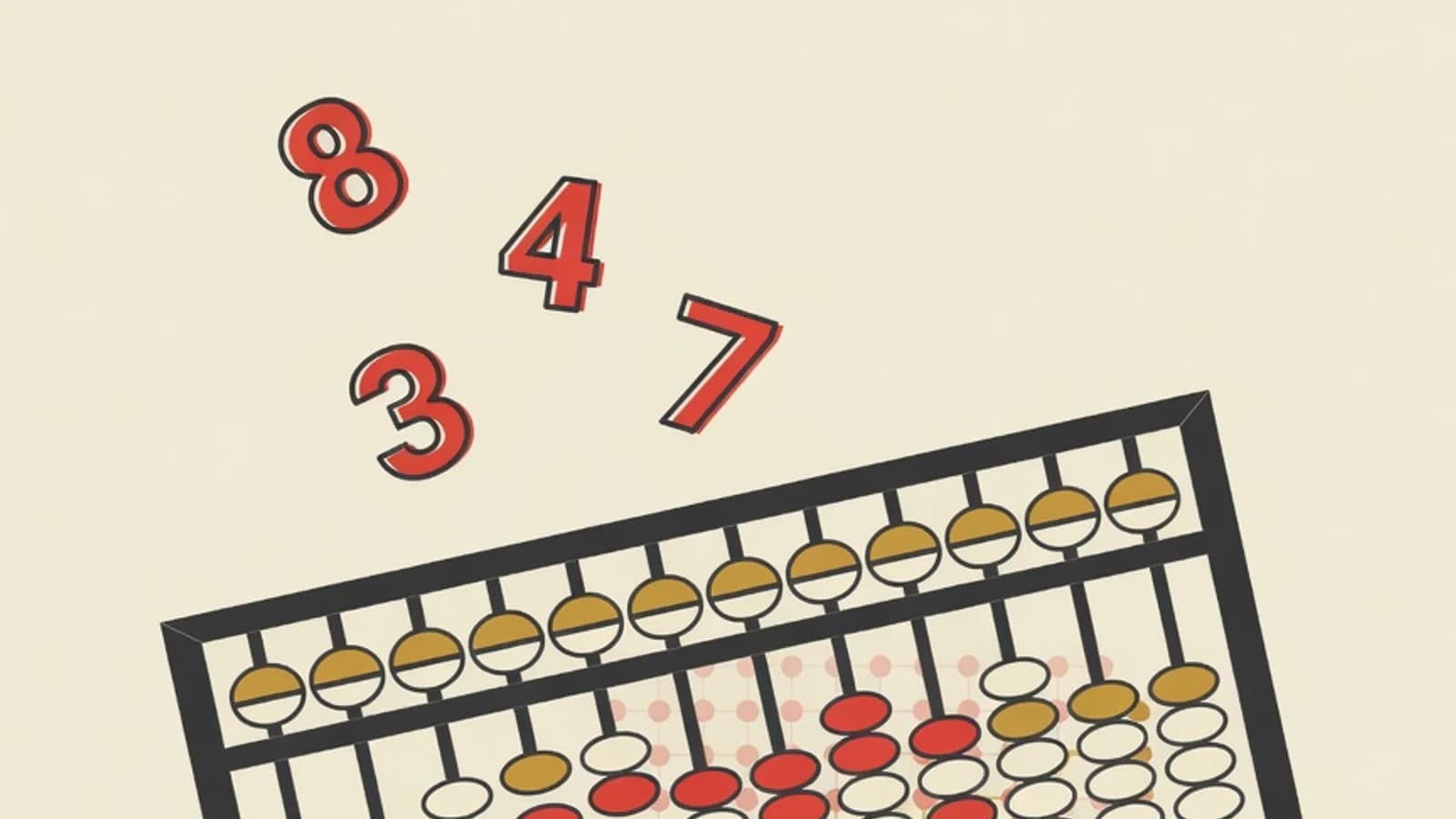
Teaching a child the abacus begins by introducing the beads and place value, then practicing addition and subtraction on the physical abacus until finger movements feel automatic. From there the child learns to picture the abacus in their head, the core of mental arithmetic. Short daily practice makes this progression far lighter for the child to carry.
- Start on the physical abacus so the child grasps place value concretely before calculating in their head
- Mental arithmetic grows from the habit of imagining the beads move, the fruit of patient practice
- Short 10 to 15 minute daily sessions build fluency better than long, infrequent practice
- One abacus (soroban) with clearly arranged beads that a child's fingers can slide easily
- Worksheets of simple addition and subtraction that step up gradually
- A small notebook to track the child's daily progress
- Short daily practice of 10 to 15 minutes
The Abacus and Mental Arithmetic in Numbers
What the abacus and mental arithmetic are, and why they suit children
An abacus is a calculating device: a frame of rods and beads that can be slid to represent numbers. On the soroban, the type commonly used with children, each rod holds one upper bead worth five and four lower beads each worth one. By sliding beads toward the central bar, a child forms numbers and performs addition and subtraction right in front of their eyes. Mental arithmetic is the ability to calculate quickly by picturing that abacus inside the head. A child who is used to sliding beads gradually begins to see an image of the abacus in their mind, then moves those imaginary beads to calculate without a tool. The technical term for calculating with an imagined abacus is anzan. This approach suits children because it rests on a concrete object before asking for anything abstract. The child holds, sees, and moves the beads, so the idea of place value forms through direct experience. Research by Barner and colleagues published in the journal Child Development found that calculating with an imagined abacus tends to draw on visual and spatial memory, working differently from verbal calculation that leans more on language. That difference in pathway is what makes abacus practice feel fresh for many children.
Four Stages from the Physical Abacus to Mental Arithmetic
Stage 1: Knowing the beads and numbers
The child learns to read numbers on the abacus, understands that the upper bead is worth five and lower beads worth one, and forms numbers one through nine. The focus is recognition, not yet speed.
Stage 2: Calculating on the physical abacus
The child practices simple addition and subtraction by sliding beads. Correct finger movements are repeated until automatic, starting with single-digit numbers then stepping up.
Stage 3: Picturing the abacus
Once movements are fluent, the child is asked to close their eyes briefly and imagine the beads moving. Problems start with small numbers so the mental image stays clear and manageable.
Stage 4: Mental arithmetic (anzan)
The child calculates without holding the abacus, relying on the imagined abacus in their head. Speed and difficulty rise slowly at the child's comfort, without forcing any target figure.
7 Steps to Teach a Child the Abacus up to Mental Arithmetic
These seven steps guide a child from meeting the tool to calculating in their head. Work through them in order, and let the child master one step comfortably before moving to the next.
- Step 1
Introduce the abacus and the value of each bead
Before any calculating, let the child observe the abacus as an interesting object. Point out the central bar that separates the upper bead from the lower beads. Explain that one bead above the bar is worth five, and each bead below the bar is worth one. Ask the child to slide beads toward the bar to form numbers one through nine, then read them together. This step plants the basics of reading numbers on the abacus before any operation begins.
Tips- Use numbers the child already knows, such as their age or number of fingers, to make it feel familiar
- Let the child play with sliding beads for a few minutes so their fingers get used to the tool
- Step 2
Practice the correct finger movements for sliding beads
The abacus has its own way of holding and sliding. Generally the thumb pushes lower beads up, the index finger brings them back down, and the upper bead is moved with the index finger. Correct movement from the start makes a child calculate faster and avoid errors later. Practice sliding one bead, then several, until the motion feels smooth. Repeat slowly on the first days; speed will come on its own.
Tips- Model the movement slowly and have the child imitate it while saying the number aloud
- Fix the grip early, since a wrong finger habit is hard to change once it settles in
Letting a child slide beads with any random finger feels faster at first, but it holds back fluency once problems grow more complex. - Step 3
Begin single-digit addition and subtraction
Once the child forms numbers fluently, move to the simplest operations. Start with addition that does not yet involve exchanging beads, such as two plus one or three plus five. Have the child slide the beads to match the problem, then read the result. Move on to subtraction with the same pattern. Consistency matters more than the number of problems. A few problems done with correct movement are worth more than many done in a rush.
Tips- Order problems from easy to hard, from those that need no carrying to more challenging ones
- Celebrate each correct answer with a short word of praise so the child enjoys the process
- Step 4
Teach the friend-number rules for combinations of five and ten
The abacus has a technique that helps a child add or subtract when there are not enough beads, often called friend numbers or the small friend and big friend. For example, to add four when the lower beads fall short, the child raises the five bead then lowers one, because four pairs with one toward five. Introduce one pattern at a time and practice until the child understands the logic. This grasp of patterns is what later makes mental arithmetic flow quickly.
Tips- Teach the pairs toward five first (one with four, two with three), then the pairs toward ten
- Make sure the child understands the reason for each move, avoiding rote memory without understanding
Forcing all the rules at once overwhelms a child. One pattern per session is far easier to absorb. - Step 5
Step up to two-digit numbers and sequential operations
When single-digit operations are fluent, extend to two-digit numbers and problems that add several numbers in sequence. This is where place value becomes real: the rod to the left represents tens, the next represents hundreds. The child learns to slide beads on the rod that matches each place value. Sequential problems, such as adding three to five numbers one at a time, build sustained focus alongside smooth movement. This step-up should follow the child's comfort, not a rigid schedule.
Tips- Reinforce the location of the ones, tens, and hundreds rods whenever a larger number appears
- Give a pause if the child tires, since kept focus is more useful than a forced session
- Step 6
Guide the child to picture the abacus in their head
The move to mental arithmetic begins with imagining practice. Have the child solve an easy problem on the physical abacus, then set the abacus aside and repeat a similar problem while closing their eyes and picturing the beads move. Start with small numbers whose image is easy to hold in the head. Some children are helped by moving their fingers in the air as if still holding the abacus. Gradually the mental picture becomes clearer and the movement grows faster.
Tips- Begin imagining with a single digit, adding difficulty only when the child's image is stable
- Let the child return to the physical abacus whenever unsure, this transition is meant to be gradual
Jumping to mental arithmetic before movement on the physical abacus is truly fluent makes the mental image blur easily and the child lose heart. - Step 7
Keep practice regular, short, and enjoyable
Abacus progress grows from habit, not from an occasional marathon session. Short ten to fifteen minute sessions every day work better than an hour once a week. Slip in games like a race to read numbers or a light challenge that makes the child smile. Note small gains in a simple book so the child sees their own progress. When practice feels like play, a child stays engaged and mental arithmetic fluency forms naturally.
Tips- Choose the same time each day so practice becomes a routine to look forward to, not a burden
- End the session while the child is still keen so they look forward to the next one
Practice Focus by Abacus Learning Stage
| Stage | Practice focus | Sign the child is ready to move on |
|---|---|---|
| Knowing the beads | Reading numbers and understanding bead value | The child forms numbers one to nine without hesitation |
| Physical abacus | Finger movement and single then two-digit operations | Addition and subtraction flow with few stops |
| Picturing the abacus | Repeating easy problems without the tool, eyes closed | The child solves small problems with a stable mental image |
| Mental arithmetic | Calculating in the head with speed rising slowly | The child is comfortable answering without holding the abacus |
Moving up a stage should follow the child's comfort and readiness, not a uniform time target for every child.
“The children who progress fastest are usually the ones whose practice is short but regular and free of pressure. Once movement on the physical abacus is truly fluent, the mental image of the abacus arrives on its own, and at that point mental arithmetic feels like a game to the child.”
Readiness Checklist Before a Child Starts the Abacus
- The child recognizes and can name the numbers one to ten
- The child can sit and focus for about ten minutes on a simple activity
- The child's fingers are dexterous enough to slide beads on a suitably sized abacus
- The child shows curiosity about numbers and counting
- A parent is ready to accompany short, regular practice at home
Learning the Abacus at Home and with Guidance
- A flexible practice schedule that follows the child's daily rhythm and mood
- Parents come to understand the child's progress up close and can encourage them directly
- Many abacuses and basic worksheets are easy to obtain to get started at home
- Wrong grip and bead movement are hard for a parent to spot without a correct reference
- The order of the friend-number rules needs gradual sequencing so the child is not confused
- A tutor helps sequence the material, correct movement early, and pace the transition to mental arithmetic
- Learning the abacus moves in stages: knowing the beads, fluency on the physical abacus, picturing the abacus, then calculating in the head
- Mental arithmetic is born from the habit of imagining the beads move, the fruit of fluent physical abacus practice
- Short, regular, enjoyable sessions build fluency better than long, infrequent practice