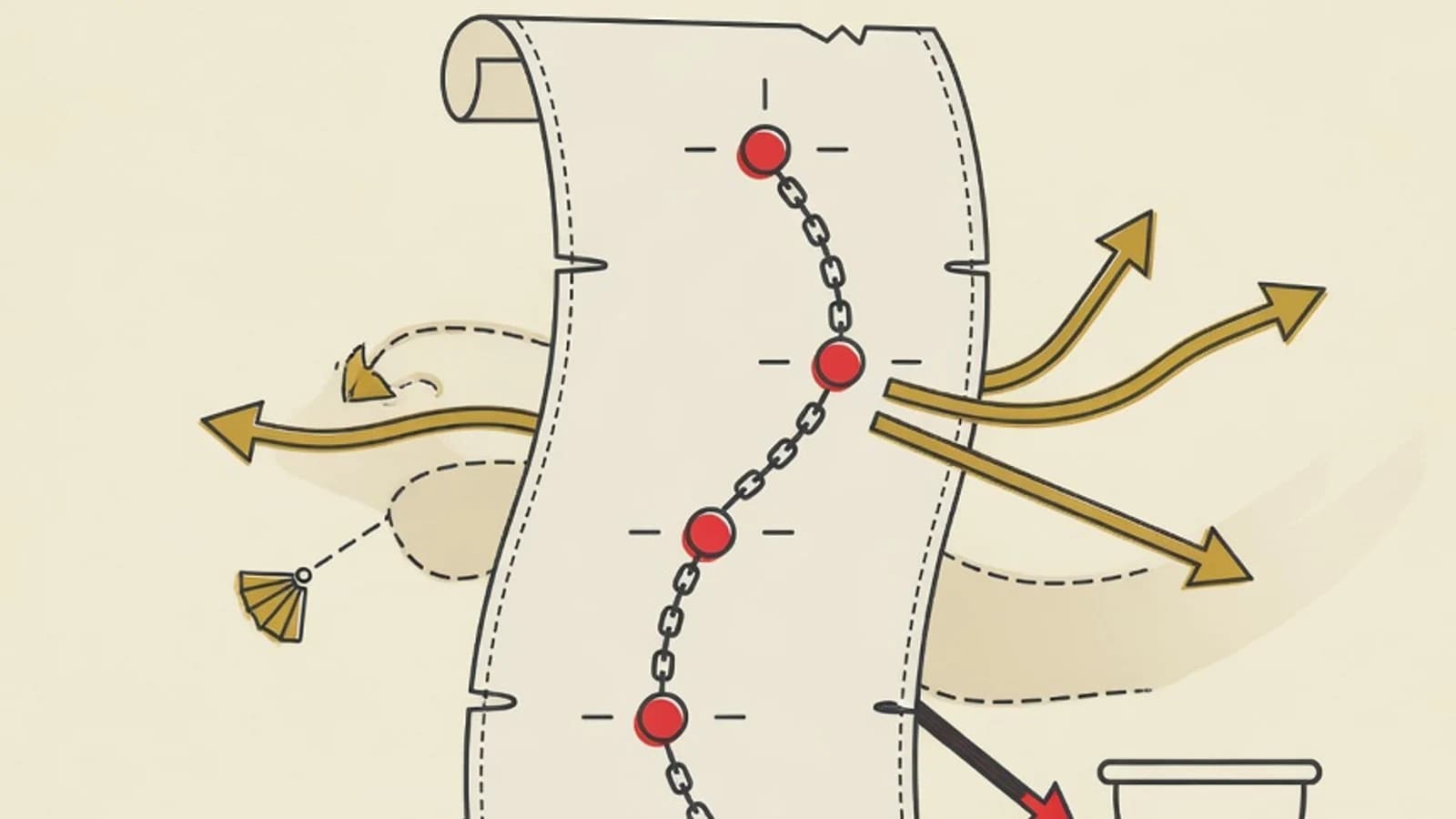
The most durable way to learn history is to read every event through cause and effect. Treat the date as a marker, then trace what pushed the event into being and what changed afterward. The mind stores connected stories far more neatly than a list of loose numbers. This causal chain is what makes history material whole and long lasting in memory.
- Dates act as markers while the links between events carry the real understanding
- Every event has a cause behind it and a consequence ahead that can be traced
- Grasp the causal chain first, and the important dates fall into place on their own
- A history textbook or module for the right grade level
- Large paper or a board to build a timeline
- Note cards to mark events, causes, and effects
- A steady 20 to 30 minutes per day
Recognized Frameworks for Historical Thinking
Why memorizing dates alone fades fast
A list of standalone years is hard to keep because it has no hooks. Sam Wineburg, in his work on historical thinking, explains that understanding the past demands reasoning that does not come naturally, such as placing events in context and tracing their causes. Memorizing numbers without a story makes the mind work hard for a result that fades quickly. The way memory works favors a causal approach. Events strung together in cause and effect form a web of meaning, and each node calls up the others. When someone knows that an economic crisis stirred discontent, that discontent sparked a movement, and that the movement brought change, the order of years falls into place along the logic of the story. In Indonesian history classes this framework already has familiar names. Diachronic thinking means tracing one sequence of events over time, exactly the work of following a chain of cause and effect. Synchronic thinking completes it by picturing the many factors at work at once within a single era.
7 Steps to Learn History Through Cause and Effect
These seven steps train the habit of reading history as a chain of events that cause one another. Work through them in order, since each step prepares the way of thinking for the next.
- Step 1
Turn dates into event markers
Begin by shifting focus from the year to the event it marks. Instead of memorizing 1908 as a string of digits, connect it to the founding of Budi Utomo and what it meant for the rise of the national movement. The date still matters as a reference point, and it sticks more easily once attached to a meaningful event. Write the event on a card, place the year in a small corner, and leave a large space for its cause and effect.
Tips- Write the event name in large letters and the year in small letters on the card
- Say the event first and the year second when reviewing the material
- Step 2
Ask two key questions about every event
For each event, ask what caused it to happen and what changed afterward. These two simple questions turn passive reading into active tracing. Cause and consequence is one of the pillars of historical thinking in the Seixas and Morton framework, and asking them repeatedly builds a reflex for reading history. The answers that surface become the material for building the chain of events in the next step.
Tips- Stick the two questions on your book cover as a reminder
- Look for the answers in the paragraphs before and after the event is discussed
Avoid stopping at a single cause. Major events usually arise from several causes working at once. - Step 3
Separate long-term causes, triggers, and consequences
Not all causes are equal. Some conditions build up over a long time, such as economic inequality or a repressive policy, while a trigger ignites them, such as one decision or a specific incident. Guidance on historical reasoning from The Historical Association stresses separating these causal layers so the analysis stays deep. Use different colors: one for long-term causes, one for triggers, one for consequences. This separation makes the pattern of history clear and easy to retell.
Tips- Long-term causes are usually conditions, while triggers are usually single events
- Tell apart immediate consequences that appear at once from long-term ones that emerge later
- Step 4
Build a cause-and-effect timeline in one diagram
Take a large sheet, place the events along a timeline, then draw arrows from cause to consequence. This diagram turns scattered material into one map you can view at a glance. Diachronic thinking in the Merdeka Curriculum works exactly this way, tracing one sequence of events over time. When the whole chain sits on one page, connections that were once vague become visible and the dates fall neatly into place.
Tips- Use thick arrows for strong cause-and-effect links and thin ones for weaker links
- Leave room below the timeline to note factors that work at the same time
- Step 5
Retell the chain of events without looking at notes
Close the book and the diagram, then retell the sequence of events from the first cause to the final consequence in your own words. This technique of pulling answers from memory, which Dunlosky and colleagues call retrieval practice, is proven to be among the strongest for long-term mastery across subjects. Telling the story forces the brain to reassemble the causal logic, so memory becomes firmer than rereading. After telling it, open your notes to check any part you missed.
Tips- Retell it as if explaining to a friend, complete with cause and effect
- Repeat the same story a few days later to strengthen the memory
- Step 6
Practice synchronic thinking to see many factors at once
Once the chain has grown and settled, add a cross-section of a single era. Synchronic thinking means seeing the political, economic, social, and cultural factors working at the same time. For example, when studying a period of occupation, review the economy, the ruler's policies, and public attitudes all at once. This lens adds contextual depth to the causal analysis, so cause and effect are read with proper nuance.
Tips- Make four factor columns: political, economic, social, cultural, then fill them for one period
- Connect findings across columns to spot causes that reinforce one another
- Step 7
Test understanding with why and how questions
Replace rote drilling with answering why an event happened and how it changed the situation. Analytical questions like these are the form of history question that appears often in secondary exams and university entrance selection. Practicing them trains the reasoning that is asked for, while closing gaps in understanding that were not yet visible. Every answer that stalls marks a part of the chain that needs another look.
Tips- Work on analytical essay questions alongside rote multiple-choice ones
- Grade your own answers by checking whether the cause and effect are complete
Memorizing Dates vs Tracing Cause and Effect
| Aspect | Memorizing Dates | Tracing Cause and Effect |
|---|---|---|
| Form of memory | Loose strings of numbers | A chain of interconnected events |
| Durability | Fades soon after the exam | Lasts long because it has a logic |
| Questions it serves | Date recall questions | Analytical why and how questions |
| Brain work | Raw repetition many times | Weaving meaning between events |
| End result | Knowing when an event happened | Understanding why and what its impact was |
Both can run together. Dates stay noted as markers, and causal understanding forms the backbone.
“Students who struggle to memorize dates often change the moment they are asked why an event happened. History stops feeling like a list of numbers and starts feeling like a story that makes sense.”
First-Week Starter Checklist
- Pick one history chapter you are currently studying as practice material
- Write each event on a card with a large name and a small year
- Ask the cause and effect questions for every event
- Color-code long-term causes, triggers, and consequences differently
- Build one cause-and-effect timeline on a large sheet
- Retell the chain without looking at notes at the end of the week
Self-Study vs Guided by a Tutor
- Free of charge and can be arranged around your own schedule
- Builds independence in reading and linking events
- Fits chapters whose storyline is already fairly clear
- Hard to judge on your own whether the causal chain you built is accurate
- Easy to get stuck on a single cause with no one to correct it
- Personal guidance helps train analytical why and how answers for exams
- Understanding history through cause and effect keeps the material connected and long lasting in memory
- Treat dates as markers, then separate long-term causes, triggers, and consequences
- Retrieval practice by retelling the chain of events strengthens mastery far beyond rereading