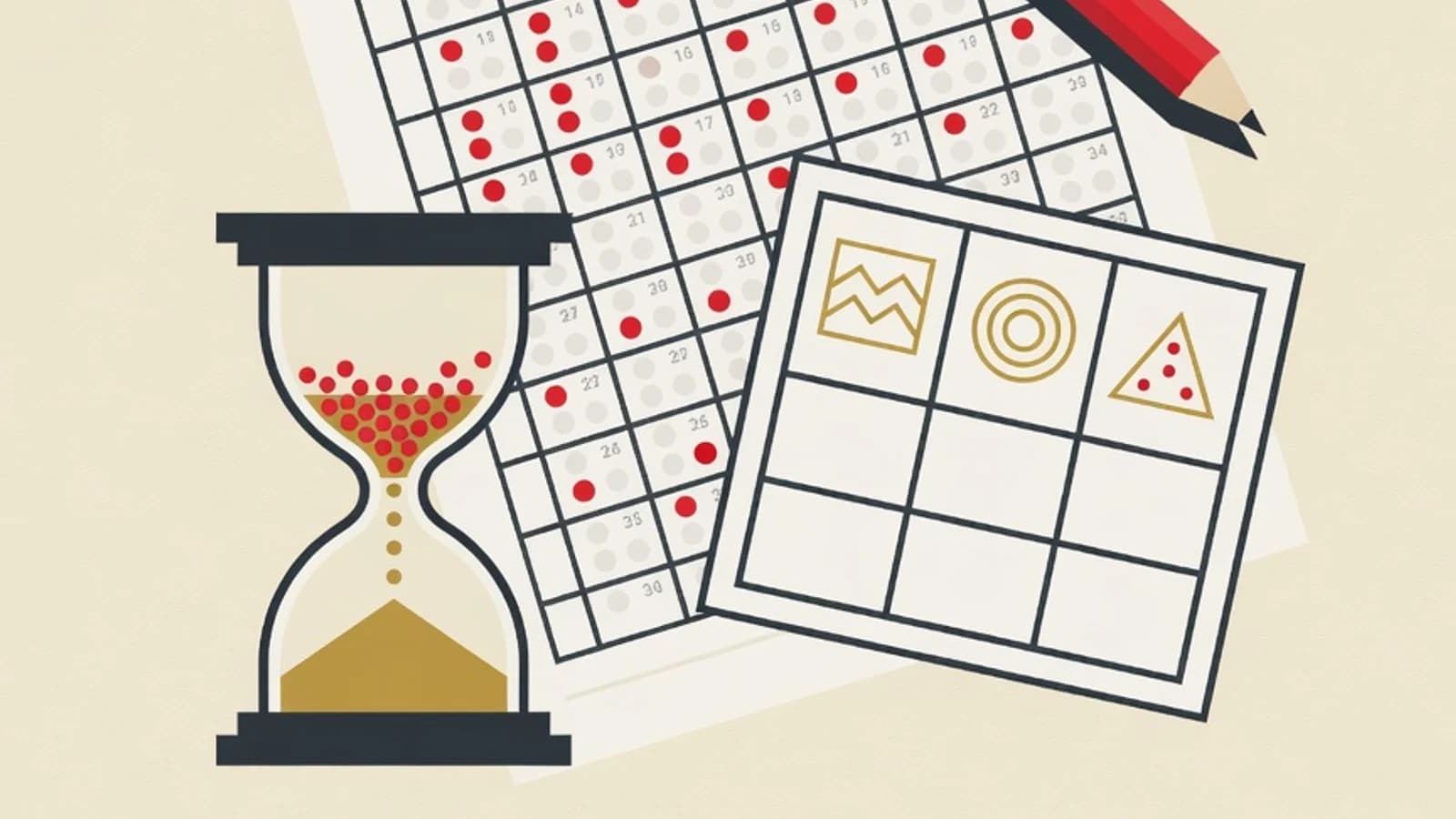
How to face a job psychometric test means first mapping the battery you will sit, drilling the ability parts such as number series and rapid arithmetic, then answering the personality test honestly and consistently. Sleep well, read every instruction to the end, and share your time across each section. Scheduled preparation over a few weeks lets you arrive calm.
- Find the test line-up from the invitation letter or job posting before the day arrives
- Ability tests are built by repeated practice; personality tests are answered honestly and consistently
- Enough rest and per-section time management keep your performance steady to the final test
- The invitation letter listing the test battery, venue, and required supplies
- Practice questions for the ability sections: number series, verbal analogies, and serial addition
- A full stationery set: 2B pencils, black pen, eraser, and a spare sharpener
The Job Psychometric Test in Numbers
What Does a Job Psychometric Test Actually Measure?
A job psychometric test is a set of psychological measuring tools companies use to read your thinking ability, working style, and fit for a role. A psychometric session rarely stands alone. You usually move through several tests in a row on the same day, and each one highlights a different side of you. Broadly, the questions cluster into three groups. The first assesses cognitive ability: number logic, verbal reasoning, and calculation accuracy as in the newspaper test. The second captures personality, for example through statement-choice tests that describe your habits and tendencies. The third is projective, where free drawing such as the Wartegg and tree tests reveals how you arrange your ideas. Assessors are not hunting for perfect answers. They read patterns: how quickly you grasp instructions, how steady your output stays, and how aligned your personality answers are from start to finish. Understanding this viewpoint makes your preparation sharper, because you know each part calls for a different attitude.
The Test Line-Up You Usually Meet in One Session
Numerical Ability Test
Number series, applied arithmetic, and word problems that measure quantitative logic. The best way to handle it is getting used to the question patterns through steady practice until solving feels quick.
Verbal Reasoning Test
Synonyms, antonyms, word analogies, and syllogisms that assess how you connect concepts. Widen your vocabulary and learn the types of word relationships so lookalike options do not trip you up.
Newspaper Test (Kraepelin and Pauli)
Adding single-digit number strings at a steady tempo. What counts is consistency and stamina, so drill a stable rhythm and let go of chasing a brief peak of speed.
Personality Test
A run of statements you pick to match yourself, such as the DISC or EPPS models. Answer honestly and consistently, because similar questions are repeated on purpose to check steadiness.
Drawing Test
The Wartegg test continues eight stimuli, the Baum test asks for a whole tree, the DAP test asks for a person. Focus on drawings that are neat, logical, and complete per the instruction.
Accuracy and Symbol Test
Matching pairs of numbers or symbols within a tight time to read your carefulness. Work row by row and avoid skipping lines so nothing is missed.
How to Face a Job Psychometric Test Step by Step
These seven steps guide your preparation from well ahead of time down to the final minute in the test room. Work through them in order, and match your practice share to the part you feel needs the most attention.
- Step 1
Map out the tests you will face
The most calming first step is knowing what awaits. Read the invitation letter carefully, noting the total duration, venue, and required supplies. Many companies name the tests in general terms, and you can round out the picture by looking up experiences of applicants for similar roles. If your application went through a staffing agency or a particular psychology firm, the test line-up often repeats from one batch to the next. With this map, you know whether to drill the newspaper test, verbal reasoning, or steady your mind for the drawing tests. Well-aimed preparation saves far more energy than studying everything at once with no focus.
Tips- Note every test type you find, then rank them by which one challenges you most
- Keep the invitation letter and schedule confirmation in one place for easy rechecking
- Step 2
Drill the ability tests with repeated practice
The cognitive part is the one you can sharpen most through practice. Work on number series, verbal analogies, applied arithmetic, and serial addition regularly, a little every day. Repetition trains your brain to recognize question patterns, so on the test day you no longer spend time understanding the question format. Practice with a timer to get used to the real time pressure. Afterward, review the answers you got wrong and understand where the mistake sat, because fixing one type of question you often miss is worth more than simply piling up questions. Speed built on understanding lasts longer than speed that is forced.
Tips- Separate practice by question type first, then blend them in a mixed simulation
- Do basic arithmetic without a calculator so you get used to fast mental math
Cramming the night before the test drains your energy and lowers your concentration on the day. - Step 3
Answer the personality test honestly and consistently
The personality test measures your tendencies, so there is no answer that is absolutely right or wrong. The biggest temptation is guessing the answer the company is thought to prefer. That approach is risky because many tests repeat similar questions in a different arrangement to check your steadiness. Engineered answers easily clash with one another and end up making your profile read as unstable. Answer according to your genuine habits, staying within a professional frame. If you understand the values a role prizes, it is enough to honestly bring forward the relevant side of yourself without inventing a new identity. This consistency is what makes your results read convincingly.
Tips- Read each statement calmly, and do not be lured toward the option that sounds impressive
- Know the core values of the role you want so you can tell which honest side deserves emphasis
- Step 4
Steady your mind for the drawing tests
Drawing tests often make applicants anxious because they feel abstract, yet the scoring rests on things that can be practiced. For the Wartegg test, develop each stimulus into a meaningful object that suits its base shape, then add a little context so the drawing looks whole. For the tree test, draw one woody tree complete with roots, trunk, branches, and clear leaves. For the person-drawing test, make a whole human figure from head to toe in a natural pose. You do not need high artistic skill. What assessors read is neatness, completeness, and how you arrange space inside the box. Practicing a few times makes your hand more confident when time is short.
Tips- Fill every Wartegg box even if one feels hard, since an empty box reads as incomplete
- Draw with firm, decided lines and avoid repeated faint scribbles
- Step 5
Read each section's instructions to the end
Many marks are lost because the instruction was skipped, even by applicants who are clearly capable. Each test type has its own rules, from the direction of work and how to mark answers to a tight time limit. Listen to the examiner and read the written guidance closely before pencil touches paper. If there is a sample question at the start, work it seriously so you truly grasp the mechanism. Asking during the open question window is far better than working an entire sheet the wrong way. The habit of reading instructions calmly also gives the impression that you are careful, a trait valued in almost every role.
Tips- Underline the key words in written instructions, such as time, direction, and number of options
- Use the sample-question window to confirm your understanding before the scored test begins
Starting the questions before the instruction is finished risks getting a whole section pointed the wrong way. - Step 6
Manage your time and stamina across tests
A psychometric session demands endurance because it runs for several hours with tests back to back. On a timed test, work the questions you are sure of first, then return to the hard ones if time remains. Holding yourself at one stuck question eats into the share for other questions that are actually easy. Between tests, use the short break to breathe, stretch your hands, and drink a little water. Keeping your tempo makes your performance even from the first test to the last. The later parts of a psychometric are often done as energy dips, so saving strength from the start helps you stay careful until the final sheet is collected.
Tips- Flag hard questions and skip ahead first, so one number does not hold up your progress
- Drink water and steady your breath during breaks so your head stays clear for the next test
- Step 7
Rest well and arrive early
Your physical state decides how clearly you think in the test room. The night before the psychometric, stop heavy studying and sleep enough so your brain is fresh. Prepare your full stationery, the required documents, and neat clothes from the night before so the morning runs calmly. A modest breakfast keeps your energy up to the last test. Arrive early to settle into the room, steady your breathing, and ease your nerves before the session starts. Normal nerves will fade once the first test gets going. Good physical preparation completes all the practice you have gathered, so you can show your best ability on the day that matters.
Tips- Pack a bag with stationery, ID card, and the invitation letter from the night before
- Allow a generous travel time so you are not rushing right before the test
Handling Ability Tests and Personality Tests Differently
| Aspect | Ability Test | Personality Test |
|---|---|---|
| What is assessed | Logic, calculation, and accuracy | Habits, attitudes, and working tendencies |
| A right answer exists | Yes, one correct answer | No, what matters is honesty and alignment |
| How to prepare | Repeated practice and timed simulations | Know yourself and the role's values |
| Key during the test | Speed with accuracy kept intact | Steady answers across similar questions |
| Common mistake | Stuck on one hard question too long | Engineering ideal answers that clash |
These two groups pull in opposite directions. Practice sharpens the ability tests, while consistent honesty keeps the personality test reading convincingly.
“The most prepared applicants are usually the ones who understand their test map best, often outrunning those who are merely clever. When you know which part needs drilling and which part just needs an honest answer, your energy and focus land right on target across a long session.”
Your Ready List Before Psychometric Day
- Reconfirm the venue, time, and required supplies from the invitation letter
- Pack 2B pencils, a black pen, an eraser, your ID card, and the invitation letter
- Do one light simulation to warm your hand and mind, without forcing heavy study
- Sleep enough and stop intensive practice on the night before the test
- Have a modest breakfast so your energy lasts through the whole test battery
- Plan your journey with generous time so you can arrive early and calm
- Knowing the test line-up in advance makes psychometric preparation focused and energy-saving
- Ability tests are sharpened through repeated practice and timed simulations
- Personality tests are answered honestly and consistently because similar questions repeat to check steadiness
- Drawing tests are judged on neatness and completeness of the drawing per the instruction
- Enough rest, reading instructions, and pacing your time keep performance up to the final test