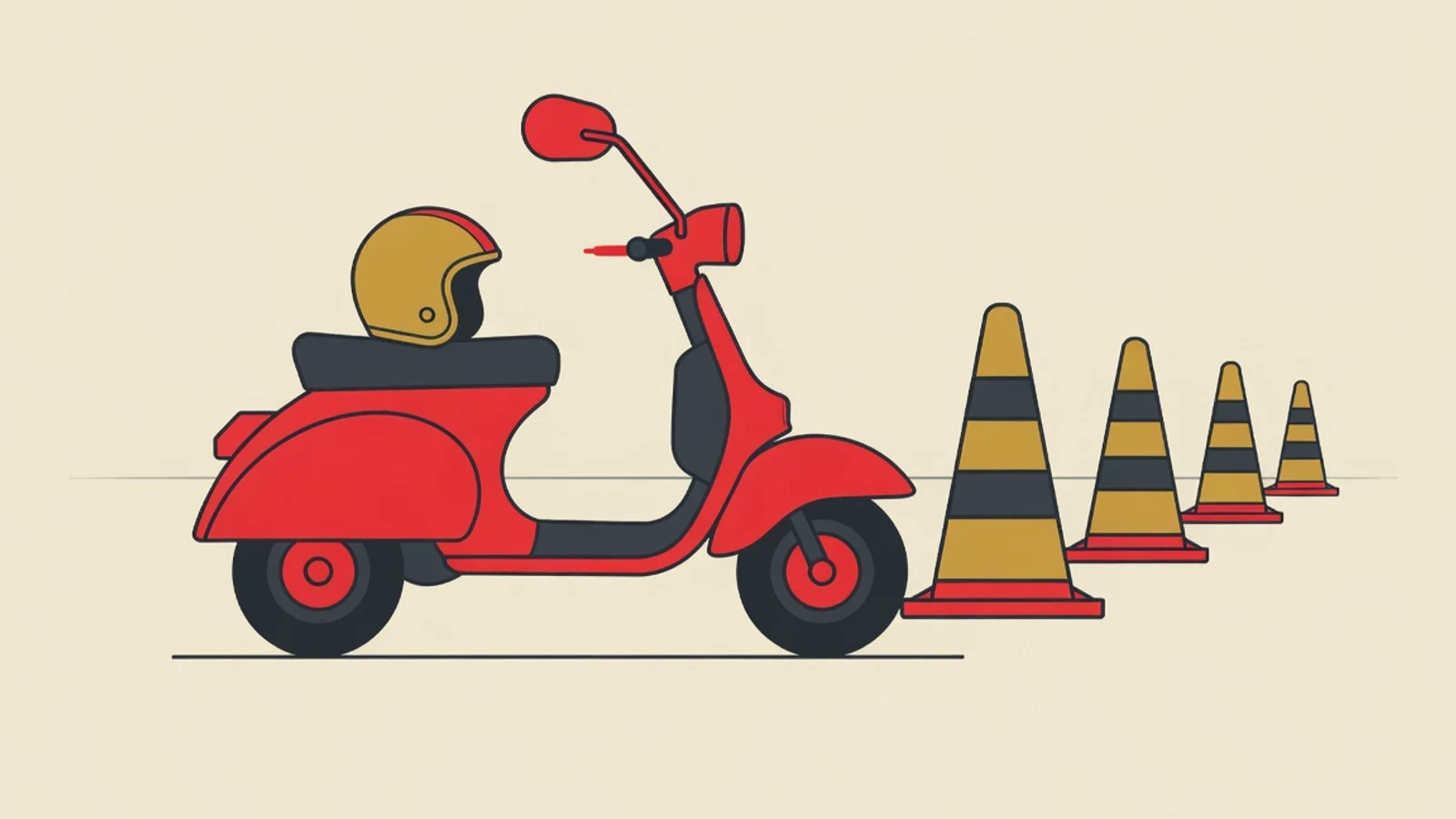
How to learn to ride an automatic scooter for beginners starts with getting to know the throttle and its two brakes, then practising fine throttle control and balance in an empty area before touching the road. An automatic scooter is beginner friendly because it has no clutch or gears, so you can focus on the throttle, the brakes, and keeping the scooter upright as it rolls slowly.
- An automatic scooter only needs throttle and brake control, so a total beginner can focus on balance first
- Early practice happens in a safe empty area until the basic movements feel automatic
- Confidence grows from gradual practice, starting with fine throttle work and stopping with feet planted steadily
- A well-fitting SNI helmet with a working chin strap
- Gloves and closed shoes to protect hands and feet
- An automatic scooter with a seat height that lets both feet reach the ground
- An empty practice area such as a quiet field or parking lot away from traffic
Automatic Scooters and Safe Riding in Numbers
Why an automatic scooter is the friendliest choice for total beginners
An automatic scooter simplifies learning to ride by removing the two things beginners find most confusing: the clutch lever and gear shifting. On automatic scooters such as the Beat, Scoopy, Vario, or NMAX, you only deal with the throttle on the right grip and two brake levers. The left hand holds the rear brake, the right hand holds the throttle and the front brake. This simplicity frees up your mind for what truly matters early on, namely balance and slow speed control. Many beginner women and homemakers choose an automatic scooter as a first step precisely because the learning curve is gentle. The seat height of several automatic models is also friendly for smaller riders, so both feet can plant firmly on the ground when stopping. The security of feet planted steadily is the foundation of confidence in the early sessions. One thing to understand from the start: an automatic scooter uses a CVT transmission that makes the scooter creep forward the moment the throttle is touched. This character feels unfamiliar to beginners, and recognising it early helps you control that creep instead of being startled by it.
7 Steps to Learn to Ride an Automatic Scooter from Zero
These seven steps run from the most basic toward complete slow riding. Make sure each step feels comfortable and automatic before moving to the next, because a solid foundation makes the road stage far lighter later on.
- 1
Get to know the scooter's controls before starting the engine
Before turning the key, sit on the scooter with the engine off and study where each control sits. The right grip holds the throttle, which you twist toward yourself to add speed, with the front brake lever right in front of it. The left grip holds the rear brake lever, plus the horn, turn signal, and high beam buttons. Squeeze both brake levers a few times until your fingers learn their reach and pressure. Find the side stand and centre stand too, because you will use both often. This step of getting to know the controls builds a map of the scooter in your head, so your hands move by reflex without searching once you are moving.
Tips- Practise reaching the rear brake with your left hand repeatedly until it feels natural
- Make sure both feet plant on the ground comfortably when seated, and reconsider the scooter if the seat feels too tall
- 2
Start and stop the engine safely, and get used to the stands
Modern automatic scooters usually require a brake lever to be pressed before the starter button will start the engine, a built-in safeguard so the scooter does not lurch when started. Sit upright, press the rear brake with your left hand, then press the starter button. Let the engine idle for a moment while both hands keep holding the brake and the throttle stays fully closed. Practise raising and lowering the side stand and centre stand as well, because on many models an automatic scooter switches off when the side stand is still down. Mastering this starting and stopping ritual keeps you calm, because the scooter stays under control from the first second the engine runs.
Tips- Always press the brake when starting the engine so the scooter does not creep unexpectedly
- Raise the side stand fully before moving so the engine does not cut out suddenly
Never twist the throttle while starting the engine. An open throttle together with the engine firing makes the scooter creep forward suddenly and startles a beginner. - 3
Set a relaxed seating position and handlebar grip
Body position determines how easily you keep balance. Sit slightly forward so your feet reach the ground easily, keep your back upright and relaxed, and let your elbows bend a little so you are not stiff. Hold the handlebars with a soft grip, as if holding a glass filled to the brim with water. A grip that is too tight makes the steering jerky and tenses your whole body. Direct your gaze far ahead, around ten to fifteen metres, and keep it off the front wheel. Eyes that look far help the body balance the scooter automatically, because the scooter tends to follow the direction of your gaze. A relaxed posture and a far gaze are two small habits with a big effect on stability.
Tips- Loosen your shoulders and release some tension in your arms before you start moving
- Practise looking far ahead and avoid the habit of staring at the front wheel, which makes the steering wobble
- 4
Practise fine throttle control to tame the creep
This is the most decisive skill on an automatic scooter. Because the CVT transmission makes the scooter creep the moment the throttle is touched, you need to learn to open the throttle in very small, smooth amounts. In an empty area, with your feet still ready to plant, open the throttle as thinly as possible until the scooter creeps slowly for a few metres, then close the throttle and brake gently until it stops. Repeat this creep and stop many times until your hand understands how little throttle is needed. This practice erases the reflex of opening the throttle too much, which makes the scooter jerk. Once your hand is used to the fine throttle amount, controlling slow speed becomes far easier.
Tips- Imagine the throttle as a water tap you open little by little until the scooter moves smoothly
- Practise the creep then stop pattern repeatedly until the scooter's movement feels predictable
Avoid closing the throttle while grabbing the front brake abruptly while still creeping. A front brake snapped at very low speed can lock the front wheel and make the scooter tip. - 5
Keep your balance while riding slowly in a straight line
Once the creep is under control, add distance and let the scooter roll slowly in a straight line. The secret to a motorcycle's balance lies in enough speed and a far gaze. A moving scooter is actually easier to keep upright than one nearly still, so do not be afraid to add a little pace. Lift both feet onto the footrests and let the scooter travel straight for ten to twenty metres while looking at a distant point ahead. If it feels wobbly, resist the urge to close the throttle suddenly, just keep the throttle steady and your gaze forward. The more often you feel the scooter balance itself as it moves, the faster your confidence grows.
Tips- Lift both feet onto the footrests once the scooter starts moving, do not dangle your feet on the tarmac
- Keep the throttle steady when wobbling, closing it suddenly only makes the scooter shakier
- 6
Master smooth braking with both brakes
Stopping smoothly matters as much as riding. On an automatic scooter, get used to pulling both brakes together and gradually: the rear brake on the left hand as the main brake for low speed, helped by the front brake on the right hand for stronger stopping power. Pull both softly and progressively, never snatched. Approaching a full stop, lower your left foot first to plant it on the ground while keeping the brakes held so the scooter does not creep again. Practise stopping at a point you set yourself, for example level with a cone, until the stopping distance feels predictable. Smooth, measured braking is the skill that keeps you safe once you begin sharing the road with other vehicles.
Tips- Use the rear brake as the main brake at low speed, adding the front brake gradually
- Lower your left foot as you almost stop while keeping the brakes held so the scooter stays fully still
- 7
Practise slow turns, shoulder checks, and repeated stops
The final step combines every skill into full control at low speed. Arrange a few cones into a wide turning lane, then practise turning slowly by following your gaze toward the exit of the curve. Get used to checking behind through the mirror and a brief head turn before moving or turning, a habit that will save you on the road. String together a pattern of slow riding, turning, then stopping with feet planted, repeatedly in the empty area until it all feels connected. At this stage you already hold a complete foundation of automatic scooter riding and are ready to add mileage in gradually more challenging surroundings, ideally with an instructor alongside.
Tips- Aim your gaze at the exit of the curve, the scooter will follow where your eyes look
- Get used to a shoulder check and scanning around before turning while still practising in the empty area
Key Automatic Scooter Controls Every Beginner Must Know
Throttle (right grip)
Twisted toward the rider to add speed. On an automatic scooter, a small touch already makes it creep, so fine control is the main key.
Front brake (right lever)
Gives the strongest stopping power, but used gradually. Snatching it at very low speed risks locking the front wheel.
Rear brake (left lever)
The main brake for low speed and slow manoeuvres. It feels more stable and beginner friendly while you learn to stop smoothly.
Side and centre stands
The side stand is handy for a short stop, the centre stand for stable parking. Many scooters cut the engine while the side stand is still down.
Common Automatic Scooter Beginner Mistakes and How to Fix Them
| Mistake | Consequence | Fix |
|---|---|---|
| Opening the throttle too much at start | The scooter jerks forward and the beginner panics | Practise fine throttle until the creep is controlled |
| Staring at the front wheel while moving | The steering wobbles and the body tenses | Look far ahead, ten to fifteen metres in front |
| Snatching the front brake at low speed | The front wheel locks and the scooter tips | Favour the rear brake, add the front brake gradually |
| Dangling feet on the tarmac while riding | Balance breaks and a foot can get clipped | Lift both feet onto the footrests once moving |
Almost every beginner mistake stems from too much throttle and a gaze that is too close, so both deserve practice until they become fully automatic.
“Beginners on automatic scooters often think the difficulty is about strength or courage, when it is almost always about throttle control and where the eyes look. Once someone gets used to opening the throttle as thinly as possible and looking far ahead, the scooter feels tame and balance comes on its own.”
Practising in an Empty Area vs Going Straight to the Road
- Full focus on throttle, brakes, and balance without the pressure of other vehicles
- A beginner's mistakes become safe lessons in an area free of other vehicles
- Confidence grows gradually until the basic movements feel automatic
- You can repeat the creep, stop, and turn patterns as many times as needed
- Controlling the scooter and reading traffic arrive at once and overwhelm a beginner
- The room for error is very narrow because other vehicles are around
- Panic surfaces more easily and blocks the forming of correct habits
- The risk of injury is far higher before basic skills are formed
Checklist: Signs You Are Ready to Ride an Automatic Scooter on Your Own
- You can start the engine and raise the stand calmly without the scooter jerking
- You control the fine throttle so the scooter creeps smoothly without a jolt
- You can ride slowly in a straight line with both feet on the footrests and your gaze far ahead
- You can stop smoothly with both brakes and plant your left foot steadily
- You are used to checking your mirror and surroundings before moving or turning
- Learning to ride an automatic scooter starts from getting to know the throttle and two brakes, then practising fine throttle and balance before adding speed.
- Fine throttle and a far gaze ahead are the two skills that most determine a beginner's stability on an automatic scooter.
- Practising in a safe empty area forms correct habits before sharing the road with other vehicles.
- An SNI helmet is required from the first session, and riding on public roads requires a SIM C licence under traffic rules.