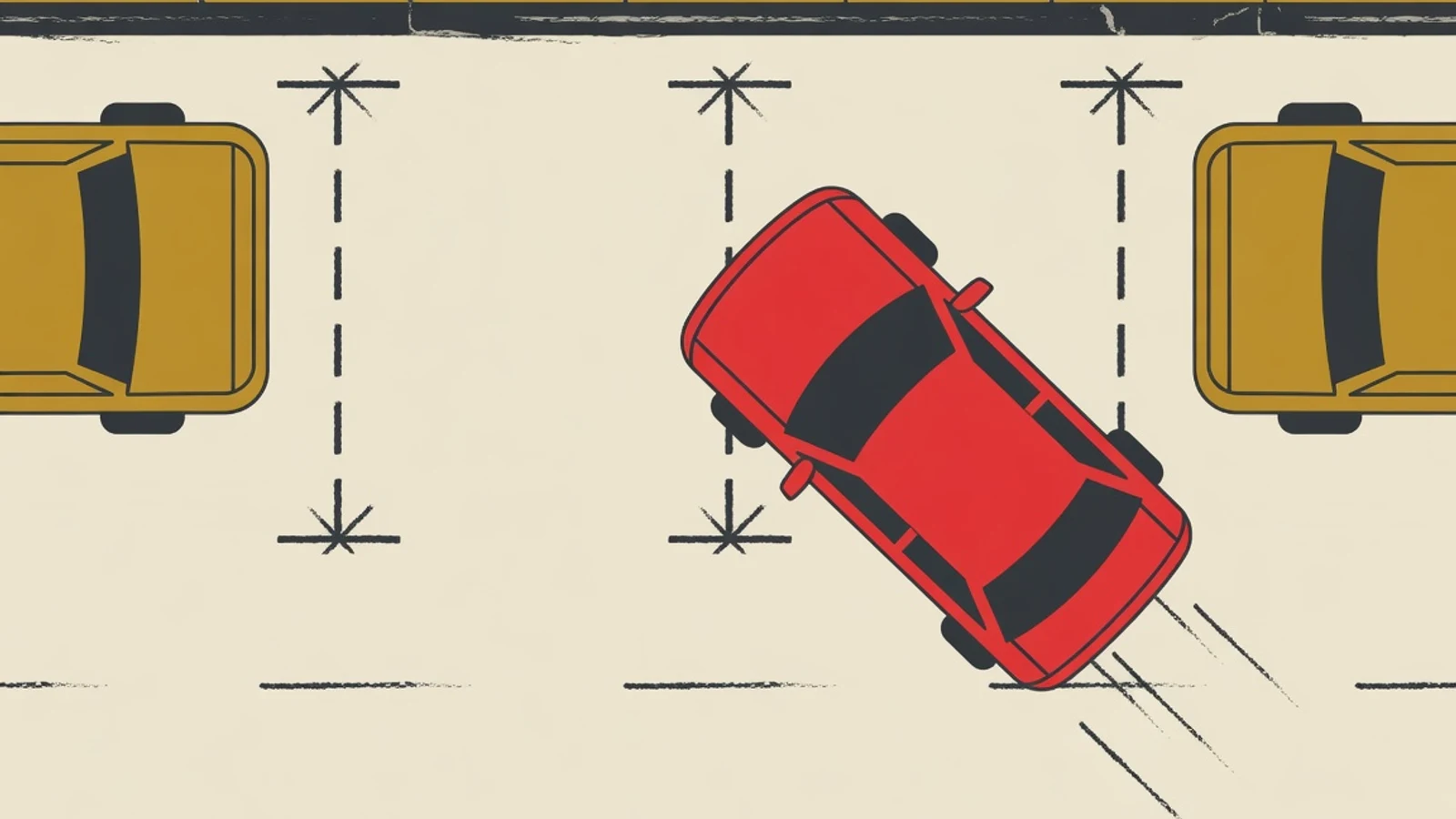
How to parallel park a car for beginners is easiest done in stages. Line your car up beside the vehicle ahead of the space with about one meter of side gap, reverse slowly until your mirror meets the rear bumper of that car, turn the wheel fully toward the curb, then straighten as the body starts to enter. Mirror reference points and an angle of roughly 45 degrees keep the motion measured and repeatable.
- Pick a space about one and a half times your car's length for safe room to swing in while reversing
- Make your mirrors the main reference, backed up by an occasional reviews your shoulder
- Turn the wheel at the right moment, then reverse it to straighten the body parallel to the curb
- One car to practice with, ideally the car you drive every day so its dimensions and blind spots are already familiar
- A quiet practice area with two cones or water bottles marking the front and rear edges of a parking space
- A space about one and a half times your car's length so there is comfortable margin while learning
Key Reference Numbers Before Parallel Parking
Why parallel parking feels hard for beginners
Parallel parking asks you to bring the car into a space that lies along the road through a reversing motion combined with steering. The source of difficulty is simple. When driving forward, your eyes are used to reading direction through the wide windshield, while in reverse your view shifts to the mirrors and rear glass, which are far narrower. A beginner's brain has no map yet linking wheel rotation to the direction of the car's rear, so the body often swings too far out or hugs the curb. The good news is that parallel parking follows a fixed pattern. Any car reversing with its front wheels turned will swing the rear to one side first, followed by the front. Once you understand that sequence and mark when to turn and when to reverse the wheel, a motion that felt random becomes a repeatable set of steps. Reference points on the mirrors replace guesswork with clear markers. This is why parallel parking is mastered much faster in your own car. Body length, mirror position, and viewing angle differ between cars, so a reference point that fits one car may not fit another. Practicing in the vehicle you actually drive every day makes those markers immediately useful.
7 Steps to Parallel Park a Car for Beginners
These seven steps follow the order instructors usually teach when coaching parallel parking: set the mirrors, line up the car, reverse and turn, read the reference points, straighten the body, then tidy the spacing. Work through each step slowly until it feels comfortable before joining them into one flowing motion.
- 1
Adjust the mirrors and choose a space long enough
Before approaching the space, adjust all three mirrors to your seating posture. The center mirror shows the whole rear window, while the left and right mirrors show a sliver of the body plus the curb below it. That visible edge of the body matters because it becomes your gauge of distance to the curb while reversing. Then pick a space about one and a half times your car's length. A space barely as long as the car can be entered by an expert, but for a beginner more room gives margin to err and correct without panic. Also watch for a pole, a gutter, or a protruding vehicle that could shrink the real usable space.
Tips- Tilt the curb-side mirror down slightly if your car auto-tilts in reverse gear, so the curb edge is easier to see
- Drive past the space once, sizing it up with your eyes, before deciding to enter
Forcing into a space nearly as long as the car leaves you out of room mid-maneuver. Look for a roomier space while you are still learning. - 2
Line the car up with the vehicle ahead of the space
Pull forward until you are level with the vehicle parked just ahead of the empty space. Being level means your body sits alongside the front car's body, with a side gap of about one meter. That gap gives your rear room to swing while reversing without scraping. Roughly align the back of your car with the back of the front car, or match the mirror positions of both cars as an easy starting reference. Come to a full stop here, take a breath, and check that no vehicle or pedestrian is behind you before reversing. Switch on the turn signal toward the space so other road users understand you intend to park.
Tips- If unsure about the one-meter gap, imagine being able to open your door without touching the front car
- Match the two side mirrors as a consistent starting marker
- 3
Shift into reverse and turn the wheel fully toward the curb
Shift into reverse, release the brake gently, and let the car creep very slowly. As the rear begins to pass the back of the front car, turn the wheel fully toward the curb, meaning to the left if you are parking on the left side of the road. This full turn steers the rear into the mouth of the space at an angle of roughly 45 degrees to the curb. Keep the speed at a crawl so you have time to read the mirrors and stop at any moment. Your gaze alternates between the left mirror, the rear glass, and the right mirror to make sure the rear does not get too close to the car behind the space. Tidy parallel parking comes from controlled low speed, because the slower the car moves the more time you have to correct direction.
Tips- Turn the wheel while the car is moving, turning it while stationary strains the steering system
- Keep your foot ready on the brake, release only to creep then hold again if you need to think
Reversing too fast makes the entry angle pass by and the rear risks nudging the car behind. Keep a crawling pace throughout the maneuver. - 4
Read the mirror reference points to know when to straighten
This is the key that separates guessing from a measured motion. While reversing with the wheel fully turned, watch the right mirror or rear glass. When the headlights of the car parked behind the space start to appear fully in the road-side mirror, that signals the body has entered enough and it is time to return the wheel to straight. Another common marker is when the back of the front car appears in the middle of the passenger-side window, meaning your rear has usually cleared into the space. Each car's reference point differs slightly, so in early sessions you may stick a small piece of tape on the glass as a temporary marker. After a few practice runs, your eyes will recognize this moment without aids. Reading the mirrors patiently makes parallel parking feel like following a clear map.
Tips- Learn one reliable reference point first, such as the rear car's lights in the mirror, before adding others
- Stop the car briefly to read the mirror if confused, a short pause is fine while practicing
- 5
Straighten the wheels then turn the wheel the opposite way
Once the rear is in and the reference point is reached, return the wheel to straight while still creeping backward a few hand-spans. The car now moves deeper into the space at a shrinking angle. When the front of your car has cleared the rear of the front car, turn the wheel fully the opposite way, meaning away from the curb, so the front swings in and the body lines up with the road. This two-stage motion, turning toward the curb then turning away, is the heart of parallel parking. The rear enters first, then the front follows to snug in. Do this while still checking the left mirror to keep the rear wheel off the curb and the right mirror to hold distance from the car behind.
Tips- Feel the wheel returning to straight by counting turns, it usually returns with the same number of rotations
- If the front still juts out, keep reversing a little while the wheel points away from the curb
Forgetting to reverse the wheel away from the curb leaves the front angled out of the space. Make sure this second phase of the turn happens. - 6
Tidy the position with small forward and back moves until parallel
Perfect parallel parking in a single motion is rare, and that is normal even for experienced drivers. Once the body is in, check the distance to the curb via the left mirror. If too far from the curb, pull forward a little with the wheel toward the curb then reverse again to straighten. If a wheel nearly touches the curb, pull forward slightly with the wheel away to give space. The final target is a body parallel to the curb about 30 centimeters away, close enough not to obstruct traffic yet not scraping the rim. Also balance the front and rear spacing so the cars ahead of and behind you still have room to exit. A few forward-and-back corrections are a normal part of the process, so do them calmly without rushing.
Tips- The 30-centimeter target is roughly one adult foot-width from wheel to curb
- Leave enough room front and back so you and the neighboring cars can pull out easily
- 7
Repeat in different spaces until the reference points become reflex
Mastering parallel parking rests on repetition across varied conditions. Once the basic motion feels comfortable, seek out spaces with a different challenge: the right side of the road, a slightly shorter space, or a road with a mild slope. This variety trains your eyes to read shifting reference points and your hands to adjust the amount of wheel turn. On an uphill or downhill road, add the habit of holding the brake longer since the car tends to drift on its own. Practicing in quiet late afternoons gives safe room to err without the pressure of horns. The more you repeat, the faster your eyes recognize the moment to turn and reverse the wheel, until parallel parking finally feels automatic. For those preparing for the SIM A driving practical test, this skill is also one of the tested items, so regular practice doubles as test preparation.
Tips- Note how many corrections you need each session as a gauge of progress
- Bring an experienced companion in early sessions to call out distances from outside the car
Parallel Parking Compared to Other Parking Types
| Parking type | Entry direction | Main challenge |
|---|---|---|
| Parallel parking | Reverse with a turn, along the road | Reading the rear swing through mirrors |
| Bay or perpendicular | Reverse straight into the bay | Keeping the body centered and straight |
| Angled parking | Forward or reverse at an angle | Judging a gentler entry angle |
| Parking on a slope | Aim wheels toward the curb | Holding the car from rolling |
Parallel parking is considered the most demanding because it combines reversing, full two-way turns, and mirror reference reading at once. Mastering it makes the other parking types feel lighter.
Common Beginner Parallel Parking Mistakes and Fixes
Rear nudges the car behind
Entry angle too sharp or reversing too fast. Slow to a crawl and start turning the wheel a little earlier.
Body ends up far from the curb
Wheel straightened too early before the rear entered enough. Wait for the mirror reference point before straightening.
Front sticks out of the space
The second phase of turning the wheel away from the curb was skipped. After the rear enters, turn the wheel the opposite way while reversing slightly.
Panic when a queue forms behind
Pressure rushes the motion and it misses. Signal, breathe, and run the steps as usual, road users generally understand.
“A beginner who memorizes the mirror reference points first parks calmly because they know exactly when to turn and when to reverse the wheel, while a few forward-and-back corrections are a normal part that need not be seen as failure.”
Quick Checklist Before You Start Parallel Parking
- Are all three mirrors adjusted and the body's edge to the curb visible
- Is the chosen space long enough, about one and a half times my car
- Am I level with the front car at about one meter of side gap
- Is the turn signal on and the road behind clear
- Am I ready to creep slowly and stop at any moment to read the mirrors
Bringing reference points, low speed, and correction together into habit
Smooth parallel parking is the result of three habits that grow together. Reference points tell you when to turn and reverse the wheel, low speed gives time to read those points, and forward-and-back correction perfects the final position. A beginner who only memorizes the steps without reading the mirrors often drifts because every space is slightly different. A beginner who reads the mirrors but reverses too fast loses the moment to stop and think. All three need to be trained within the same motion. The most comfortable way to build that habit is gradual practice in a safe setting. Start in an empty lot to feel the rear swing, move to a quiet space with cones, then to a real, low-traffic street. Each short, regular session is worth more than one long occasional session, because the brain needs repetition to turn reference points into reflex. Guidance from an instructor speeds this up because a small error in entry angle or the moment of reversing the wheel can be pointed out before it becomes a habit. For those also preparing for the SIM A driving practical test, this parallel parking practice trains a skill that is indeed tested at the licensing center, so road confidence and test readiness grow side by side.
- Parallel parking is done in stages: line up the car, reverse with a turn, read the reference points, straighten, then tidy the spacing
- Mirror reference points replace guesswork, for example the rear car's lights appearing fully signals when to straighten the wheel
- Controlled crawling speed gives time to read the mirrors and stop at any moment to correct
- A few forward-and-back corrections are normal, the final target is about 30 centimeters from the curb
- Parallel parking is part of the SIM A driving practical test, so regular practice also prepares you for the test