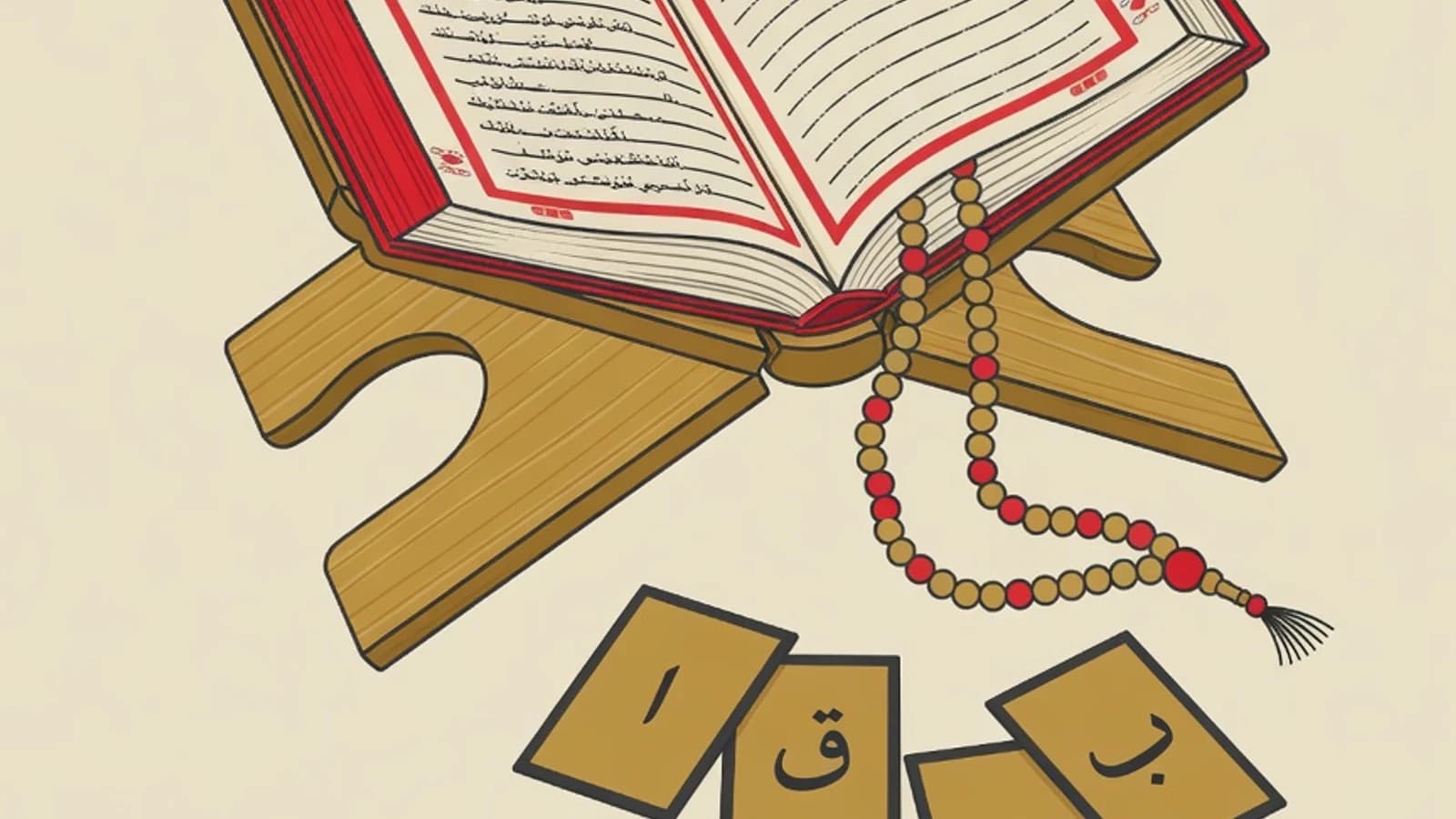
For adult beginners, learning to recite the Qur'an starts with knowing the hijaiyah letters and harakat, choosing one structured method such as Iqro or the adult Ummi levels, then practising makhraj with a teacher and repeating the reading every day. Progress grows from small, consistent routines.
- Adult-level workbooks are more concise than children's volumes
- Talaqqi guidance corrects pronunciation from the very first session
- Fifteen minutes of daily practice works better than an occasional long session
- An adult-level workbook (a concise Iqro or the 3-volume Ummi set)
- A Qur'an with large print and tajweed marks
- Hijaiyah letter cards for solo practice
- Recordings of a teacher's recitation to listen to at home
Learning to recite as an adult beginner, in numbers
Why learning to recite differs for adults and children
Adults bring two things a young child does not: a strong reason and limited time. A mother who wants to recite alongside her child, or an employee who wants to improve the recitation in prayer, finds the process deeply meaningful. On the other hand, a packed schedule calls for a method that is efficient and to the point. In terms of learning, adults excel at understanding patterns and rules. The idea of harakat, the marks for long and short sounds, and tajweed rules can be explained logically and then applied straight away. The challenge appears on two sides. First, the tongue's muscle memory for articulating the makhraj of each letter needs repeated practice, much like learning a new sport. Second, some adults feel self-conscious starting from the basic letters, especially when peers are already fluent. That feeling is natural and eases once practice gets going with a patient companion. For this reason, an adult beginner's path is best served by a concise adult-level workbook, private sessions focused on pronunciation correction, and small weekly targets that are easy to measure.
Six steps for adult beginners to learn Qur'an recitation
The sequence below maps the journey from knowing the letters to reading short verses. Each step is designed to fit an adult's rhythm, learning between work and household duties.
- 1
Build solid recognition of the hijaiyah letters and their shapes
Begin by learning the 28 hijaiyah letters together with their connected forms at the start, middle, and end of a word. For adult beginners, the fastest way is to group letters with similar shapes, such as ba, ta, and tsa, then tell them apart by their dots. Use letter cards and place them where you often glance. This practice does not need to be long; five to ten minutes repeated several times a day works well. The target of this step is simple: you can name every letter without hesitation when it is pointed to at random.
Tips- Group similar letters so their dots and curves become easier to distinguish
- Say each letter's name aloud so your ear is trained too
- 2
Understand harakat as the key to pronunciation
Once the letters are familiar, the next step is harakat: fathah, kasrah, and dammah, then the sukun and tasydid marks. Harakat turns a silent letter into a readable sound, so this part is the heart of reading the Qur'an. Adult beginners usually catch the logic quickly because it resembles vowel-sound rules. Practise by reading simple letter combinations such as ba-bi-bu, then move up to two or three letters. When you can smoothly join harakat sounds, you already hold half of the reading skill.
Tips- Read slowly while pointing to each letter so eye and tongue stay in sync
- Repeat the same sound pattern until it feels automatic before adding a new letter
Do not rush for speed. The correct sound matters more than fast but inaccurate reading. - 3
Choose one adult-level method and follow it through
This is the most decisive stage. Pick one structured method, for example a concise Iqro or the three-volume adult Ummi set, then work through it in order. Adult-level workbooks are deliberately compact because adults can absorb several concepts at once. Sticking to one method prevents the confusion that comes from switching books. Each page of the level raises the difficulty little by little, so you are always learning something new on top of a foundation that is already firm. Finish one page correctly before moving on, and ask your teacher to mark the parts that need review.
Tips- One method is enough. Switching books too often makes progress feel stuck
- Finish a page thoroughly before stepping up to the next
- 4
Practise makhraj through talaqqi guidance
Makhraj is where each letter's sound emerges in the mouth and throat. Several Arabic letters, such as ain, ha, kha, and qaf, have no equivalent in the Indonesian language, so they are hard to master from a book alone. The most effective way is talaqqi: the teacher recites, you imitate, then the teacher corrects on the spot. This listen-and-repeat method improves pronunciation from the first session and stops wrong habits from settling in. For adult beginners, private sessions help a great deal because the correction is personal, without feeling awkward in front of a crowd. Record your own reading at home, then compare it with your teacher's example to hear the gap.
Tips- Record your own voice and compare it with your teacher's reading to catch subtle differences
- Focus practice on the throat letters that most challenge an Indonesian tongue
- 5
Move into basic tajweed gradually
Once reading letters with harakat is steady, begin learning basic tajweed: the long and short of a reading (mad), the nasal sound (ghunnah), and the rules of nun sukun and tanwin. The good news is that adults grasp tajweed fairly easily because it is presented as a logical set of rules. Learn one rule at a time, find its example on the workbook page or the mushaf, then practise until it feels familiar. Tajweed makes your reading orderly and pleasant to hear while keeping the meaning of the verse intact. This stage need not be chased all at once; let it grow as your reading hours add up.
Tips- Learn one tajweed rule at a time until it feels familiar before adding another
- Mark examples of each rule in the mushaf so they are easy to recall on a re-read
- 6
Shift to the mushaf and build a reading routine
The final step is moving from the workbook to the Qur'an itself, starting with the short surahs in the last juz that you often hear during prayer. Familiarity with those readings makes the transition feel light. Set a small routine you can keep, such as reading a few lines after every Maghrib prayer. Daily consistency has far more effect than long sessions done rarely. Include regular sessions with a teacher to correct your reading and keep the learning on track. With this pattern, your reading ability grows steadily over time.
Tips- Start with short surahs already familiar to your ear so confidence builds
- Tie your reading time to a daily habit, such as after prayer, so it is easy to maintain
Getting to know the method choices for adults
The Iqro method
Six volumes that introduce letters and pronunciation directly, with little theory. It suits adult beginners who want to see progress quickly, since each page delivers a tangible step forward.
The adult Ummi levels
Condensed into three volumes for adults, then continued into the mushaf. It emphasises tartil reading in line with tajweed rules through talaqqi, where the teacher reads and the student imitates.
The Tilawati method
Instils tajweed and the rost melody early through a mix of classical and individual approaches. It helps adult beginners read with an orderly rhythm and tidy pronunciation.
Private talaqqi approach
One teacher to one student, where the teacher recites and the student imitates. Very effective for correcting makhraj and comfortable for adults who are just starting out.
Comparing methods to match your needs
| Method | Main focus | Best for |
|---|---|---|
| Iqro | Letter recognition and quick reading | Adults who want progress to show soon |
| Adult Ummi | Tartil and tajweed from the start | Adults who want tidy, rule-based reading |
| Tilawati | Rhythm and fluent pronunciation | Adults who enjoy learning with melody |
| Private talaqqi | Personal makhraj correction | Adults shy about learning in a crowded class |
The best method is the one you follow consistently. Talk it over with a teacher to choose a fitting starting point.
A readiness list before your first session
- One adult-level workbook you will follow through to the end
- A Qur'an with large print and coloured tajweed marks to ease the eyes
- A steady, realistic schedule, for instance two guided sessions per week
- Daily solo practice of about 15 minutes at the same hour each day
- A simple voice recorder to check your own reading at home
“Adult beginners often underestimate the power of short, regular practice. Ten minutes of reading each day with proper guidance shapes pronunciation far more than a long session done only now and then.”
- Adult beginners learn to recite smoothly by following one adult-level method through to the end
- Talaqqi guidance corrects makhraj from the first session and prevents wrong reading habits
- About 15 minutes of daily practice has more effect than long sessions done rarely
- Feeling awkward starting from scratch is natural and eases with a patient companion and small targets