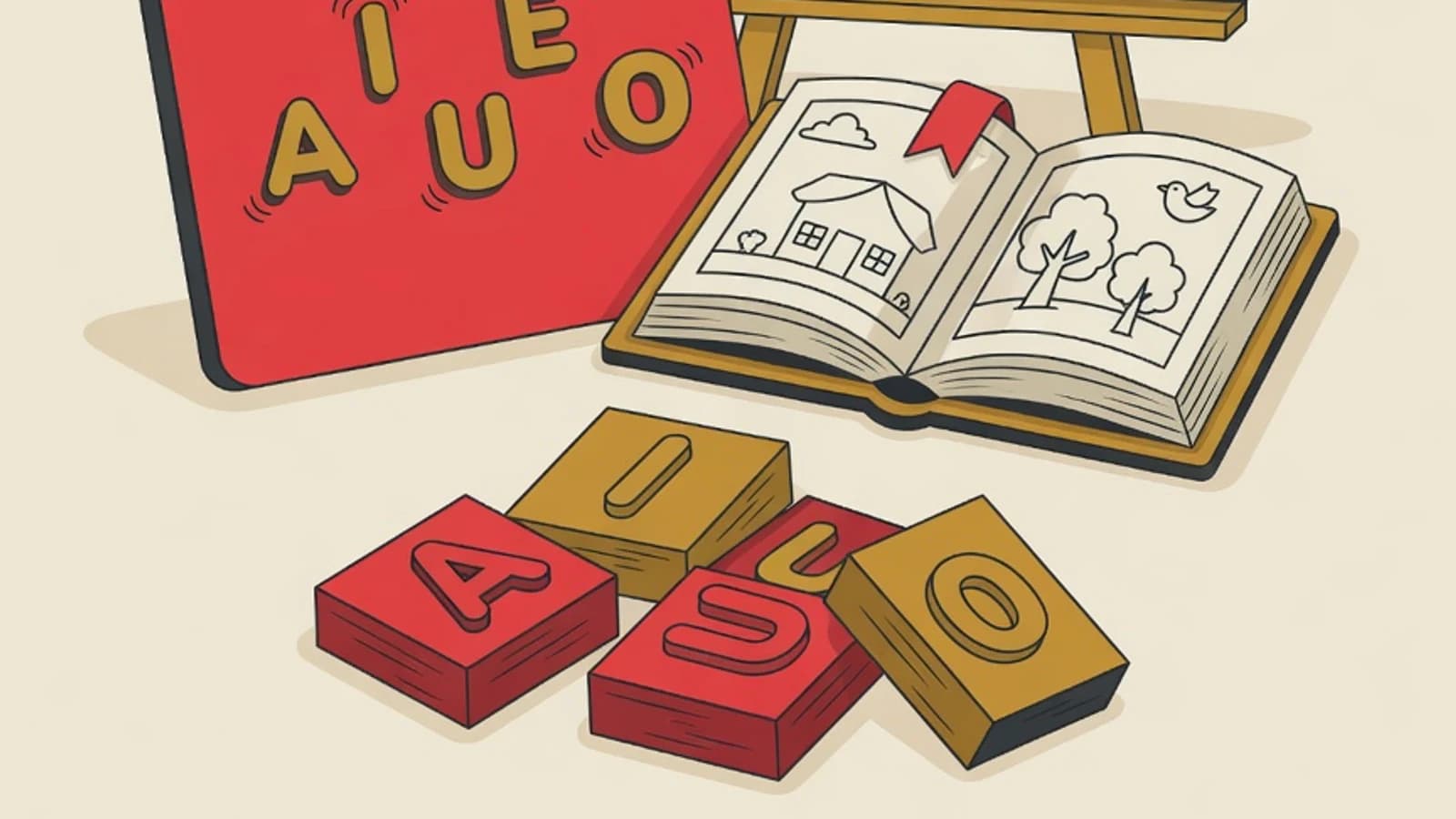
To teach a child to read without spelling, replace memorising letter names with recognising letter sounds. The child voices the sound of each letter, then blends those sounds straight into a word. This approach is called the phonics method, and it works best for children aged 4 to 7.
- Introduce letter sounds, such as /b/ and /a/, before the letter names
- Train the child to blend sounds directly into a word
- Short 10 to 15 minute sessions every day beat long occasional ones
- Simple letter-sound cards made from thick paper (a, i, u, e, o, and the most common consonants)
- Picture storybooks with large print to read together every day
- A small whiteboard or blank paper for building sounds into words
- Short-named household objects that are easy to read, such as ball, milk, and bread
Why an Early Reading Foundation Matters
Why Spelling First Often Confuses Children
The spelling approach asks a child to memorise letter names first, for example "bee", "ay", then merge them into "ba". The trouble is that letter names often differ from the sounds used in actual reading. When a child says the letter names aloud, the result rarely forms the target word directly, so the child has to translate twice inside their head. Phonics removes that extra step. The child voices each letter sound as it is, a short crisp /b/, then /a/, and slides them into "ba". The child's brain links the letter symbol straight to the sound coming out of their mouth. Because Indonesian spelling is consistent, with one letter almost always mapping to one sound, this feels natural and sticks quickly.
Spelling Method vs Phonics Method
| Aspect | Spelling Method | Phonics Method |
|---|---|---|
| What the child memorises | Letter names (bee, cee, dee) | Letter sounds (/b/, /c/, /d/) |
| Steps to read a word | Say names, merge, re-translate | Say sounds, blend straight away |
| Mental load on the child | Two rounds of translation | One round, straight to the word |
| Best-fit age | Often feels heavy for young ones | Feels natural at ages 4 to 7 |
For Indonesian, with its regular spelling, phonics usually helps a child form their first words faster.
Steps to Teach Reading Without Spelling
The six steps below build up gradually. Master one step until the child feels comfortable, then move to the next. The keys to success are daily consistency and a calm atmosphere.
- Step 1
Start with vowel sounds before letter names
Introduce the five vowel sounds first: /a/, /i/, /u/, /e/, /o/. Show one letter card, voice its sound short and clear, then ask the child to copy you. Link each sound to the mouth shape that makes it, for example a wide open mouth for /a/ and a rounded one for /o/. Vowel sounds serve as anchors because they appear in almost every Indonesian syllable. Turn it into play: guess which sound Mum or Dad just made, then swap roles. Avoid using letter names at this stage, and stick to the sounds alone so the child stays clear-headed later on.
Tips- A 5 to 10 minute session is enough for the early stage
- Use a different colour for vowel cards to make them easy to spot
- Repeat the same sound for a few days before adding a new one
- Step 2
Add the most common consonants
Once the child knows the vowel sounds, move to the most-used consonants: /m/, /b/, /p/, /t/, /s/, /n/, /l/, /k/. Voice each consonant as short as possible, saying /b/ crisply without turning it into "bee", and /m/ without "em". Consonants said with a long tail make blending harder later. Introduce three or four consonants per week, never all at once. Slip in a game of finding household objects that start with the same sound, such as /m/ for meja (table) and mangkuk (bowl). The child learns that these sounds live in the real world, so they feel useful and alive in everyday life.
Tips- Prioritise consonants found in the child's own name so it feels personal
- Practise in front of a mirror so the child sees their mouth shape
Do not voice consonants with an added vowel like "bee" or "cee". That extra sound makes word blending fall apart. - Step 3
Blend two sounds into a syllable
This is the heart of phonics. Take one consonant and one vowel, say /m/ and /a/. Voice them slowly while sliding a finger from the first letter to the second, then speed up until it reads as "ma". Do it together with the child, stretch the sound like a train pulling away: /mmm...aaa/ becoming "ma". Practise several pairs: ma, mi, mu, ba, bi, bu. The child will be amazed to realise those two sounds turned into a syllable they recognise. Repeat daily with different pairs until sliding the sounds together feels automatic and no longer needs to be stretched.
Tips- Tracing a finger along the letters helps the child feel the flow of sound
- Celebrate the first syllable the child reads with a round of applause
- Step 4
Join syllables into short meaningful words
Once syllables flow, join two of them into a whole word: ma and ma becoming "mama", su and su becoming "susu" (milk), bo and la becoming "bola" (ball). Choose words that are familiar to the child so they grasp the meaning the moment they read it. Show the object where you can, read "susu" while holding a glass of milk. The moment a child realises the print on the card connects to a real object is precious, because that is when reading turns from a chore into a discovery. Lengthen the words slowly, from two syllables to three.
Tips- Make word cards from the child's favourite things: toys, snacks, or a pet's name
- Let the child read at their own pace without being rushed
- Step 5
Introduce closed syllables and consonant clusters
Raise the difficulty to syllables that end in a consonant, such as "kan", "bur", "tas". The child already has the sounds, so it is just a matter of blending three sounds at once: /t/, /a/, /s/ into "tas". After that, move to common consonant clusters, such as "ng" in "bunga", "ny" in "nyanyi", and "nk" in bank. This part needs extra patience because the child must hear new sounds that are not always spelled by a single letter. Repeat the same example words several times, and tie them to everyday words so the new sound becomes familiar quickly.
Tips- Group words with the same pattern, for example everything ending in -ang
- Read storybooks that feature that new pattern often
If the child starts to look tired or frustrated, stop and continue tomorrow. Pushing at this stage can make a child resist reading. - Step 6
Move up to reading sentences and short stories
When the child reads words fluently, offer short sentences of three or four words, then simple picture stories. The focus shifts from merely sounding out to understanding what is read. After the child finishes a sentence, chat about it: who is the character, what happened, how does the child feel about the story. Light questions like these train comprehension, which is the ultimate goal of reading. Make reading time a pleasant ritual before bed, so the child links books with warmth and closeness far from any pressure.
Tips- Choose books with repeated sentences so the child feels confident
- Take turns reading one sentence each with the child to ease fatigue
Signs a Child Is Ready for the Next Stage
Ready for Syllables
The child voices vowel sounds and several consonants without hesitation, even when the cards are shuffled.
Ready for Words
The child blends syllable pairs like ma, bi, tu quickly without needing them stretched out any more.
Ready for Sentences
The child reads two-syllable words fluently and starts wondering about the meaning of what they read.
“A child who learns through sounds reads with more confidence because they understand how letters actually work, down to the sounds they make. Our job is to make sure every child moves through the stages at a comfortable pace, so reading feels like play.”
A Daily Home Reading Routine
- Set aside 10 to 15 minutes at the same time each day
- Warm up by revisiting sounds the child already knows
- Introduce just one new sound or pattern per session, no more
- Slip in a game of finding sounds on objects around the house
- Read one picture storybook before bed every night
- Praise the child's effort, including the small steps along the way
- Phonics replaces memorising letter names with recognising letter sounds, so the child builds words straight away.
- The order is gradual: vowel sounds, consonants, blending syllables, short words, closed syllables, then sentences.
- Short 10 to 15 minute sessions every day work better than long, infrequent ones.
- An enjoyable atmosphere and praise for the child's effort keep the love of reading growing.