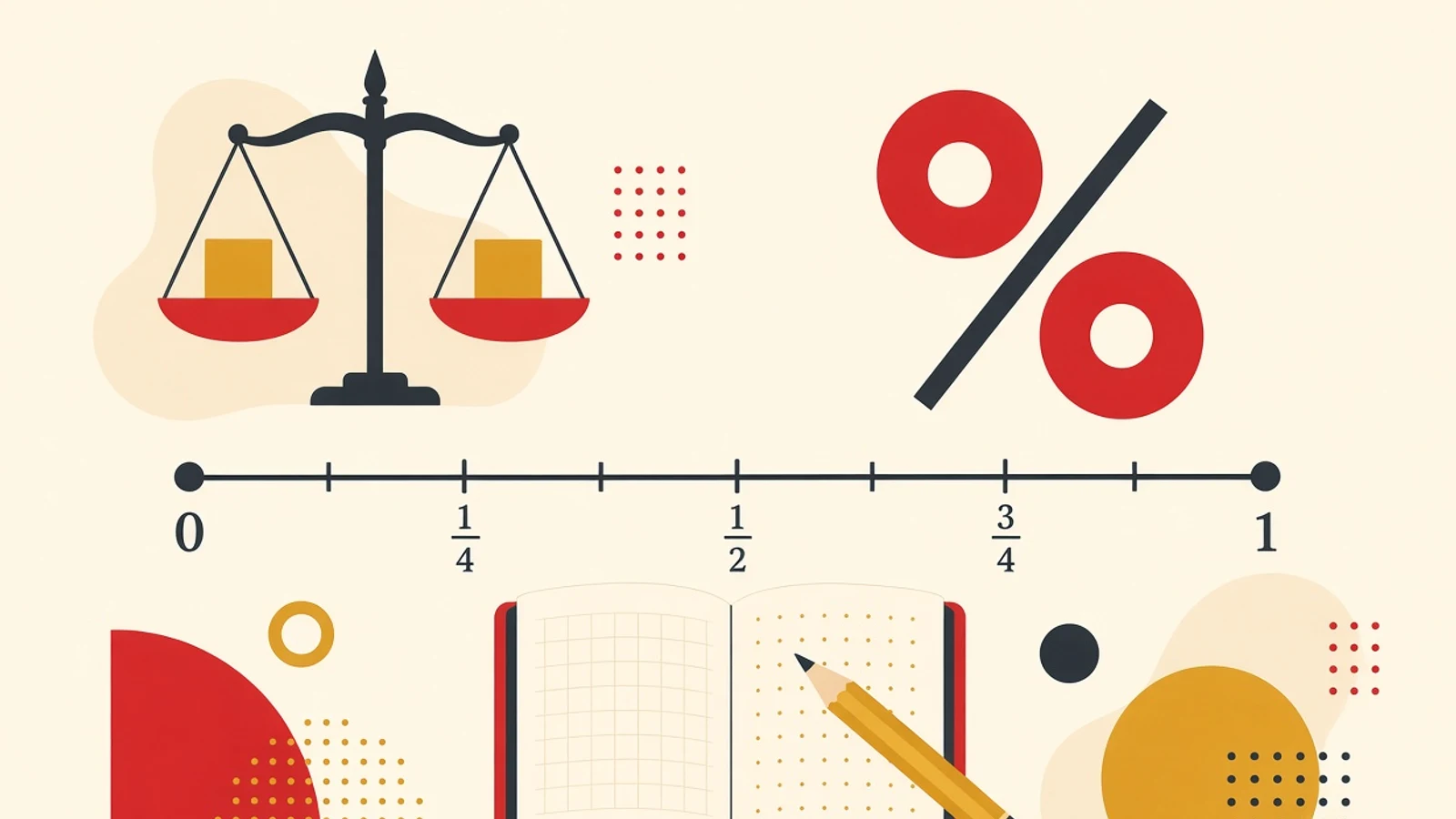
Relearning maths as an adult begins with finding the exact point where your understanding stalled years ago. That point nearly always sits in one of three topics: fractions, percentages or algebra. Test yourself with a primary-level sheet, then a lower-secondary one, rebuild from the first layer that feels shaky, and handle the anxiety carried over from school along the way.
- Under Pusmendik's assessment frameworks, fractions, decimals and percentages are taught at primary level in Indonesia, and ratio and basic algebra follow in junior secondary.
- Siegler and colleagues found, across two large datasets, that understanding fractions and division predicts algebra skill years later.
- A meta-analysis by Barroso and colleagues pooling 747 effect sizes shows the link between maths anxiety and achievement persists into adulthood.
- A lined or squared exercise book used only for maths practice
- A pencil and eraser, so working steps can be crossed out and rewritten
- Two self-made question sheets: one for the primary layer, one for the lower-secondary layer
- A blank page at the back of the book for an error log
Why adult maths tends to stall at one particular point
School maths is built in layers. Almost every new topic rests on something taught a year or two earlier, so a single chapter that never quite made sense quietly weakens every chapter after it. Someone who fell behind on fractions can usually get through the next year by memorising procedures, and then loses their footing when algebra arrives and memorised steps stop being enough. Years later, all that remains is a feeling that maths is hard, with no record of which chapter actually made it hard. That is why relearning maths as an adult costs the least effort when it starts with a map, before anyone turns to page one of a textbook. The map can be read off everyday moments. Hesitating when a restaurant bill adds a 10 percent service charge, or being unsure whether 3/5 is bigger than 5/8, points to a gap in the first layer, which Indonesian schools teach at primary level. Stalling when a team bonus has to be split by ratio, when a floor plan's scale needs converting to metres, or when one missing value in a spreadsheet formula has to be found, points to the second layer, which arrives in junior secondary. This split follows the assessment frameworks for Indonesia's Academic Ability Test (TKA), published by Pusmendik at the education ministry (Kemendikdasmen). Here those frameworks serve purely as a running order of topics, and adult readers are not being prepared to sit the test itself. With a two-layer map, a big, vague question (where do I even start after forgetting everything) shrinks into a small one you can answer in an afternoon: in which layer does the first hesitation appear? The answer differs from person to person. An office administrator may handle percentages comfortably and wobble on equations, while someone who was fluent in algebra at school discovers they have always guessed when comparing two fractions. Going back to basic maths from the right point means study time goes where the gaps really are.
Your reason for learning decides which topic gets rebuilt first
| Reason for learning | Topics that usually need strengthening | First check question |
|---|---|---|
| CPNS civil service test (numerical items in the TIU) | Percentages, proportion, quick arithmetic | Convert 3/8 to a percentage without a calculator |
| Company recruitment aptitude test | Quick arithmetic, percentages, proportion | Work out 6 × 15 and 84 ÷ 7 mentally, then check on paper |
| Returning to university or finishing a degree | Algebra, linear equations, functions | Solve 3x + 12 = 45 |
| A job that runs on numbers | Percentage change, ratio, averages | Express a rise from 240 to 300 units as a percentage |
| Helping a child with homework | The child's own level, often fractions | Add 2/3 and 1/4 |
| Personal goals | Percentages, ratio, reading tables and charts | Split 150 boxes in the ratio 3 : 2 |
Recruitment aptitude tests vary from one employer to the next, so question counts and timings are left out here. Answers: 37.5%; 90 and 12; x = 11; a 25% rise; 11/12; 90 and 60 boxes.
Eight steps for relearning maths from the right starting layer
The sequence moves from mapping, to calming anxiety, to rebuilding from the foundations. Steps one to three fit into a single weekend. Steps five to seven are the core of the work and usually take several weeks; the twelve-week figure at the top of this page is a rough estimate for a learner practising several times a week.
- Step 1
Write down why you are learning and by when
Your reason for relearning maths sets how deep the rebuilding needs to go, so the first step happens with a pen, before a single question is opened. CPNS applicants meet numerical items inside the General Intelligence Test (TIU), answered under a tight time limit. Learners heading back to university need tidy algebra, because statistics, economics and accounting courses lean on it from the first weeks. People who build weekly sales, stock or budget reports use percentages and ratio far more often. Anyone hoping to sit beside a child during homework needs to be comfortable with that child's level first. And some people learn purely for themselves, so they stop shrinking back every time numbers come up in a meeting. Write one sentence about your goal on the first page of the exercise book, with a deadline if there is one. For example: comfortable calculating percentages and ratios for the monthly report before the quarter closes. A sentence that short works as a filter. Anything that does not serve the goal can wait, guilt-free. Without a filter, adult learners tend to open a book at chapter one, run out of energy by chapter three, and stop, when what they needed was perhaps two chapters in the middle.
Tips- If you have more than one reason, rank them by the nearest deadline.
- Copy the goal sentence onto the inside cover so you read it every time practice begins.
This guide does not use any CPNS recruitment schedule as a reference point. Follow the official announcements from BKN and the agency you are applying to. - Step 2
Test the primary layer: fractions, decimals, percentages, LCM and HCF
The first sheet deliberately uses primary-school questions, because that is where most adults find their first gap. Eight to ten short items are enough as long as they touch five skills: simplifying a fraction, comparing two fractions, moving between fractions, decimals and percentages, adding fractions with different denominators, and finding a lowest common multiple or highest common factor. Those five skills are condensed from the Number element of Pusmendik's primary framework. A few you can use straight away: simplify 18/24; which is larger, 5/8 or 3/5; write 0.35 as a percentage; work out 2/3 + 1/4; find the LCM of 12 and 18. Work without a calculator and give every question one of three marks: fluent, unsure, or no idea how. An unsure mark matters as much as a no-idea mark, because that is usually where guessing habits hide. A correct answer reached by a method you cannot explain again in your own words also gets marked unsure. This step produces a map, so the number of right answers is never treated as a score. Keep the sheet safe; you will redo the very same questions a few weeks from now and compare.
Tips- Answers to the sample questions: 3/4; 5/8; 35%; 11/12; 36.
- Do the sheet at a calm moment with no clock running, so the map you get is an honest one.
- Step 3
Move up to the lower-secondary layer: ratio, proportion and basic algebra
The second sheet opens with questions that feel like office work. How many kilometres is 4 cm on a map at a scale of 1 : 50,000? Six workers finish a job in 10 days; how many days would four workers need? What is x if 3x + 12 = 45? What is the simplest form of 2(x + 5) - 3x? The first two test ratio and direct and inverse proportion, the last two test basic algebra. Round the sheet up to ten questions in the same spirit, and slip in one inequality such as 5 - 2x > 1 plus the pair of equations x + y = 10 and x - y = 4. Everything on this sheet is junior secondary content in Pusmendik's framework, and it is the layer most used in numerical selection-test items and in everyday work. Your stopping point is the first layer crowded with unsure marks. If the primary layer is solid and ratio already wobbles, start from ratio. If fractions wobble, hold algebra back for now; step five explains why. Mapping yourself like this is legitimate and accurate enough to begin. Learners who choose to work with a tutor go through a similar mapping in their first paid session, with questions matched to the goal written down in step one.
Tips- Answers to the sample questions: 2 km; 15 days; x = 11; -x + 10; x < 2; x = 7 and y = 3.
- Also flag the questions that make you reach for a calculator straight away. That urge points to a layer that is still loose.
- Step 4
Recognise the old anxiety before practice starts
Plenty of adult learners feel their chest tighten at the sight of stacked fractions, and that reaction has a measurable explanation. Ashcraft and Kirk (2001) studied university students and found that those with high maths anxiety showed smaller working-memory spans, especially on tasks built around calculation. When mental addition had to be done while holding other information in mind, their response times grew longer and their errors increased. Anxiety seems to occupy part of the mental workspace that calculation needs. The practical remedy is simple: move the load from your head onto paper. Write every intermediate step, including the ones that feel trivial, so working memory never has to juggle many numbers at once. A second technique comes from Park, Ramirez and Beilock (2014): spending a few minutes writing your thoughts and feelings about an upcoming test right before taking it. In their study, highly anxious participants who wrote performed better on demanding problems. The evidence is mixed, though, because a conceptual replication with 168 university students found no difference in accuracy. Treat it as something worth trying: use it a few times and keep it if it helps.
Tips- Open each practice session with one question you are sure you can solve, so your body learns that numbers are safe ground.
- Feeling embarrassed about asking fraction questions is normal. Asking basic questions is a sign that learning is under way.
If anxiety is seriously affecting daily life, consider speaking with a psychologist. A study guide cannot replace professional support. - Step 5
Rebuild fractions and division as the foundation
Siegler and colleagues (2012) analysed two large longitudinal datasets from the United States and the United Kingdom. Knowledge of fractions and division in primary school predicted algebra knowledge and overall maths achievement in high school five to six years later, even after controlling for other maths knowledge, general intelligence, working memory, and family income and education. The study followed children, so its findings cannot simply be transferred to adults. What can be taken from it is the order: fractions and division act as prerequisites for algebra. A fractions and percentages refresher holds best when a fraction is understood as a number with its own place on the number line. Draw a line from 0 to 1, mark 1/2, 1/4 and 3/4, then 2/3, and notice why 2/3 lands between 1/2 and 3/4. Dividing fractions starts to make sense when read as a question of how many times one amount fits inside another. A 3/4-litre bottle of syrup poured into 1/8-litre measuring glasses fills 6 glasses, and that is exactly what 3/4 ÷ 1/8 = 6 means. Repeat with recipe quantities, lengths of fabric or part-time working hours until the flip-and-multiply rule feels like a logical consequence that needs no memorising.
Tips- Explain one fraction problem out loud as if teaching someone else. Wherever you stumble, the understanding is still incomplete.
- Stay with fractions until the unsure marks from the step-two sheet are gone, then move on to percentages.
- Step 6
Connect percentages and ratio to the numbers at work
A percentage is a fraction with 100 as its denominator, so this layer sits directly on the previous one. Practise with numbers that genuinely turn up at work. Sales rise from 240 to 300 units: the difference is 60, divided by the starting figure of 240, which gives 25 percent. The most common slip is dividing by the final figure and getting 20 percent. A second example tests intuition: 200 customers fall by 10 percent to 180, then rise by 10 percent to 198. The figure never returns to 200, because the increase is calculated from a number that has already shrunk. Ratio works in a similar way. Splitting 150 boxes between two warehouses in the ratio 3 : 2 means dividing 150 into 5 parts, so the first warehouse receives 90 and the second 60. Inverse proportion appears when people and time trade places: six people need 10 days, the job totals 60 person-days, so four people need 15 days. For CPNS applicants, fluency with percentages and proportion is the arithmetic groundwork for the numerical part of the TIU; for working adults, this is the basic maths of monthly reports. Solve each question twice, once with fractions and once with decimals, and confirm both give the same result.
Tips- Each week, take one real figure from a work report and calculate its change as a percentage.
- When unsure which number to divide by, ask yourself: changed from what?
- Step 7
Enter algebra through linear equations in one variable
Picking algebra back up after a long gap feels gentlest when the letter x is treated as a box holding a number nobody knows yet. The equation 3x + 12 = 45 reads as: three identical boxes plus 12 make 45. Subtract 12 from both sides to leave 3x = 33, then divide both sides by 3 to get x = 11. Check by substituting back: 3 × 11 + 12 = 45. The habit of checking by substitution costs little and catches many arithmetic slips. Once linear equations feel comfortable, move on to the distributive property, for example 2(x + 5) = 2x + 10, and then to linear inequalities. One rule about inequalities is easily forgotten: when both sides are multiplied or divided by a negative number, the sign flips direction. A pair of equations whose two letters are found together, functions with their domain and range, and number patterns that run in order arrive later, and for some goals that part can be skipped. Learners whose goal is work-related are often well served once they reach linear equations and inequalities. Those heading into statistics or economics courses need to carry on to functions, because the graphs and simple models in those subjects are built from there.
Tips- Write one operation per line. Tidy lines make the location of a mistake easy to spot.
- If algebra jams again, return briefly to fractions. The jam often starts there.
- Step 8
Set a practice rhythm and redo the map regularly
Adult learners have jobs, households and other commitments, so a rhythm that survives matters more than an ambitious plan that collapses in week two. As an adjustable starting point, three or four practice sessions a week of roughly thirty to forty-five minutes each is plenty. Treat that as practical advice you can shift around your schedule. Use the back page of the book as an error log: write down each wrong answer and label its cause as a concept error, a calculation slip, or a misreading of the question. After a few weeks, the pattern of labels shows what needs revisiting. Every four weeks, redo the sheets from steps two and three and compare the fluent, unsure and no-idea marks with your first attempt. If you are preparing for a selection test, add time limits only once the concepts are stable, since time pressure introduced too early tends to wake the old anxiety. Anyone who wants a practice partner can book EduPoint Maths Tutoring face to face or online, with each meeting lasting 60, 90 or 120 minutes. Recordings and progress reports are kept in the learner app.
Tips- Short, regular sessions are easier to keep going during a busy working week.
- Celebrate every mark that moves from unsure to fluent. That shift is the most honest measure of progress.
Going back to basic maths on your own: strengths and limits
- You choose the practice hours, including late evenings after work or early mornings before leaving.
- It costs nothing beyond a book and stationery, which suits the mapping stage at the start.
- Embarrassment is easier to handle when nobody watches you relearn the basics.
- You get used to reading questions independently, a habit both tests and jobs require.
- Pace is yours to set: skip the solid layers and repeat the shaky ones for as long as needed.
- An unnoticed misconception can be practised over and over until it hardens into habit.
- With nobody asking why, a lucky guess is hard to tell apart from real understanding.
- The rhythm breaks easily in busy weeks because there is no appointment holding it in place.
- Old anxiety can steer a learner away from exactly the chapters they need most.
Signals in your error log that a private maths tutor would help
The error log from step eight is the most honest gauge for this decision. If calculation slips and misread questions grow rarer over three or four weeks, self-study is working and deserves to continue. It is a different story when concept errors pile up in the same chapter, say dividing fractions or moving terms across an equation. That suggests the textbook explanation is not landing, and someone needs to watch how you think while you work. Two further signals come from outside the book: a selection test or a new semester drawing close, and practice sessions that keep slipping because of anxiety. Adult learners at EduPoint study through the Mathematics Tutoring programme, and session material is drawn from whichever level the log stops at. The fractions and percentages layer uses primary maths, the ratio and algebra layer uses junior secondary maths, and senior secondary and university-level maths follow when the goal is a degree. The material follows the stopping point, whatever the learner's age. So bring the error log to the first meeting; that page is what the tutor uses to order the chapters. On timing, online sessions open at 06:00 and the last one ends by 23:00, which suits anyone whose free hours are before work or late in the evening. On cost, relearning maths as an adult with a private tutor starts at Rp 69,000 per hour. A meeting runs for 90 minutes, or for 60 or 120 when that fits better. A monthly package holds 4 to 28 meetings, and the final figure is worked out in the registration form. A package can be paid in full or in two halves, one at the start and one midway, through QRIS, e-wallet, Virtual Account, bank transfer, card, or at an Alfamart or Indomaret till. To begin, message EduPoint on WhatsApp, or fill in the form, and describe your goal and deadline; that first conversation is free. Your schedule and needs are noted, EduPoint finds a maths tutor based on those notes, and the first meeting goes ahead. If the first tutor does not feel right, the replacement costs nothing. One limit is worth stating plainly. A tutor supports understanding and practice habits, while results in a selection test, an aptitude test or a grade depend on each learner's starting point, practice hours and deadline. Nobody can guarantee clearing the TIU threshold.
Six things to prepare before relearning maths
- One sentence stating your learning goal and deadline, written on the inside cover of the exercise book.
- A primary-layer sheet (fractions, decimals, percentages, LCM, HCF) marked fluent, unsure or no idea.
- A lower-secondary sheet (ratio, proportion, linear equations) marked the same way.
- The name of the layer where the first unsure mark appeared, written clearly as your starting point.
- A weekly practice schedule that fits your working week, with specific days and times.
- An error-log page with three cause labels: concept error, calculation slip, misread question.
- Relearning maths as an adult is most efficient when it starts from the point where understanding stalled, found with two test sheets: a primary layer and a lower-secondary layer.
- A gap in fractions, decimals or percentages points to the primary layer; a gap in ratio, proportion or basic algebra points to the junior secondary layer, following the order of levels in Pusmendik's assessment frameworks.
- Fractions and division act as prerequisites for algebra, so that layer is rebuilt first, ahead of linear equations.
- Maths anxiety correlates negatively with achievement (r = -0.28 in a meta-analysis of 747 effect sizes); writing intermediate steps on paper eases the load on working memory.
- EduPoint Maths Tutoring starts at Rp 69,000 per hour, with 60, 90 or 120-minute meetings; test results and grades are never promised.