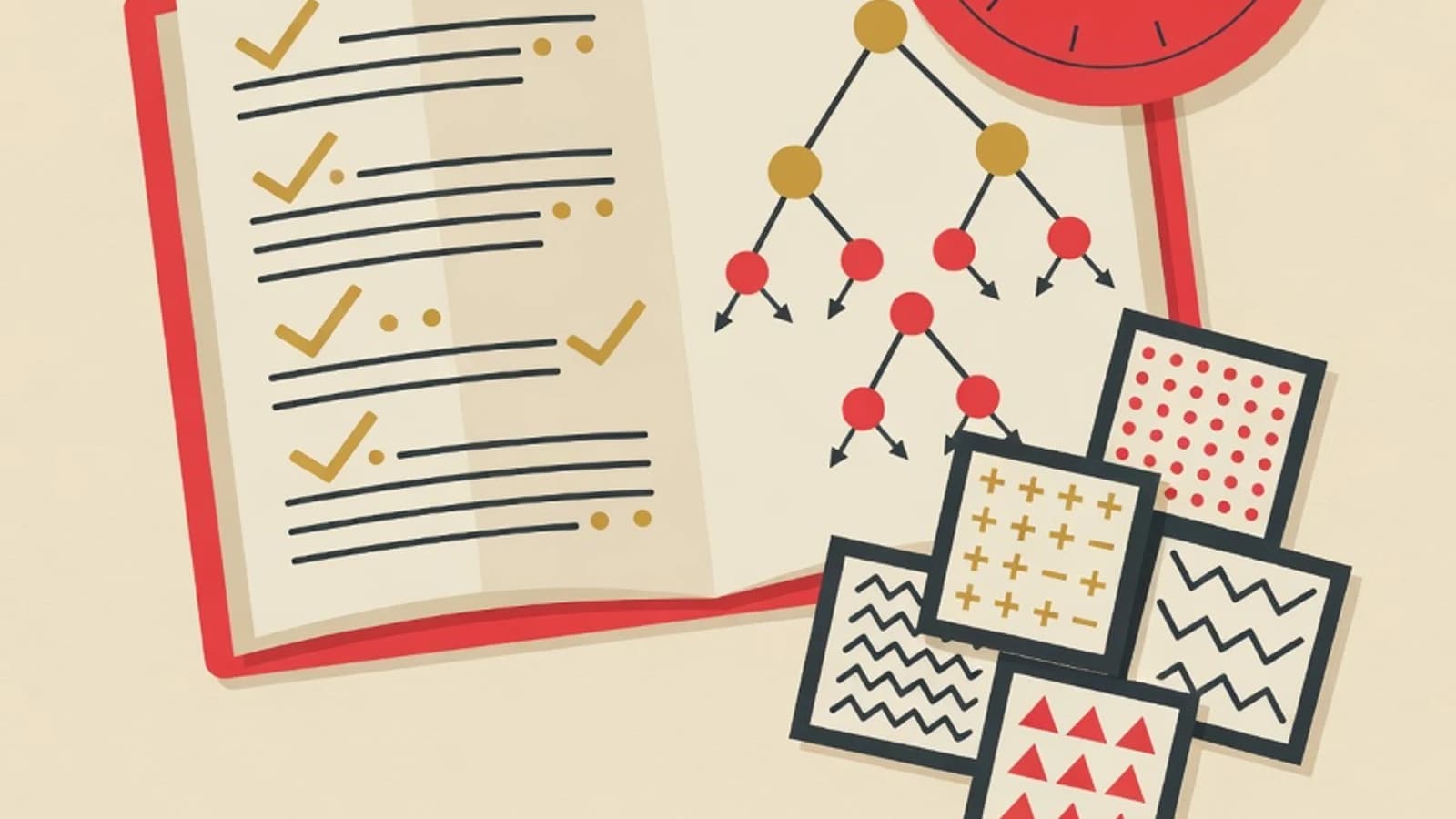
The most effective way to study for the UNAIR Independent Selection TPA is to separate its three areas, namely verbal, numeric, and logical reasoning, then drill each question type on a spaced schedule with error analysis. The TPA measures thinking patterns, so getting familiar with the question types matters far more than memorizing loose formulas.
- The UNAIR written-test TPA assesses verbal, numeric, and logical reasoning
- An early diagnostic maps your weakest area before deeper practice begins
- Spaced drilling with error analysis forms the core of TPA preparation
- A set of recent independent-selection TPA questions across the three reasoning areas
- A notebook for vocabulary and the question patterns you keep missing
- A timer to build a steady pace for each reasoning area
- An error log to sort mistake types after every practice run
The UNAIR TPA in Numbers
What the UNAIR TPA actually measures
The Academic Potential Test (TPA) in the UNAIR Independent Selection written test measures the reasoning readiness that underpins study in every program, from Medicine to Communication Studies. Its questions foreground how you think: how quickly you grasp relationships between words, how nimbly you handle numbers, and how coherently you draw conclusions from a set of premises. Three areas work together throughout the test. Verbal reasoning calls for language sensitivity through synonyms, antonyms, analogies, and short passage comprehension. Numeric reasoning tests sequences, applied arithmetic, and basic quantitative knowledge worked out quickly without a calculator. Logical reasoning arranges premises into conclusions through syllogisms and analytical patterns. The TPA differs from the Academic Ability Test (TKA), which digs into subjects by cluster. Because the TPA highlights thinking potential, anyone can build it through consistent exposure to question types. Preparation that carves out TPA practice from the start gives the brain room to recognize patterns comfortably before exam day arrives.
The Three TPA Areas and Their Practice Focus
| Area | What It Tests | Practice Focus |
|---|---|---|
| Verbal Reasoning | Synonyms, antonyms, analogies, comprehension | Grow vocabulary and word-relationship patterns |
| Numeric Reasoning | Sequences, applied arithmetic, quantitative | Fast mental math, recognize number patterns |
| Logical Reasoning | Syllogisms, drawing conclusions, analytical | Practice reading premises and forming conclusions |
The weighting of each area can vary from year to year. Always check the latest details at ppmb.unair.ac.id.
Steps to Study for the UNAIR Independent Selection TPA
These seven steps order your TPA preparation from the first diagnostic to an exam-day simulation. Work through them in sequence, then repeat the drill-and-analyze cycle until your pacing feels steady.
- Step 1
Measure your starting point with a diagnostic mock
Work through one full TPA set under timed conditions before building any schedule. The result gives an honest map of which area holds your score back most, whether verbal feels slow, numeric burns time, or logic often lands on the wrong conclusion. From that map you split your practice hours, giving more time to the weakest area without neglecting the other two.
Tips- Record the score for each area separately from the total so weaknesses show up specifically
- Keep this diagnostic sheet to compare against your next mock test
- Step 2
Build vocabulary and verbal patterns
Verbal reasoning rests on a broad vocabulary and a feel for how words relate. Collect new words from analogy questions and passages, then revisit them through flashcards every few days. Analogies ask you to recognize the type of relationship, such as cause and effect, part and whole, or function, before finding a matching pair. Regular practice makes recognizing these relationships feel almost automatic on test day.
Tips- Group analogies by relationship type so the patterns become easy to spot
- Read across a range of topics to widen vocabulary and train comprehension at once
- Step 3
Train fast mental math for the numeric area
TPA numeric questions reward both speed and accuracy since they are solved without a calculator. Master basic multiplication, percentages, ratios, and number sequences until they feel reflexive. For sequences, train your eye to scan the difference or ratio between terms before guessing the pattern. Smart estimation often saves time: on multiple-choice items, rounding numbers then ruling out clearly impossible options speeds up the solution.
Tips- Memorize squares up to 25 and common fractions in percent form
- Work on sequence questions daily in small doses so the patterns stick
Memorizing a formula without understanding where it comes from leaves you stuck when a question is framed in a new way. Understand the logic behind each formula. - Step 4
Master logical reasoning step by step
The logic area demands orderly thinking. Start with simple syllogisms of two premises, get used to marking keywords such as all, some, and none, then move up to analytical questions that arrange an order or position from several conditions. Drawing a small table or diagram helps organize stacked information so the conclusion becomes clear. This area needs the most practice, so it pays to train it early.
Tips- Translate long premises into compact symbols or tables
- Test each conclusion by looking for one case that could disprove it
- Step 5
Drill on a spaced schedule and mix question types
Spreading practice across many short sessions over weeks builds far more durable memory than cramming it into one night. The Dunlosky review ranks spaced practice among the highest-utility techniques. Interleave the three areas within a single session so the brain practices identifying the question type before solving it, a core skill on a timed test. Research by Rohrer and Taylor shows that shuffling question types raises later test scores even though it feels harder during practice.
Tips- Design a weekly schedule that revisits each area three to four times
- Avoid doing twenty questions of the same type back to back in one sitting
- Step 6
Dissect every mistake through an error log
Mock-test scores alone yield little progress. The leap comes from understanding why an answer went wrong. Specific feedback ranks among the strongest influences on learning in the work of Hattie and Timperley. After each practice, note the missed question and its error type, whether a concept gap, misreading, carelessness, or running out of time. Rework that question a few days later to confirm the correct strategy has stuck.
Tips- Separate mistakes from not understanding versus rushing, they need different fixes
- Review your error log each weekend to see recurring patterns
- Step 7
Simulate the TPA in a timed CBT format
The UNAIR Independent Selection written test runs as a Computer-Based Test on the Surabaya campus, so practice should resemble those conditions as exam day nears. Do full simulations on screen with a running timer and a question navigator, get used to flagging hard questions to revisit, and set your pace so the areas you command secure points first. Reading long questions on a screen is more tiring than on paper, so your eyes need that stamina trained too.
Tips- Do a first pass for confident questions, flag the rest, then return on a second pass
- Schedule full simulations twice a week in the final month of preparation
“Candidates who stay calm during the TPA have usually worked through hundreds of questions across all three areas and know exactly which patterns tend to trip them up. That familiarity comes from practice dissected one question at a time until the patterns become readable.”
Preparing for the TPA Alone or With a Tutor
- A flexible schedule that follows your own study rhythm
- Relatively light cost through books and question banks
- Builds the discipline and independence of setting your own targets
- Weaknesses per area are hard to map without targeted feedback
- Flawed thinking patterns can recur because they go uncorrected
- Motivation dips easily when a question feels like a dead end
UNAIR TPA Readiness Checklist
- Diagnostic scores per area are recorded as a baseline
- Vocabulary and analogy flashcards are reviewed regularly
- Fast mental-math practice is a short daily routine
- The error log is filled and dissected every weekend
- Timed CBT simulations run as exam day approaches
- Sleep is adequate and your working pace feels steady
- The UNAIR TPA tests three reasoning areas: verbal, numeric, and logic
- A diagnostic mock maps the weakest area before practice hours are split
- Spaced drilling with error analysis and CBT simulation forms the core of TPA prep