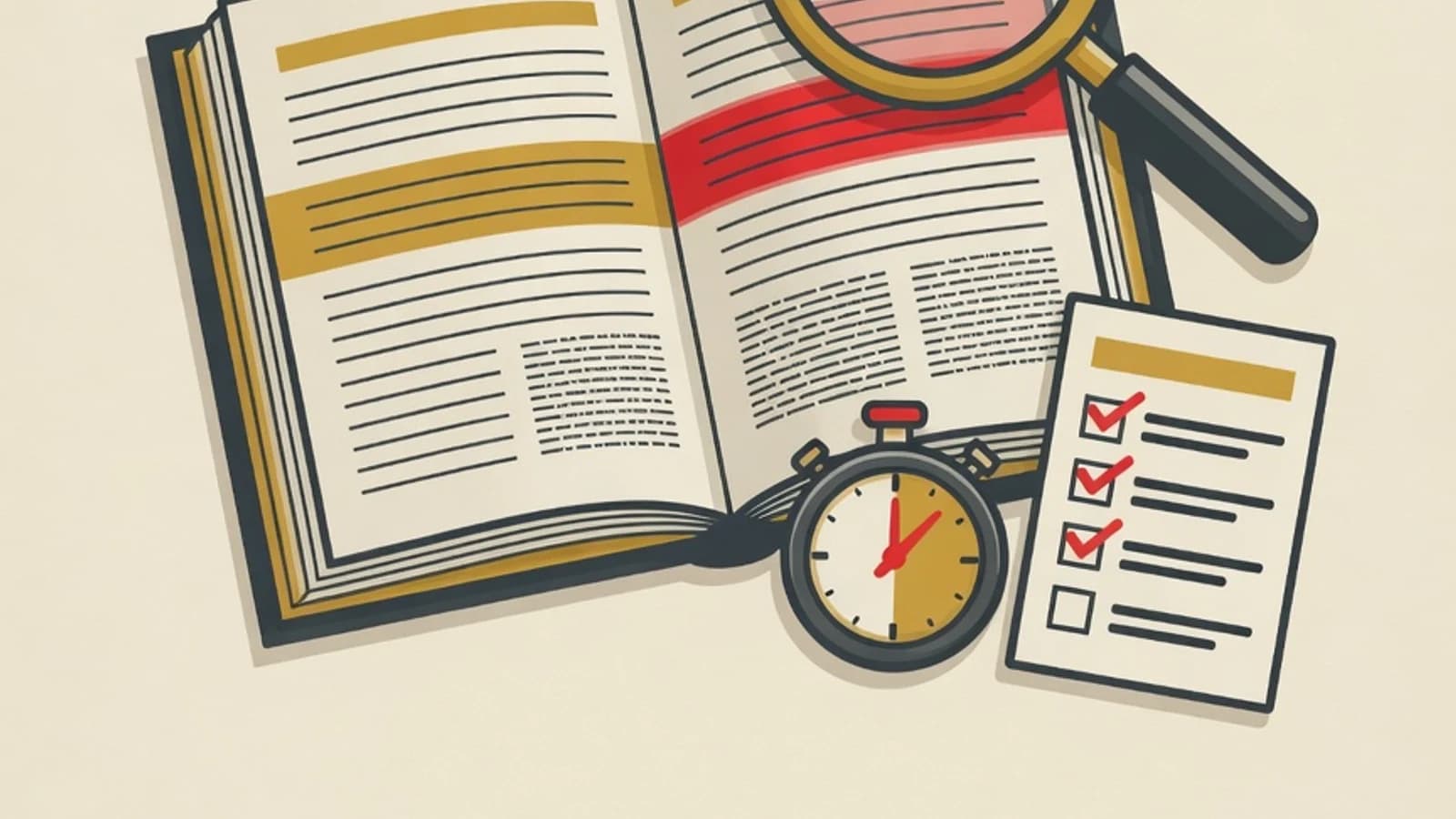
Improving your IELTS Reading score rests on two foundations: mastering fast-reading techniques (skimming and scanning) and recognising the patterns of the 11 question types. The test has 40 questions to complete within 60 minutes with no extra transfer time, so accuracy and speed need to be trained together in a measured way.
- 40 questions, 60 minutes, with no extra answer-transfer time
- Around 30 of 40 correct answers maps to band 7 for the Academic module
- There is no penalty for wrong answers, so attempt every question
- Official Cambridge IELTS books (series 15 onward) for authentic questions
- A timer or stopwatch for the 60-minute simulation
- A notebook for academic vocabulary and collocations
BWhat IELTS Reading actually measures
IELTS Reading assesses how quickly and accurately you locate information, grasp main ideas, follow the writer's argument, and pick up implied opinion. The Academic module uses three long passages drawn from books, journals, magazines, and newspapers, with denser vocabulary. The General Training module uses lighter texts from notices, advertisements, workplace handbooks, and everyday material. Because Academic texts are more demanding, the number of correct answers needed for a given band differs between the two modules. General Training candidates need more correct answers for the same band. Understanding this difference helps you set a realistic target IELTS Reading score for the module you are taking. Your practice then focuses squarely on the kind of text you will actually meet on test day.
Steps to improve your IELTS Reading score
The six steps below are ordered from building core technique to closing gaps through error analysis. Work each step until it is steady before moving to the next.
Build the skimming and scanning habit
Skimming means reading quickly to capture the main idea of a paragraph in a short time, while scanning means sweeping the text to find specific keywords such as names, numbers, or terms. Practise both daily with English articles of 700 to 900 words. For skimming, read the first and last sentence of each paragraph, then write one short phrase summarising it. For scanning, set five target words and time how many seconds it takes to find them. These techniques save time in IELTS Reading because you avoid reading every word to answer a single question.
- Move your eyes down the column, not word by word
- Underline keywords in the question before returning to the text
Learn the 11 question types and their strategies
IELTS Reading uses around eleven question types, including multiple choice, matching headings, True/False/Not Given, matching information, sentence completion, summary completion, and short answer. Each type tests a different skill. Matching headings asks you to grasp a paragraph's main idea, while sentence completion demands precision on detail and grammar. Build a one-page strategy summary for each type, then drill the types that most often lose you points in isolation before combining them in a full simulation.
- Group question types that hunt for detail versus those that hunt for the main idea
- For completion questions, respect the word limit in the instructions
Master True/False/Not Given deliberately
True/False/Not Given and Yes/No/Not Given questions often lower an IELTS Reading score because candidates confuse False with Not Given. False means the text states something that contradicts the statement in the question. Not Given means the text provides no information to confirm or deny that statement. Practise by giving a short reason for each answer: write down which sentence in the text supports your choice. If no supporting sentence exists at all, the answer is most likely Not Given.
- Avoid guessing from your own outside knowledge
- Read the full statement before deciding
Pace yourself at about 20 minutes per passage
Because there is no extra time to transfer answers, allocate about 20 minutes to each passage, including writing answers on the answer sheet. The third passage is usually the densest, so avoid overspending on the first. If a single question leaves you stuck for more than 90 seconds, flag it, enter your best guess, then move on. Return to flagged questions if time remains. A steady rhythm keeps you completing all 40 questions, which matters because every question carries equal weight.
- Keep a clock or timer in your line of sight while practising
- Simulate the answer sheet from the start so transferring feels natural
Enrich academic vocabulary and paraphrasing
IELTS Reading questions rarely use the exact same words as the text. Item writers use paraphrasing, replacing words in the question with synonyms or a different structure from the text. Because of that, academic vocabulary and sensitivity to synonyms decide how quickly you match a question to the right part of the text. Note new vocabulary with its collocations, for example 'significant increase' or 'gradual decline'. Review those notes two to three times a week using spaced repetition so they stay with you longer.
- Group synonyms by theme, for example words for 'increase' and 'decrease'
- Learn words inside a sentence for lasting recall
Analyse your errors after every practice set
The fastest gains in an IELTS Reading score come from reviewing errors honestly. Adding more questions without review only repeats the same mistaken pattern. After each practice set, build a table with the question number, question type, your answer, the correct answer, and the reason you went wrong. After several sets, a pattern appears: perhaps you often miss matching headings, or run out of time on the third passage. Direct your next practice at closing that specific pattern. Honest review turns mistakes into a clear map for improvement.
- Keep your error log in one file so trends are easy to read
- Redo the questions you got wrong after two weeks to test retention
Approximate correct-answer to band conversion
| Band | Academic (correct of 40) | General Training (correct of 40) |
|---|---|---|
| Band 5 | 15 | 23 |
| Band 6 | 23 | 30 |
| Band 7 | 30 | 34 |
| Band 8 | 35 | 38 |
Figures are approximate (a range). Exact thresholds can shift by a few marks between test versions due to statistical equating. Source: IDP IELTS.
Question types that most often challenge candidates
Matching Headings
Match a heading to the right paragraph. It demands grasping each paragraph's main idea as a whole. Read the headings first, then skim each paragraph.
True/False/Not Given
Separate statements that contradict the text (False) from those the text does not cover (Not Given). It takes discipline to avoid guessing.
Summary Completion
Complete a summary with words from the text or a given list. Mind the grammar and the word limit in the instructions.
IELTS Reading applies no penalty for wrong answers. Leaving a question blank simply forfeits a chance at a point. When time is nearly up, enter your best guess for every remaining question.
- Save the final two minutes to make sure no answer box is empty
- Check spelling, since a misspelled answer counts as incorrect
- Both British and American spellings are accepted
“Candidates whose IELTS Reading score jumps usually stop chasing question counts and start dissecting the reason behind each mistake. That is where practice becomes focused.”
Weekly IELTS Reading practice checklist
- Two full passage simulations (3 passages) under a 60-minute timer
- Separate drilling for your weakest question type
- A complete error log with a reason column
- 20 new academic vocabulary items with their collocations
- One review session of last week's wrong answers
- IELTS Reading has 40 questions completed within 60 minutes, with no extra time to write answers.
- Skimming, scanning, and recognising the 11 question types form the foundation for raising an IELTS Reading score.
- Around 30 of 40 correct answers maps to band 7 Academic; General Training requires more.
- Analysing errors after each practice set turns a mistaken pattern into a clear improvement map.