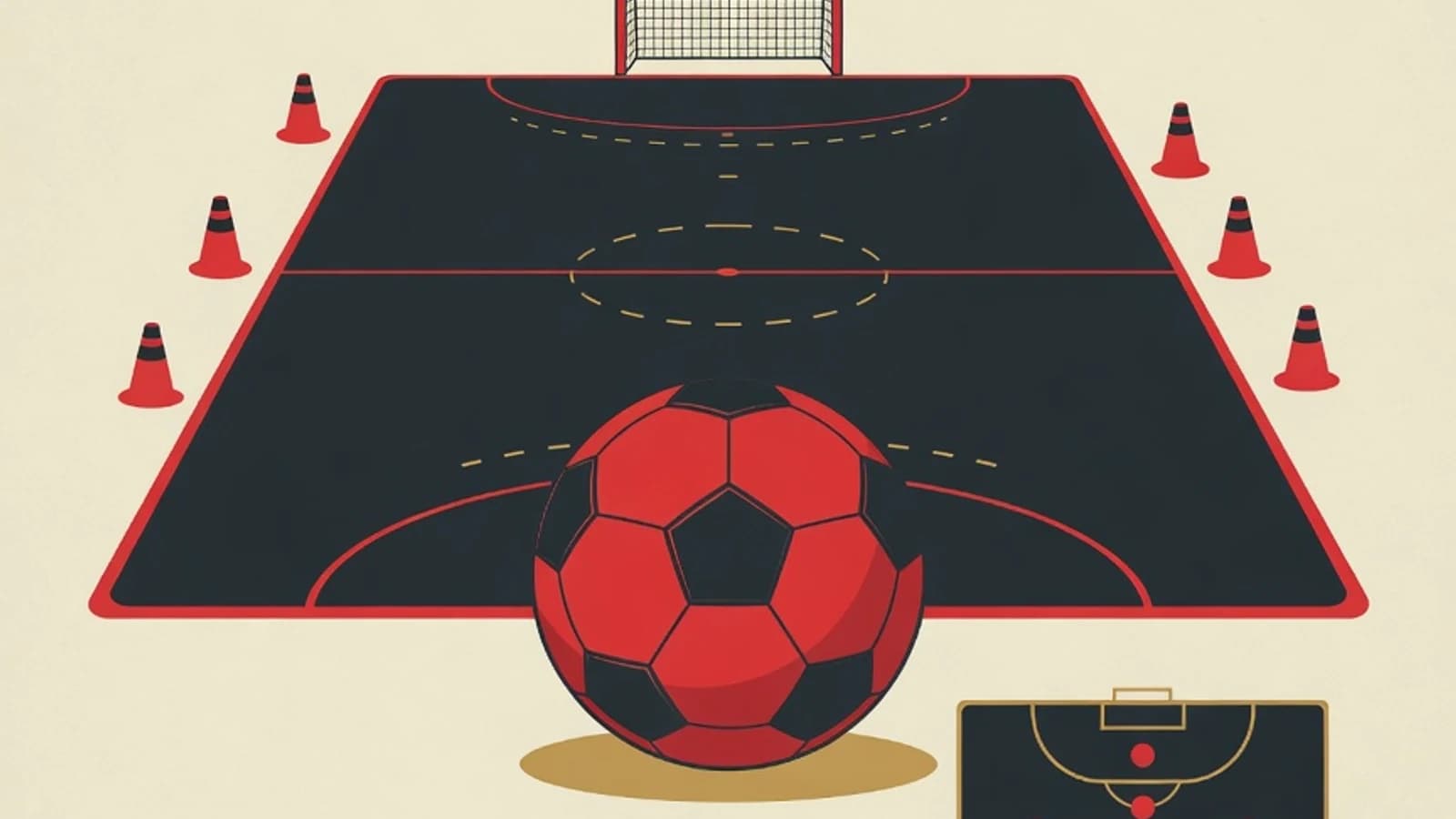
Training basic futsal skills and strategy for beginners starts with ball control using the sole of the foot, followed by accurate inside-foot passing, short-touch dribbling, then targeted shooting. Once individual technique is steady, build a 2-2 formation with simple rotation so the tight court stays open and the ball moves quickly between players.
- Sole-of-the-foot control is the foundation of futsal because the tight court demands a close first touch
- Inside-foot passing prioritizes accuracy and a ball that stays on the floor, since the futsal ball bounces low
- A 2-2 formation with rotation keeps spacing between players and opens passing lanes
- A size 4 futsal ball with a low bounce, which is heavier and does not bounce away wildly like a grass-field ball
- Flat-soled futsal shoes or flat sports shoes that grip a hard surface
- A flat hard space such as an indoor futsal court, a wide garage, or a hall, big enough to move a few steps
- A few cones or water bottles as dribbling-path markers and passing targets
The Basic Numbers That Set Futsal Apart From Football
Why basic futsal skills differ from outdoor football
Futsal is played on a hard, narrow court with five players per team, using a size 4 ball whose bounce is deliberately kept low. These three factors change how you touch the ball. The tight space keeps opponents close, so the first touch must stay tight and the ball must not bounce far from the foot. The low-bounce ball invites control with the sole of the foot, a futsal signature rarely used on a grass field. Because each team has only five players, there is no rigid split between pure attacker and pure defender. A beginner needs to get used to switching roles within seconds, from pressing the ball to opening space to receive a pass. This makes individual technique and positional understanding grow together from the start. Passing is the heartbeat of futsal. Because distances between players are short, the ball moves more through chains of floor-hugging passes than through long dribbles. A beginner who builds clean control and passing first will feel far calmer entering real play than one who chases powerful shots straight away.
7 Steps to Train Basic Futsal Skills and Strategy for Beginners
These seven steps follow the order futsal coaches usually use: build control and passing as the foundation, add dribbling and shooting, then combine them through positional understanding and formation. Finish each step until it feels comfortable before moving to the next.
- Step 1
Get to know the futsal ball and get used to sole-of-the-foot control
Start by getting to know the character of the size 4 futsal ball, which is heavier and bounces low, so it tends to stick to the floor. This is why the sole of the foot becomes the main control tool in futsal. Stand relaxed, have someone roll the ball to you or bounce it off a wall yourself, then stop the ball by placing the sole on top of it until it settles right under your foot. Practice alternating right and left feet. Tight sole-of-the-foot control makes the ball ready to play in an instant, a big advantage in a tight, high-pressure space.
Tips- Keep knees slightly bent and weight forward so you react quickly after stopping the ball
- Practice holding the ball with the sole while dragging it slightly back to change direction right away
Stopping a futsal ball by lifting your foot too high lets it bounce loose. Touch the top of the ball with your sole, do not kick it. - Step 2
Master accurate, floor-hugging inside-foot passing
Passing is the most used technique in a futsal match, so practice this the most. Use the inside of the foot because its wide surface produces the most accurate pass. Place your standing foot beside the ball facing the target, swing your passing foot and strike the center of the ball with the inside, keeping the ball on the floor. Focus on direction first, power later. Practice bouncing the ball off a wall and receiving it back with the sole, because this chain of clean passes is what drives the whole futsal game.
Tips- Point the toe of your standing foot at the target, since its direction strongly decides where the ball travels
- Practice one-two passing with a partner to get used to passing quickly without holding the ball long
- Step 3
Train short-touch dribbling for tight spaces
Futsal dribbling differs from grass-field dribbling. Because space is tight and opponents are close, the ball must stay near you through short, frequent touches, mostly using the sole and side of the foot. Set up a few cones close together, then dribble through them with small touches, pushing and holding the ball alternately with the sole. Add pulling the ball back then pushing it sideways to change direction, a futsal signature move useful for beating opponents in tight corners. Controlled dribbling gives a beginner the confidence to keep the ball without easily losing it.
Tips- Lift your gaze occasionally so you sense opponents and teammates, keeping your eyes off the ball at times
- Practice dragging the ball with the sole then pushing it, a move that opens space in crowded areas
Dribbling the ball too far from your foot on a tight court makes it easy to steal. Keep the ball within one step's reach. - Step 4
Build shooting that is targeted and quick
Scoring chances in futsal often come quickly from close range, so accuracy matters more than raw power. Practice two kinds of shots. First, the inside-foot shot for accurate placement into a goal corner. Second, the toe poke that is signature to futsal, useful for releasing a quick shot in a tight space without a long wind-up. Set two cones as a small goal, then practice shooting at the target from various angles. Begin close range with a still ball, then move to a moving ball after receiving a pass. A targeted, quick shot scores more often on a crowded court.
Tips- For placement, lock your ankle and aim for the low corner that is hard for the keeper to reach
- Practice the toe poke for fast situations, since it can be released without stepping back for a wind-up
- Step 5
Understand positioning and movement off the ball
In futsal, what a player does without the ball matters as much as with it. Because the court is tight, open space closes quickly, so players must keep moving to open passing lanes. Practice a simple principle: after passing, do not stand still, move into open space to receive the ball again (known as pass and move). Learn the four basic roles on a futsal court: goalkeeper, two defenders, and a forward called the pivot. Understanding when to press forward and when to drop and close space makes a beginner useful to the team even before the technique is perfect.
Tips- Apply the pass-and-move habit in every drill so you never stand still after passing
- Keep distance from teammates, do not cluster in the same area because that closes your own space
- Step 6
Set up a 2-2 formation with simple rotation
The 2-2 formation is the most basic setup and suits beginners: two players at the back as defenders and two up front as attackers, forming a box shape. It keeps a balance between defending and attacking and limits the risk of mistakes. Practice simple rotation: when an attacker drops to collect the ball, one defender pushes up to take their place, so the box shape stays intact and opponents struggle to mark. Play small games with a rule to keep this 2-2 shape. Once comfortable, the team can try variations such as a 3-1 with one pivot up front, but the 2-2 is the easiest tactic to grasp.
Tips- Name each player's role at the start (two defenders, two attackers) so rotation does not confuse anyone
- Practice rotation slowly without opponents first, then add pressure once the swapping pattern is familiar
- Step 7
Combine everything through small-sided games
Once control, passing, dribbling, shooting, and positioning are built separately, unite them through small-sided games, for example three versus three or four versus four in a limited area. This small format forces beginners to touch the ball often, make quick decisions, and apply the 2-2 rotation in match-like situations. Add simple rules such as a maximum of two touches per player to encourage quick passing, or a required pass before shooting to train teamwork. Playing small-format games regularly is the fastest way to merge all the techniques into a game that flows and feels fun.
Tips- Limit the number of touches (for example two touches) to force quick decisions and flowing passes
- End the session with free play without strict rules so training stays enjoyable
Four Basic Futsal Skills to Train First
Sole-of-the-Foot Control
Stopping and holding the ball with the sole placed on top of it. This futsal signature keeps the ball tight and ready to play in a crowded, high-pressure space.
Inside-Foot Passing
Passing with the inside of the foot for the highest accuracy, keeping the ball on the floor. This is the technique used most throughout a futsal match.
Short-Touch Dribbling
Dribbling with small, frequent touches, keeping the ball within one step's reach. Ideal for beating opponents in crowded corners.
Targeted Shooting
Inside-foot shots for placement and toe pokes for quick situations. Accuracy matters more than raw power on a crowded court.
How Futsal Technique Differs From Outdoor Football
| Aspect | Futsal | Outdoor Football |
|---|---|---|
| Ball control | Heavy use of the sole of the foot | More inside foot and chest |
| Ball character | Size 4, low bounce, hugs the floor | Size 5, bounces higher |
| Passing style | Short, floor-hugging, quick, frequent | Varied, including long lofted passes |
| Playing space | Tight, opponents always close | Wide, room for long runs |
| Player roles | Everyone attacks and defends | More fixed positions |
Because the space is tight and the ball bounces low, futsal sharpens the first touch and quick decisions that also help when playing on a grass field.
“In futsal, a player who masters sole-of-the-foot control and floor-hugging passing usually becomes useful to the team faster than one who relies on powerful shots. The tight court punishes a poor touch in an instant, so train this foundation first, then add tactics like the 2-2 rotation once the basics feel calm.”
Beginner Futsal Training Session Checklist
- Light warm-up and ball touches with the sole of the foot, about 7 minutes
- Inside-foot passing practice against a wall or partner, about 10 minutes
- Short-touch dribbling through cones, about 8 minutes
- Targeted shooting at a small goal from various angles, about 8 minutes
- Small game of three versus three while keeping the 2-2 shape, about 10 minutes
- Cool-down and light stretching, about 2 minutes