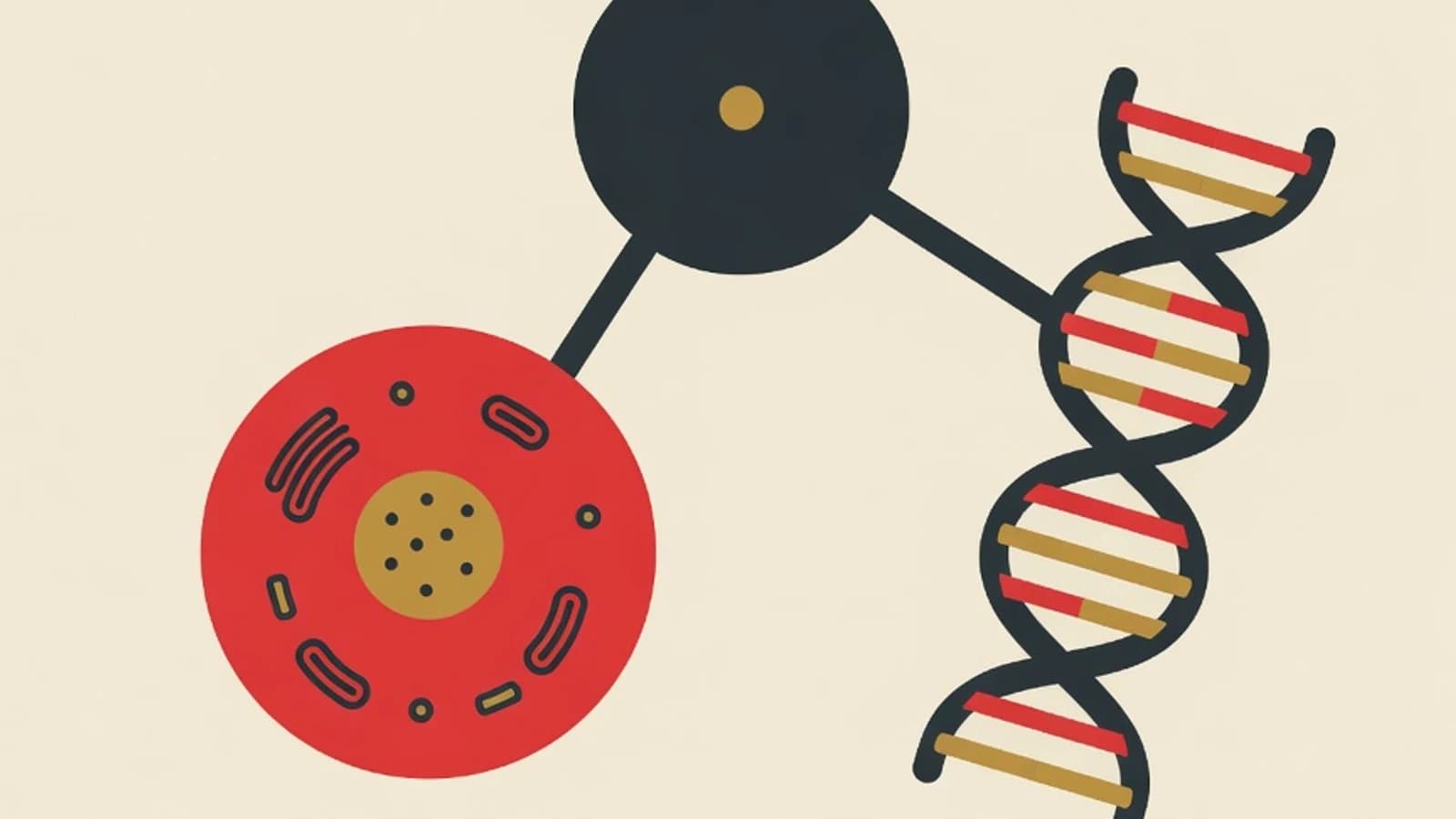
A biology mind map sticks when one chapter sits at the center, branches grow along its concept hierarchy, each branch carries its own colour, and small symbols mark key terms. Cover the map, redraw it from memory, and a heavy biology chapter becomes a single connected picture.
- One biology chapter fits into one centered mind map
- Colour and symbols fire three memory channels at once
- Redrawing the map trains active recall
- A3 paper or a blank notebook page
- Three to four coloured markers or pens
- Your biology textbook or notes for the chapter being studied
Why a mind map suits biology material
The brain holds biology better as a branching picture
Biology material is built in layers. Cells form tissues, tissues form organs, organs form systems, systems form the body. A layered structure like this is hard to memorize as a long list, and it fits perfectly as branches spreading from one center. This is where a biology mind map earns its place: its shape mirrors how the material is organized. The brain stores images and positions far more densely than lines of text. When a biology keyword is given a colour, placed on a specific branch, and paired with a small symbol, memory stores it through shape, location, and meaning together. Allan Paivio called this pairing of picture and word pathways dual coding, and its effect makes biology terms easier to retrieve during an exam. A mind map also shows connections that usually vanish in ordinary notes. Photosynthesis and cellular respiration, for example, appear as two processes that feed each other the moment you link them with a single line on the map. Those visible connections are what keep understanding in place for the long run.
Seven steps to build a biology mind map that sticks
Follow this order for one chapter. Once it becomes a habit, a single biology mind map takes about thirty to forty-five minutes.
- Step 1
Place the chapter title at the center of the page
Turn the paper landscape so branches have room to spread in every direction. Write the chapter title in the middle, for example Respiratory System or Genetics, then circle it. This center is the anchor of the whole biology mind map. A title seated in the middle gives balanced room for every branch and mirrors how thinking spreads from one main idea. In a digital app, create a single parent node with the same chapter name.
Tips- One chapter per mind map, avoid combining two chapters in one map
- Write the title slightly larger so the eye finds the center instantly
- Step 2
Draw main branches from the chapter's big structure
Look at the subheadings in your biology textbook and turn each one into a thick branch coming out of the center. For a Respiratory System chapter, the main branches could be the organs, the mechanism of inhalation and exhalation, gas exchange, and respiratory disorders. Four to six main branches are enough for one chapter. A controlled branch count keeps the map readable and stops it from getting crowded. Arrange branches clockwise following the logical order of the material so the flow is easy to retrace.
Tips- Take main branches straight from the book's subheadings, a framework that already works
- Leave space between branches so smaller twigs have room later
- Step 3
Fill twigs with a single keyword, skip full sentences
From each main branch, grow twigs holding only one or two biology keywords, such as alveolus, diffusion, or diaphragm. A single keyword forces the brain to summarize and understand before writing it down, and that is the part that makes material stick. Long sentences on twigs turn a biology mind map back into ordinary notes that tire the eye. When a term needs explaining, add a child twig below it with another keyword, so the chain of concepts stays visible.
Tips- The rule is one keyword per line, explanations move to the next twig
- Write Latin names briefly, highlight the distinguishing trait on a child twig
Copying whole textbook sentences onto twigs makes the map dense and actually lowers recall. - Step 4
Give each main branch its own colour
Colour each main branch and its twigs with one consistent colour. The respiratory organs branch can be blue, the mechanism branch green, the disorders branch red. Colour gives memory a location code, so during an exam you can retrieve information through its colour and position on the map. Colour grouping also separates concept clusters at a glance, helping the brain organize biology material into a few clearly bounded parts. Three to four colours are plenty, and too many colours only cause confusion.
Tips- Use the same colours each time you map a similar chapter to build a habit
- Bright colours for core concepts, softer colours for supporting examples
- Step 5
Add simple symbols or drawings
Put a small drawing beside important keywords: lungs as a balloon shape, a mitochondrion as a bean, DNA as a twist. The drawing need not be good, it only needs to represent the concept. Symbols strengthen the visual memory pathway and make abstract biology terms feel more concrete. This is dual coding in action: one concept stored through word and through picture. For sequential processes like the Krebs cycle, small arrows between stages are enough to make the flow readable in a single glance.
Tips- Stick figures and simple shapes are faster and just as effective
- Arrow symbols for processes, a box frame for terms that appear often in exams
- Step 6
Link the branches that relate to each other
Draw connecting lines between branches that share a relationship, even when they sit far apart on the map. The photosynthesis branch and the cellular respiration branch are linked because the output of one becomes the input of the other. These cross-links show the big picture of biology as an interdependent system, and it is precisely these connections that reasoning questions ask about most. Add a short label on the connecting line, such as produces or triggers, so the relationship is clear when the map is reread.
Tips- Dashed lines for cross-links so they differ from main branches
- Focus on the three or four most important links, avoid connecting everything
- Step 7
Cover the map and redraw it from memory
The final and most decisive step: cover the mind map, take a blank sheet, and redraw as much as you remember. Redrawing forces the brain to pull information out, and that act of pulling out strengthens memory far more than rereading the map. Compare your version with the original, mark the branches you missed, then repeat the next day. Space the repeats one day, three days, then one week apart so the biology material moves into long-term memory.
Tips- Give yourself five minutes with no reference, write whatever surfaces
- A branch you keep forgetting is a sign that part needs a deeper review
Skipping the redraw step leaves the mind map as a pretty decoration that is soon forgotten.
Mind map templates for five biology strands
Cells and Tissues
Center: the cell. Branches: organelle structure, plant and animal tissue types, membrane transport. Great for telling apart the function of each cell part in one view.
Human Body Systems
Center: one system, such as digestion or circulation. Branches: organs, working mechanism, related enzymes or hormones, disorders. Easy to repeat for each system.
Metabolism
Center: cell metabolism. Branches: photosynthesis, aerobic respiration, anaerobic respiration. Link the branches to see how energy and materials flow between processes.
Genetics and Inheritance
Center: inheritance. Branches: genes and alleles, Mendel's laws, crosses, apparent deviations. A Punnett square can be attached as an example on a twig.
Ecology and Environment
Center: ecosystem. Branches: biotic and abiotic components, food chains and webs, biogeochemical cycles, interactions between organisms. Rich in cross-links between branches.
Classification and Taxonomy
Center: biodiversity. Branches: taxon levels, the five kingdoms, distinguishing traits. A colour per kingdom helps separate the groups of living things.
Mind map against other ways of taking biology notes
| Aspect | Mind Map | Linear Notes | Flashcards |
|---|---|---|---|
| Seeing concept links | Very strong | Weak | Weak |
| Memorizing isolated terms | Moderate | Moderate | Very strong |
| Time to make | Medium | Fast | Medium |
| Best suited for | Systemic, branching chapters | Sequential summaries | Latin names and definitions |
Many students use a mind map to understand a chapter, then flashcards to lock in isolated terms such as Latin names. The two complement each other.
“When students stop copying and start mapping, biology turns from a long list of things to memorize into one illustrated story. We often see a term that once felt foreign become easy to recall the moment it has a place on the map.”
Signs of a biology mind map that truly helps memory
- There is one clear center holding the chapter title
- Main branches come from the book's subheadings, four to six of them
- Each line holds a single concise keyword, with no long sentences
- Every main branch has its own consistent colour
- There is a symbol or small drawing on important concepts
- Related branches are linked with labelled lines
- It has been redrawn from memory at least once
When a mind map helps biology study the most
- Systemic chapters like the human body and ecology
- Seeing the big picture and links between processes
- Reviewing a whole chapter quickly before an exam
- Tidying material that feels scattered into something ordered
- Memorizing long, isolated lists of Latin names
- Genetics calculation practice that needs detailed steps
- Single-term definitions that suit flashcards better
- A biology mind map works because its branching shape mirrors how the material is built, from cell to system
- Colour, position, and symbols fire three memory channels at once through dual coding
- The redraw-from-memory step is the key that makes the map truly stick
- Pair mind maps for understanding a chapter with flashcards for locking in isolated terms