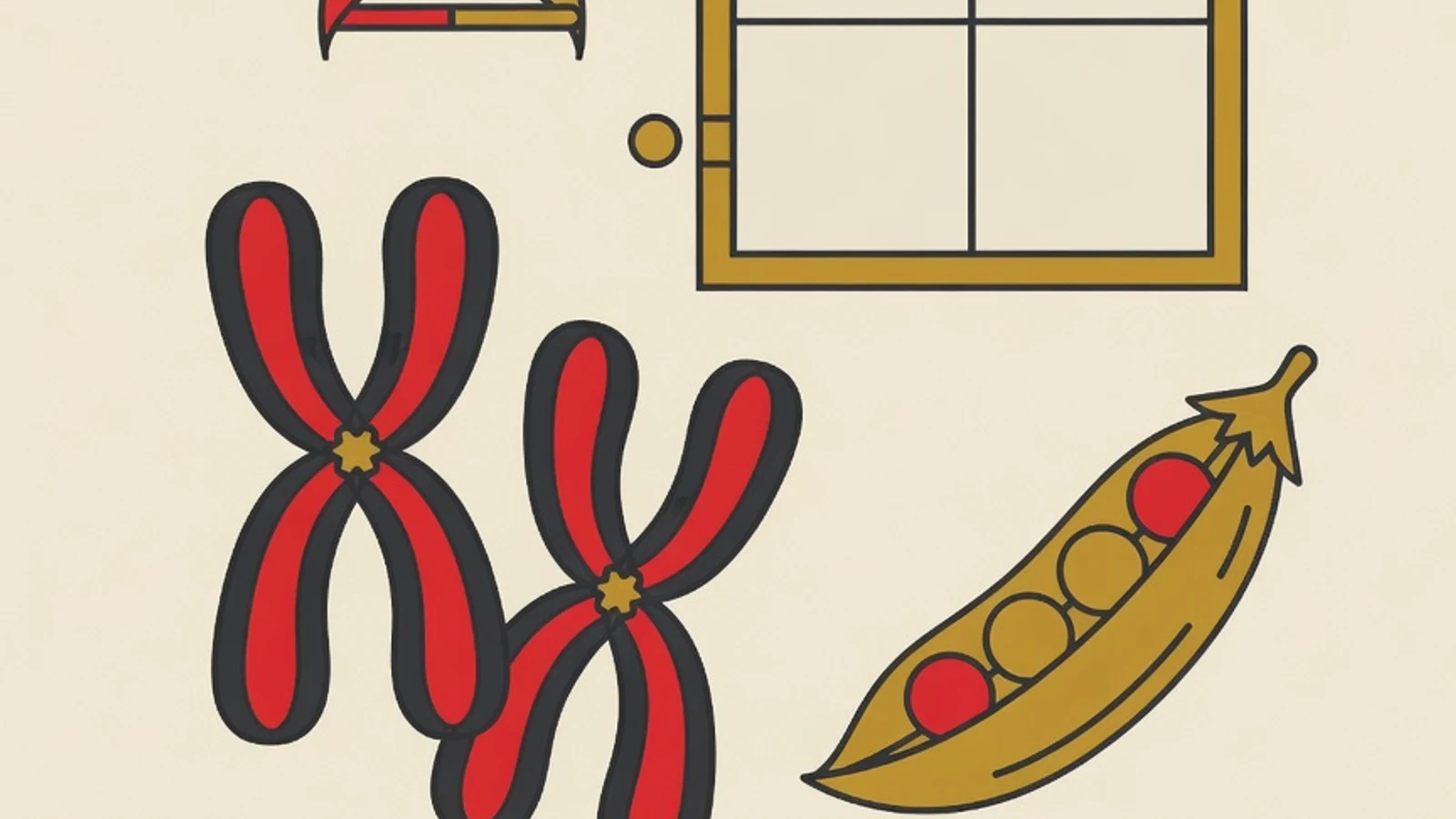
The most solid way to understand genetics is to read inheritance as cause and effect: a gene carries instructions, an allele is which version it is, and a cross simply maps the possible combinations in the offspring. Once Mendel's laws are understood as consistent rules of the game, the Punnett square becomes a sensible calculating tool and inheritance problems feel far more structured.
- Master the core vocabulary first: gene, allele, genotype, phenotype, homozygous, and heterozygous
- Understand Mendel's two laws as the rules that explain why offspring ratios appear
- Practice Punnett squares in stages, from monohybrid to dihybrid to blood type cases
- Grade 12 biology book covering inheritance and heredity
- Grid paper to lay out Punnett squares neatly
- Pencil and eraser, since cross practice involves many corrections
- A graded problem set running from monohybrid up to blood type cases
Key Numbers Behind Human Inheritance
Why genetics often feels like the scariest part of high school biology
Genetics wears a different face from other biology topics. Material like the respiratory system or ecosystems can be pictured directly, while inheritance asks a student to work with letter symbols, probability, and abstract ratios. When a student sees Aa crossed with Aa and is asked to find the offspring ratio, they are really being asked to think like a mathematician inside a biology lesson. The difficulty usually traces to one common point: the vocabulary and the logic have not been cleanly separated. Many students memorize genotype and phenotype yet mix them up when a question asks for one of them. Some can draw a Punnett square but have no idea why the boxes are arranged that way. Memorized ratios of 3:1 and 9:3:3:1 stay fragile when a student does not know where those numbers come from. The root of mastering genetics lies in understanding that genes are inherited in pairs, one from each parent, and each parent passes only one copy at random into every sex cell. This simple rule, formulated by Gregor Mendel in 1866, explains almost every basic cross pattern. Once this principle of segregation is understood, the Punnett square turns from a mysterious grid into a tidy way to list every possible combination.
6 Steps to Understand Genetics and Inheritance
These six steps are designed to climb: vocabulary first, then the logic of Mendel's laws, then the Punnett square as a tool, up to more complex inheritance cases. Finish each step before moving up, because genetics punishes students who jump ahead too soon.
- 1
Lock down six core terms before touching any cross
Genetics rests on six terms that must be crystal clear. A gene is the unit carrying instructions for a trait. An allele is a different version of one gene, for example a purple-flower allele and a white-flower allele. The genotype is the set of alleles an individual carries, written with letters such as AA, Aa, or aa. The phenotype is the trait that actually shows, such as flower color or seed shape. Homozygous means two identical alleles like AA or aa, while heterozygous means two different alleles like Aa. Before touching a Punnett square, make sure the child can point out which is the genotype and which is the phenotype in one example, because every genetics problem revolves around these six words.
Tips- Write each term on a small card with one concrete example on the back
- Self-test by identifying genotype and phenotype from a real case such as a family's eye color
Many mistakes come from confusing genotype and phenotype, so make sure the two are truly separate in the mind before moving on. - 2
Understand Mendel's law of segregation as the rule for one trait
Mendel's first law, the law of segregation, states that the two alleles in an individual separate when sex cells form, so each egg or sperm carries only one allele. This is why an Aa parent produces two kinds of sex cells: half carry A and half carry a. Understand this rule through the pea plants Mendel used: a true-breeding purple-flowered parent AA crossed with a true-breeding white-flowered parent aa produces a first generation that is all Aa and all purple, because the purple allele is dominant. When these Aa offspring are crossed with each other, white flowers reappear in some of the next generation. Understanding when and why a hidden trait can resurface is the heart of this first law.
Tips- Draw the flow from true-breeding parents to the first generation and then to the second so the pattern is visible
- Always ask where each allele came from in the offspring before computing any ratio
- 3
Build a monohybrid Punnett square and read its ratio correctly
The Punnett square is a simple table for listing every possible allele combination in the offspring. For one trait, draw a two-by-two grid. Write one parent's sex cells across the top and the other's down the left, then fill each box with the alleles combined from its row and column. Crossing Aa with Aa gives one AA, two Aa, and one aa, so the genotype ratio is 1:2:1. Because A is dominant, the phenotype ratio is three dominant to one recessive, or 3:1. Practice reading two ratios at once: the genotype ratio from the letters and the phenotype ratio from the visible trait. Many students only memorize the number 3:1 without knowing that a 1:2:1 genotype ratio sits behind it.
Tips- Use grid paper so the Punnett square stays neat and rows do not get mixed up
- Always write the genotype ratio and the phenotype ratio separately on every problem
Do not jump to dihybrid before monohybrid is fully automatic, because a dihybrid is just a monohybrid done twice at once. - 4
Move up to dihybrid crosses with a four-by-four grid
A dihybrid cross involves two traits at once, for example seed color and seed shape. This is where Mendel's second law applies, the law of independent assortment, which states that alleles for different traits are inherited independently of one another. A parent with the genotype AaBb produces four kinds of sex cells: AB, Ab, aB, and ab. That is why a dihybrid Punnett square is four-by-four and yields sixteen boxes. When two AaBb parents are crossed, the phenotype ratio becomes 9:3:3:1, meaning nine offspring with both dominant traits, three with only the first dominant trait, three with only the second dominant trait, and one with both recessive traits. The key lies in carefully writing all four kinds of sex cells for each parent before filling the boxes.
Tips- Write the four kinds of sex cells for each parent first, then lay out the four-by-four grid
- Recount each phenotype and confirm the total is sixteen before concluding the ratio
The most common dihybrid mistake is forgetting one kind of sex cell, which throws the final ratio off from 9:3:3:1. - 5
Recognize inheritance patterns that deviate from classic Mendelian ratios
Not every trait follows simple dominant and recessive rules, and this is exactly where higher-order problems like to play. In incomplete dominance, the heterozygous offspring shows an intermediate trait, for example a red flower crossed with a white one produces pink. In codominance, both alleles show together, such as blood type AB in humans. The ABO blood group itself is governed by three alleles, which is why it is called multiple alleles. There are also sex-linked traits such as color vision deficiency and hemophilia, which appear more often in males because they have only one X chromosome. Understand each pattern through one signature example, then practice its problems separately so they do not blur with ordinary Mendelian crosses.
Tips- Make one example card for each pattern: incomplete dominance, codominance, multiple alleles, and sex linkage
- For blood type and color vision, practice reading family pedigrees since they often frame the problems
- 6
Practice pedigree and real-case problems until patterns read quickly
Once basic crosses are mastered, genetics asks for the ability to read word problems and family pedigree diagrams. Problems often present a family chart and ask for the parents' genotypes or the chance the next child inherits a trait. Work this type in a fixed order: first decide whether the trait is dominant or recessive from the pattern shown, fix the genotypes that are already certain, then trace the unknown genotypes from the offspring. For probability questions, remember that each pregnancy stands on its own, so the chance for the next child is not affected by earlier children. Reworking a problem you once got wrong is far more valuable than chasing many new ones without examining the error.
Tips- Work pedigree problems in a fixed order so you are never unsure where to start
- Collect every problem you got wrong in one dedicated book and redo it a few days later
Inheritance Patterns and Their Signature Examples
Complete Dominance
One allele fully masks the other. The classic example is round and wrinkled seed shape in Mendel's pea plants.
Incomplete Dominance
The heterozygote shows an intermediate trait. A red flower crossed with white produces pink.
Codominance
Both alleles show without one masking the other. The best-known case is human blood type AB.
Multiple Alleles
One trait is governed by more than two alleles. The ABO blood group system is governed by three alleles at once.
Sex-Linked
The gene sits on the X chromosome. Color vision deficiency and hemophilia appear more often in males.
Independent Assortment
Two traits are inherited independently, the basis of the dihybrid cross with its 9:3:3:1 ratio.
Telling Monohybrid and Dihybrid Apart
| Aspect | Monohybrid | Dihybrid |
|---|---|---|
| Number of traits | One trait, such as flower color | Two traits at once, color and shape |
| Parent genotype | Aa | AaBb |
| Kinds of sex cells | Two kinds: A and a | Four kinds: AB, Ab, aB, ab |
| Punnett square size | Two-by-two, four boxes | Four-by-four, sixteen boxes |
| Phenotype ratio | 3 to 1 | 9 to 3 to 3 to 1 |
A dihybrid is essentially two monohybrid crosses running at the same time, following Mendel's law of independent assortment.
“Students who fear genetics almost always memorize the ratios before understanding where the numbers come from. Once they are guided to derive those ratios from a Punnett square themselves, the dihybrid cross that once looked frightening becomes a routine they can work through calmly.”
Checklist for Mastering Inheritance
- Can distinguish genotype and phenotype from one example without hesitation
- Can explain the law of segregation in their own words using the pea plant example
- Can build a monohybrid Punnett square and read both its genotype and phenotype ratios
- Can correctly write the four kinds of sex cells from an AaBb parent
- Can finish one dihybrid problem so the 9:3:3:1 ratio appears exactly
- Can determine the parents' genotypes from a family pedigree diagram
Learning Genetics Alone vs With a Tutor
- Can repeat the Punnett square as many times as needed without rushing
- Builds the care needed to lay out sex cells and compute ratios independently
- Suits adding more monohybrid practice once the pattern is already mastered
- Hard to notice on your own where the error is when a dihybrid ratio does not come out 9:3:3:1
- Easy to get stuck when pedigree problems and deviating patterns start mixing together
- Personal guidance ensures the logic of segregation is settled before moving to harder cases
- Genetics becomes logical once gene, allele, genotype, and phenotype are clearly separated from the start
- The 3:1 and 9:3:3:1 ratios come from a correctly filled Punnett square, so derive them before memorizing
- Climb in stages from monohybrid to dihybrid, then to deviating patterns and family pedigree problems