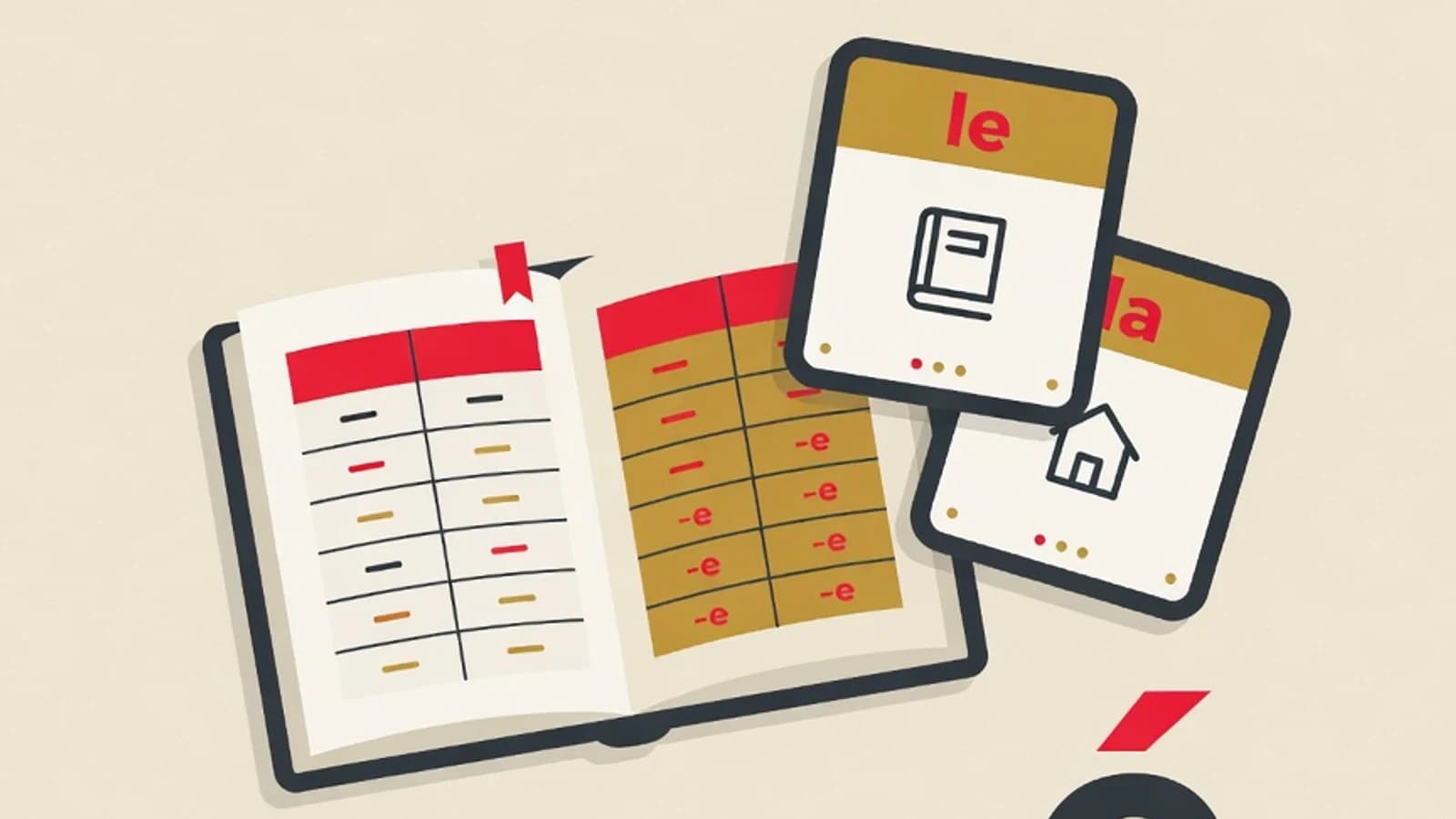
French grammar for beginners rests on six foundations: noun gender, articles, subject pronouns, the verbs etre and avoir, regular -er verbs, and the negative form ne...pas. Working through all six in order lets a beginner build simple sentences calmly and with growing confidence.
- Every French noun carries a gender: masculine or feminine
- Verbs change form to match their subject pronoun
- Around 90 percent of verbs belong to the regular -er group
- An A1-level French grammar book (e.g. Grammaire Progressive du Francais)
- A verb conjugation table you can keep on your study desk
- Flashcards to record the gender of every new noun
Reassuring numbers before you start
Why grammar is the foundation for beginner French
Many beginners start French from vocabulary and pronunciation, then stall when it is time to build a full sentence. The reason is often the same: the underlying grammar structure is still unfamiliar. French assigns a gender to every noun, adjusts articles and adjectives to match that gender, and then reshapes verbs according to their subject. The good news is that these patterns are consistent and can be trained step by step. Once you understand how gender works, how articles adapt, and how a single verb changes across six subject groups, simple sentences start to form on their own. This beginner French grammar guide arranges that foundation into six ordered steps so each step supports the next.
Six steps to master basic French grammar
Work through them in order, starting with step one. Each step adds one layer of structure, so by the end you can build simple affirmative and negative sentences.
- 1
Recognise noun gender (le genre)
Every French noun is masculine or feminine, including inanimate objects. A table (la table) is feminine, while a book (le livre) is masculine. This gender decides the form of the article and adjective that go with it, so recognising it early saves a lot of confusion. The safest habit for beginners is to memorise each noun together with its article. Instead of learning table alone, learn la table. A few ending patterns can help you guess: nouns ending in -tion, -te, and -ette tend to be feminine, while -age, -ment, and -eau tend to be masculine. These patterns have exceptions, so treat them as early hints that still need checking.
Tips- Write every new noun with its le or la on a flashcard
- Use different colour codes for masculine and feminine to recall faster
Do not guess gender from your first language. French noun gender has no link to meaning, only linguistic convention. - 2
Attach the right article (les articles)
French articles adapt to the gender and number of the noun. Definite articles mark a known thing: le for masculine singular, la for feminine singular, l' before a vowel, and les for plural. Indefinite articles mark something still general: un for masculine, une for feminine, and des for plural. For example, un livre means a book, while le livre means the specific book already mentioned. An effective drill is to take ten nouns you have memorised and pair each with both a definite and an indefinite article. This repetition ties gender to article in your memory.
Tips- Always say the noun together with its article during speaking practice
- Notice how l' replaces le or la before a vowel sound
- 3
Memorise the subject pronouns (les pronoms sujets)
Subject pronouns are the key to conjugation because every verb form is tied to its subject. The order is: je (I), tu (you, informal), il (he), elle (she), on (we, informal), nous (we), vous (you, formal or plural), ils (they, masculine or mixed), and elles (they, feminine). Beginners need two important nuances. First, tu is used for friends and family, while vous is used for formal situations or people you do not know well. Second, on appears very often in everyday conversation as a stand-in for nous. Memorising these nine pronouns makes the next conjugation step feel much lighter.
Tips- Group tu (informal) and vous (formal) so you do not confuse their contexts
- Practise on as a substitute for nous, since both are common in casual talk
- 4
Master etre and avoir
These two verbs appear in nearly every sentence, so mastering them first gives the biggest return. Etre means to be: je suis, tu es, il est, nous sommes, vous etes, ils sont. Avoir means to have: j'ai, tu as, il a, nous avons, vous avez, ils ont. Both are irregular, so their forms are memorised whole because they follow no regular pattern. The payoff is large. Etre states identity, profession, and traits (je suis etudiant means I am a student). Avoir expresses possession and age (j'ai vingt ans means I am twenty years old). These two verbs also act as helping verbs to form the past tense, so the time you invest now will be reused at the next level.
Tips- Post the etre and avoir conjugation table where you see it often
- Write five self-introduction sentences using both verbs every day
Note that French expresses age with avoir, while English uses to be. A literal translation can mislead you. - 5
Conjugate regular -er verbs
After two irregular verbs, this step feels like relief because the pattern is uniform. Around nine out of ten French verbs end in -er and follow one shared conjugation pattern. Take parler (to speak) as an example. Drop the -er ending to leave the stem parl-, then add endings by subject: je parle, tu parles, il parle, nous parlons, vous parlez, ils parlent. This set of endings, -e, -es, -e, -ons, -ez, -ent, applies to thousands of other verbs such as aimer (to like), habiter (to live), and travailler (to work). Mastering one pattern unlocks thousands of verbs at once. Practise by taking three new -er verbs each week and conjugating them fully across all six subjects.
Tips- Memorise the ending sequence -e, -es, -e, -ons, -ez, -ent as a single rhythm
- Notice that je parle, tu parles, and ils parlent sound alike though spelled differently
- 6
Form negatives with ne...pas
The final step turns an affirmative sentence into a negation, and the method is distinctly French. The negative form uses two words that wrap around the verb: ne goes before the verb and pas goes after it. The sentence je parle (I speak) becomes je ne parle pas (I do not speak). When the verb begins with a vowel sound, ne shrinks to n', as in je n'aime pas (I do not like). In everyday spoken French, native speakers often drop ne and say only pas, yet beginners should build the full form first so the structure settles firmly. With this step, you can already state something and negate it, two abilities that complete the basic sentence foundation.
Structural differences: English and French
| Grammar aspect | English | French |
|---|---|---|
| Noun gender | None | Masculine or feminine on every noun |
| Articles | Required but genderless | Required and gender-matched (le, la, un, une) |
| Verb conjugation | Minimal change | Changes with the subject (je parle, nous parlons) |
| Adjectives | Fixed form | Match the noun's gender and number |
| Negatives | One word plus not | Two words wrap the verb (ne...pas) |
These differences are normal and trainable. Noticing them early helps a beginner read French sentences with the right logic.
The three French verb groups
First group (-er)
Verbs ending in -er with the most uniform conjugation pattern. They cover around 90 percent of French verbs, such as parler, aimer, and habiter. This is the group beginners drill first.
Second group (-ir)
Verbs ending in -ir that follow the finir pattern, marked by the -iss- insertion in plural forms (nous finissons). Examples include choisir (to choose) and reussir (to succeed).
Third group (irregular)
Verbs with special patterns that must be memorised, including etre, avoir, aller, and faire. Their number is limited, yet their frequency of use is very high.
“Beginners who calmly arrange gender, articles, then conjugation in order tend to speak up sooner. A tidy structure gives a sense of safety when building the first sentence, and that safety is what fuels courage.”
Signs you have mastered the foundation
- You can name the gender of most nouns you have memorised
- You can pair definite and indefinite articles correctly
- You know all nine subject pronouns and the tu versus vous contexts
- You can conjugate etre and avoir without notes
- You can conjugate a new -er verb by the uniform pattern
- You can turn an affirmative sentence into a negative with ne...pas
- Basic French grammar rests on six ordered foundations that support one another
- Memorising a noun with its article stores its gender from the very start
- Etre and avoir deserve to be mastered first since they appear in almost every sentence
- One -er ending pattern unlocks around 90 percent of French verbs at once
- French negatives wrap the verb with the pair ne and pas