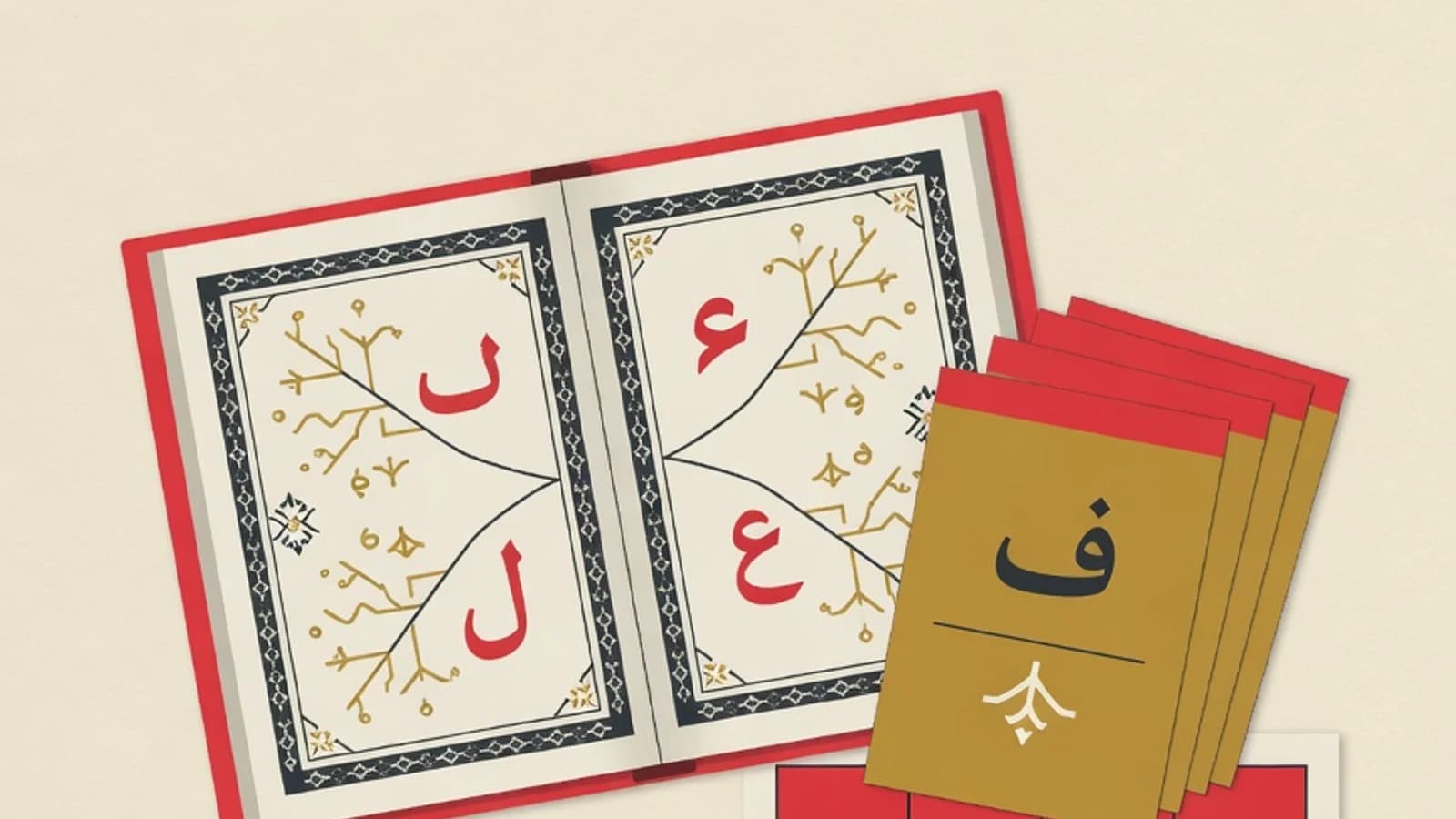
To learn nahwu and sharaf for understanding the Quran, work in order: first master the words that appear most often, then use sharaf to recognise a word's form from its root, then nahwu to read each word's role in the sentence. Word-by-word translation of short verses ties the three into real comprehension.
- Sharaf unpacks a word's form from its root, nahwu reads its role in the sentence
- Start with high-frequency vocabulary so the effort pays off the moment you open the mushaf
- Word-by-word translation of short verses is the drill that binds rules to real practice
- A fully vowelled Quran mushaf as the source for i'rab and word-by-word practice
- Matan Al-Ajurrumiyah as the foundational text for nahwu rules
- Al-Amtsilah At-Tashrifiyah and Matan Bina for sharaf conjugation drills
- A list of the most frequently occurring Quranic words with their meanings
- A dedicated notebook for recording patterns, i'rab, and word-by-word translation of each verse
The Scale of the Quran to Get Familiar With
Understanding Two Instrumental Sciences: Sharaf and Nahwu
Sharaf and nahwu are called instrumental sciences because both serve as tools for unlocking the meaning of an Arabic text. Sharaf works inside a single word: it explains how one root such as k-t-b turns into kataba (he wrote), yaktubu (he is writing), kaatib (a writer), maktuub (that which is written), and dozens of other forms through patterns called wazn. Once you recognise a wazn, you can guess the meaning of a word you have never memorised because its pattern is already familiar. Nahwu works between words: it explains the position of each word in the sentence and the change of vowel at its end, known as i'rab. A single word may end in dhammah, fathah, or kasrah depending on whether it acts as subject, object, or descriptor. That final vowel often decides who is the doer and who is acted upon within a verse, so misreading the i'rab can shift the meaning.
Steps to Learn Nahwu and Sharaf from Scratch
The sequence below builds your foundation from the lightest task up to parsing a verse. Work through each stage until it feels solid before climbing to the next.
- Step 1
Make sure your reading of letters and vowels is fluent
Before touching any rule, be sure you can read vowelled Arabic letters without spelling them out and that you recognise the long and short marks. Nahwu and sharaf are all about shifting vowels, so your eye and tongue need to be sensitive to the difference between fathah, kasrah, dhammah, and sukun. Spend the first week rereading short chapters slowly while noticing the final vowel of each word.
Tips- Read one page of juz 30 each day while pointing at the final vowel of each word
- Record your reading and compare it with a reciter to keep the length of vowels accurate
Jumping into rules before your reading is fluent makes grammar terms feel abstract and quickly saps motivation. - Step 2
Build vocabulary from the words that appear most often
Begin with a list of high-frequency Quranic words. Particles, pronouns, and common verbs repeat thousands of times, so mastering them early lets you feel the benefit quickly when you open the mushaf. Aim for five to ten new words a day, put them on flashcards, and review them with spacing so they stick. For each word, learn its root as well, because the same root will reappear in a different form.
Tips- Pick vocabulary from a chapter you are memorising so memorisation and comprehension move together
- Group words that share one root on a single card so the pattern becomes visible
- Step 3
Study sharaf through conjugation and basic patterns
Enter sharaf by memorising the tasrif, the chain of form changes derived from one root. Al-Amtsilah At-Tashrifiyah lays these patterns out in stages, from the past verb to the present verb, the verbal noun, the active participle, and the passive participle. Drill them by chanting the tasrif daily until the pattern becomes automatic. Once the wazn is embedded, you can infer a word's function from its form alone, such as telling a doer from an object.
Tips- Stick one conjugation table on your desk and recite it rhythmically like memorising
- Take one word from a verse you are reading and conjugate it fully as practice
Memorising patterns without applying them to Quranic words lets them fade fast. Always tie them back to a real verse. - Step 4
Enter nahwu through Matan Al-Ajurrumiyah
For nahwu, start with Matan Al-Ajurrumiyah, a slim text that has long been the classic gateway for beginners. Focus on the categories of words (noun, verb, particle), the markers of i'rab (rafa', nasb, jarr, jazm), and basic positions such as mubtada, khabar, fa'il, and maf'ul bih. For each new rule, immediately find its example in a short verse so theory and evidence advance together.
Tips- Study one chapter per week and summarise its rule in your own words
- For each i'rab marker, collect three examples from juz 30
- Step 5
Practise word-by-word translation of short verses
Word-by-word translation means rendering a verse one word at a time according to its position and form. Take a short verse, write each word in a column, and beside it note the root, the sharaf pattern, the nahwu position, and the meaning. This drill forces you to unite everything you have learned and is the fastest way to grow a feel for Arabic sentence structure. Begin with An-Nas and Al-Ikhlas before moving to longer verses.
Tips- Keep your word-by-word work and review it a month later to see your progress
- Match your result against a word-by-word mushaf to check accuracy
Translating loosely without dissecting each word's position skips the point of this drill. Dissect first, then assemble the meaning. - Step 6
Raise your reading gradually and seek regular correction
Once short chapters feel easy, move up to longer verses and layered sentences. At this point the guidance of a teacher helps a great deal, because a wrong i'rab is hard to notice on your own. Schedule regular correction sessions so pattern mistakes do not settle into habit. Steady progress comes from small daily practice paired with periodic feedback from someone more knowledgeable.
Tips- Set monthly targets, such as completing the i'rab of one page of juz 30
- Note the questions that arise during study to raise in the next session
Sharaf and Nahwu Side by Side
| Aspect | Sharaf | Nahwu |
|---|---|---|
| Focus | The form of one word from its root | The position of a word in the sentence |
| What you study | Patterns and conjugation | I'rab and sentence structure |
| Example question | What form is this and from which root | What role does this word play |
| Common foundational text | Al-Amtsilah At-Tashrifiyah | Matan Al-Ajurrumiyah |
The two support each other. Sharaf supplies the material, nahwu arranges that material into a meaningful sentence.
Three Layers of Vocabulary Worth Prioritising
Particles and pronouns
Priority 1Prepositions, conjunctions, and pronouns such as min, fi, alladhi, and hum recur very often. Mastering them first makes the frame of a sentence readable at once.
Common verbs
Priority 2Verbs such as qaala, ja'ala, and 'alima appear across many stories and commands. Learn their root and pattern so their derived forms are easy to infer.
Core theme nouns
Priority 3Words like rabb, kitab, and yaum attach to the Quran's major themes. Memorising them enriches your grasp of verses without repeated dictionary lookups.
“The key to understanding the Quran lies in the faithfulness of parsing one verse each day until the pattern grows familiar; the speed of finishing a text comes second.”
Readiness Checklist for Moving to Longer Verses
- Read short chapters without spelling out and stay aware of their final vowels
- Recite basic conjugations and recognise the most common patterns
- Understand the four i'rab markers and point out the mubtada and khabar
- Translate word by word at least ten short chapters on your own
- Keep a consistent daily study schedule with periodic correction sessions
Learning Alone or With Guidance
- A wrong i'rab is spotted and corrected before it becomes a habit
- The order of material follows your readiness and stays on a clear track
- There is someone to ask when you meet a verse with layered structure
- Small mistakes can settle in unnoticed for a long time
- It is easy to lose direction when choosing texts and setting your own order
- Motivation dips easily on the hard parts without a companion
- Sharaf unpacks a word's form from its root, nahwu reads its position in the sentence, and together they are the tools for understanding the Quran
- Start with high-frequency vocabulary so the benefit is felt quickly when you open the mushaf
- Word-by-word translation of short verses is the drill that unites vocabulary, sharaf, and nahwu
- Small daily practice with periodic correction protects progress better than heavy study now and then